Scientists from around the world who have been studying the centuries-old human remains that melted out of a glacier in northwestern British Columbia in 1999 will gather for the first time in Victoria later this month to talk about what they've learned from the unnamed "iceman."
The Kwäday Dän Ts'ìnchi Symposium will be held April 24-27 at the University of Victoria.
It is being held in conjunction with the Northwest Anthropology Conference.
Saturday, April 05, 2008
Scientists tantalize with 'iceman' findings
A hilltop look at history
A great archaeological site, like great art, challenges our provincialism and expands our horizons.
Tuzigoot National Monument, outside Clarkdale, does exactly that, sweeping visitors back in time and bringing them face to face with a larger reality.
Its rough-hewn, vaguely castlelike walls stand atop a small ridge near the Verde River, a conspicuous reminder of the ancient society that once thrived in the area.
Treasure! Swedes find Viking-era Arab coins
Ancient Arab coins found in Sweden (pic: Swedish National Heritage Board)
The Arab coins reveal where they were minted and the date
Swedish archaeologists have discovered a rare hoard of Viking-age silver Arab coins near Stockholm's Arlanda airport.
About 470 coins were found on 1 April at an early Iron Age burial site. They date from the 7th to 9th Century, when Viking traders travelled widely.
There has been no similar find in that part of Sweden since the 1880s.
Here's an experimental archaeology article on the concrete pyramid idea. I advocate this experimental sort of work to a limited degree, but there are so many limits on the "could they have done this?" hypothesizing.
And now for something completely different Researchers, Led by Archaeologist, Find Pre-Clovis Human DNA
Excellent study. It's kinda too bad this wasn't done ten years ago or it would have been as widely known as Monte Verde. Interesting -- odd is more like it -- how there are apparently no stone tools present; apparently, pre-Clovis people either didn't use them or could barely knock a couple of rocks together to make an Oldowan flake.
Human DNA from dried excrement recovered from Oregon's Paisley Caves is the oldest found yet in the New World -- dating to 14,300 years ago, some 1,200 years before Clovis culture -- and provides apparent genetic ties to Siberia or Asia, according to an international team of 13 scientists.
. . .
A lengthy analysis, including the collection of DNA samples from 55 UO students, supervisors, and site visitors and 12 Danish DNA researchers, was done to screen for modern DNA contamination. From that analysis, six coprolites containing the ancient DNA were radiocarbon dated using accelerator mass spectrometry and calendar calibrated to between 1,300 and 14,300 years ago.
“Of these, half date from the early arrival time,” Jenkins said. “All six coprolites containing ancient DNA underwent additional testing at two independent labs. Three of the six also contained DNA similar to red fox, coyote or wolf.” The researchers suggest that these early Americans ate the animals or that the animals urinated on the human feces during times of non-human habitation.
Excellent study. It's kinda too bad this wasn't done ten years ago or it would have been as widely known as Monte Verde. Interesting -- odd is more like it -- how there are apparently no stone tools present; apparently, pre-Clovis people either didn't use them or could barely knock a couple of rocks together to make an Oldowan flake.
Nerds only Aztec Math Used Hearts and Arrows
Also at Nat. Geo with this quote:
This is an interesting topic, IMO: Where did this idea that ancient peoples were "all about religion" come from? I've seen side discussions of it in various places, but I don't remember any extended treatises on the source. For whatever reason, the Maya and Egypt are the archetypal Total Religious Societies. In the latter, a somewhat empirical case can be made for it since they had such a tremendous building and epigraphic program devoted to the afterlife, an explicitly religious topic.
My gut feeling is that Egypt more or less set the program for interpreting ancient societies as hyper-religious. So when people started looking at the Maya they immediately saw pyramids and made the connection. OTOH, maybe the Egyptian case was already conditioned by Romanticism that saw the primitive as being bound up in the non-rational.
The Aztecs had more numbers than we do, or at least symbols denoting numerical concepts. When it came to measuring land—critical for levying the proper tax or tribute—these medieval Mesoamericans used arrows, hearts, hands and other units representing fractions, according to a new study in Science.
To figure this out, mathematician Maria del Carmen Jorge y Jorge of the National Autonomous University of Mexico (U.N.A.M) channeled the mind of an Aztec land surveyor. That meant retraining herself to use a different numerical system and combing through the Codex Vergara, one of two remaining books that record Aztec land surveying.
Working with geographer Barbara Williams and del Carmen Jorge y Jorge counted 367 fields in this book with both an overall area for the plot of land as well as the lengths of the sides. Roughly 60 percent of these fields had areas that matched the basic mathematical rule of length multiplied by width or other common surveying calculations.
Also at Nat. Geo with this quote:
"I think [the study] is neat because it shows that this sort of math and science was pretty practical in orientation," said Michael Smith, an archaeologist and Aztec expert at Arizona State University.
"We have the idea that ancient societies were dominated by religion. Yeah, religion was important, but they were also very practical people doing very practical things," Smith said.
This is an interesting topic, IMO: Where did this idea that ancient peoples were "all about religion" come from? I've seen side discussions of it in various places, but I don't remember any extended treatises on the source. For whatever reason, the Maya and Egypt are the archetypal Total Religious Societies. In the latter, a somewhat empirical case can be made for it since they had such a tremendous building and epigraphic program devoted to the afterlife, an explicitly religious topic.
My gut feeling is that Egypt more or less set the program for interpreting ancient societies as hyper-religious. So when people started looking at the Maya they immediately saw pyramids and made the connection. OTOH, maybe the Egyptian case was already conditioned by Romanticism that saw the primitive as being bound up in the non-rational.
Thursday, April 03, 2008
Trip report A few archy/geology and other photos. This was the third trip to Sequim see here, too) so not a lot of new stuff. First off, a bit of history:

Full image here.
And here's a topo map of the spit area:

Full image here.
The town of Sequim is situated a few miles inland from the spit. It's small, only about 5500 people in the town proper and much of the remainder is farmland, pastures, etc. Several years ago someone decided to revitalize the area by turning the place into a lavender mecca, so there are a lot of lavender farms. A lot of cows as well, though I don't know if they were used for meat or dairy or what. The area seems to be growing with a lot of retirees and a lot of farms seem to be turning into housing developments. Still, the downtown core is pretty livable and has quite a few decent little shops and restaurants, plus a bunch of hotels along the main strip.
We stayed out at a place right on the water called the Dungeness Bay Cottages. This is the view out the front:

Full image here.
It's kind of down near the base of the spit, which you can just see as a thin line out in the water. It was cold most of the weekend and snowing over most of the Puget Sound area, though not really sticking. Here's a semi-areal shot of the spit:

Full image here.
As noted in the former post linked above, the bluffs here are all glacial till, steadily eroding backwards. If you look at a map of the area (larger area than the one above), the islands off in the distance are the San Juans and if you straight across is the southern end of Vancouver Island. You can see Victoria from where we were.
Again, in the previous post I mentioned a visit to the local museum that houses some of the stuff from the Manis mastodon site. This time I remembered the camera! So here are a couple of shots of that:

Full image here.
I like the way they placed some of the skeleton on the painting so you can really see the scale of the critter. They have the tusks on-site in a water bath for preservation:

Full image here.
The old post has some links to both the museum (ergh: I now see two of the links are no longer valid; will check on those). Anyway, beach combing is a must:

Full image here.
This is a protected bay so oysters and numerous other molluscan species are abundant. In fact, the beach at low tide is littered with live oysters; no worries about starving. Dungeness crab is also abundant, but not nearshore enough to see any, except perhaps the young'uns which crowd under rocks at low tide. Also abundant are chiton:

Full image here.
Not sure what these are:

Full image here.
They're not posts, they're hollow pipes, look like PVC. This one has an oyster growing right next to it and another had an anemone growing within it:

Full image here.
I'm wondering if this wasn't set up specifically to attract wildlife, something like the way artificial reefs are built. Other wildlife are deer, bald eagles, a herd of elk, seals, and, um, this fierce creature:

Full image here.
One more beach shot. This is at the 3 Crabs Restaurant which is my favorite place there. It's not the fanciest food, pretty basic fare, but perfectly done. I've never been disappointed by either the food or the service.
Full image here.
The pilings going out are from the original pier (if you search around for Sequim-related sites, there are probably some historic photos of it). This was a pretty low tide and the seagulls were having a field day; there was a young bald eagle perched on one of the pilings (not in this photo). There's quite a few around the area; one had his own little perch in a tree just down the road from the motel and was sitting there nearly every morning when we drove by.

Full image here.
And the usual sunset photo.
Full image here.

And here's a topo map of the spit area:
Full image here.

The town of Sequim is situated a few miles inland from the spit. It's small, only about 5500 people in the town proper and much of the remainder is farmland, pastures, etc. Several years ago someone decided to revitalize the area by turning the place into a lavender mecca, so there are a lot of lavender farms. A lot of cows as well, though I don't know if they were used for meat or dairy or what. The area seems to be growing with a lot of retirees and a lot of farms seem to be turning into housing developments. Still, the downtown core is pretty livable and has quite a few decent little shops and restaurants, plus a bunch of hotels along the main strip.
We stayed out at a place right on the water called the Dungeness Bay Cottages. This is the view out the front:
Full image here.

It's kind of down near the base of the spit, which you can just see as a thin line out in the water. It was cold most of the weekend and snowing over most of the Puget Sound area, though not really sticking. Here's a semi-areal shot of the spit:
Full image here.

As noted in the former post linked above, the bluffs here are all glacial till, steadily eroding backwards. If you look at a map of the area (larger area than the one above), the islands off in the distance are the San Juans and if you straight across is the southern end of Vancouver Island. You can see Victoria from where we were.
Again, in the previous post I mentioned a visit to the local museum that houses some of the stuff from the Manis mastodon site. This time I remembered the camera! So here are a couple of shots of that:
Full image here.

I like the way they placed some of the skeleton on the painting so you can really see the scale of the critter. They have the tusks on-site in a water bath for preservation:
Full image here.
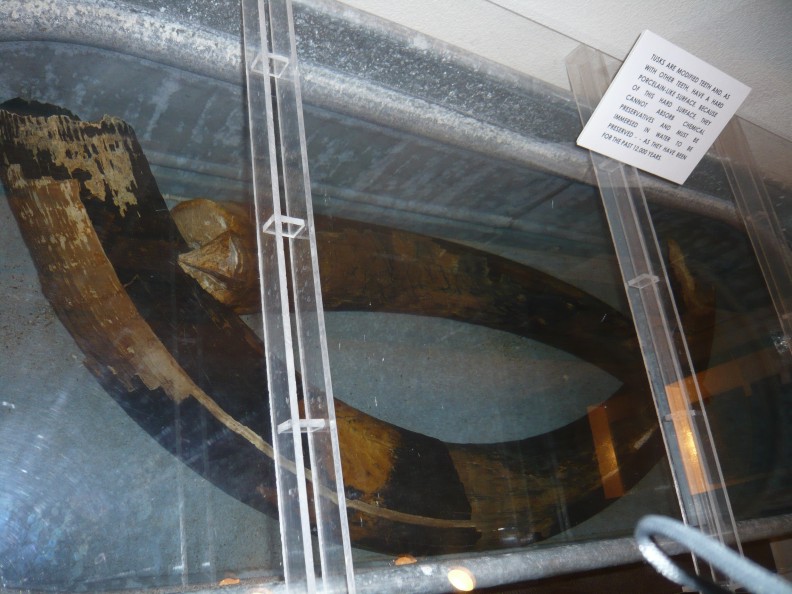
The old post has some links to both the museum (ergh: I now see two of the links are no longer valid; will check on those). Anyway, beach combing is a must:
Full image here.

This is a protected bay so oysters and numerous other molluscan species are abundant. In fact, the beach at low tide is littered with live oysters; no worries about starving. Dungeness crab is also abundant, but not nearshore enough to see any, except perhaps the young'uns which crowd under rocks at low tide. Also abundant are chiton:
Full image here.
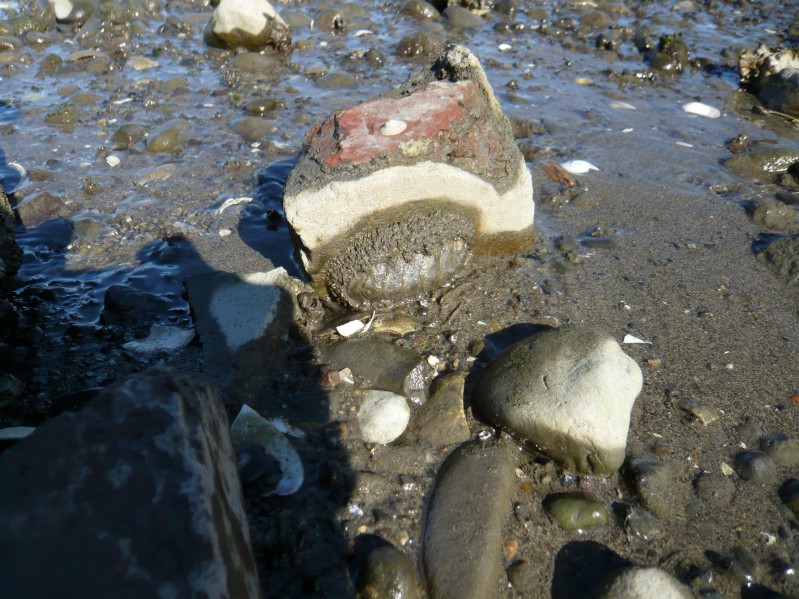
Not sure what these are:
Full image here.
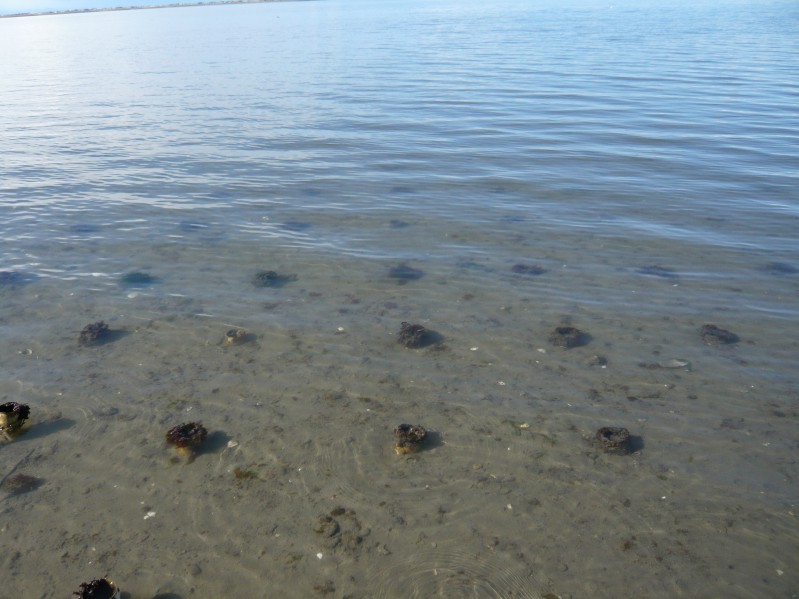
They're not posts, they're hollow pipes, look like PVC. This one has an oyster growing right next to it and another had an anemone growing within it:
Full image here.
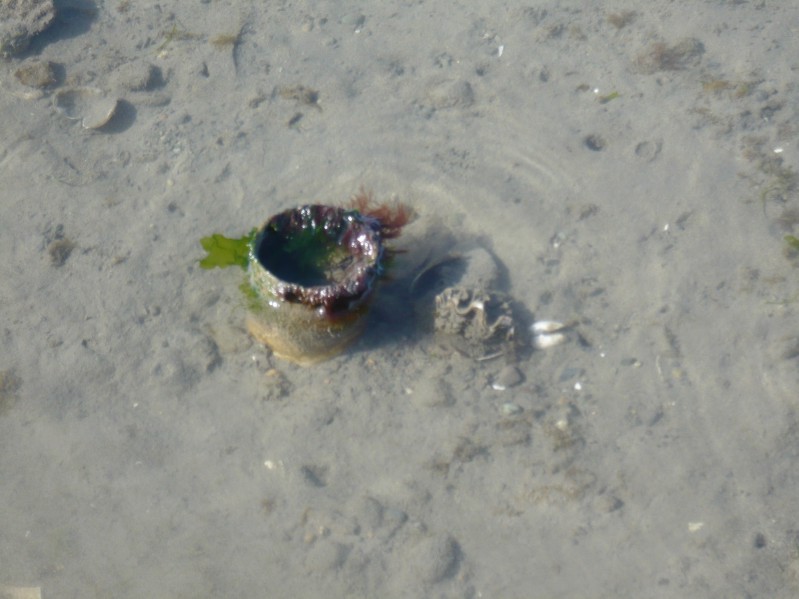
I'm wondering if this wasn't set up specifically to attract wildlife, something like the way artificial reefs are built. Other wildlife are deer, bald eagles, a herd of elk, seals, and, um, this fierce creature:
Full image here.

One more beach shot. This is at the 3 Crabs Restaurant which is my favorite place there. It's not the fanciest food, pretty basic fare, but perfectly done. I've never been disappointed by either the food or the service.
Full image here.
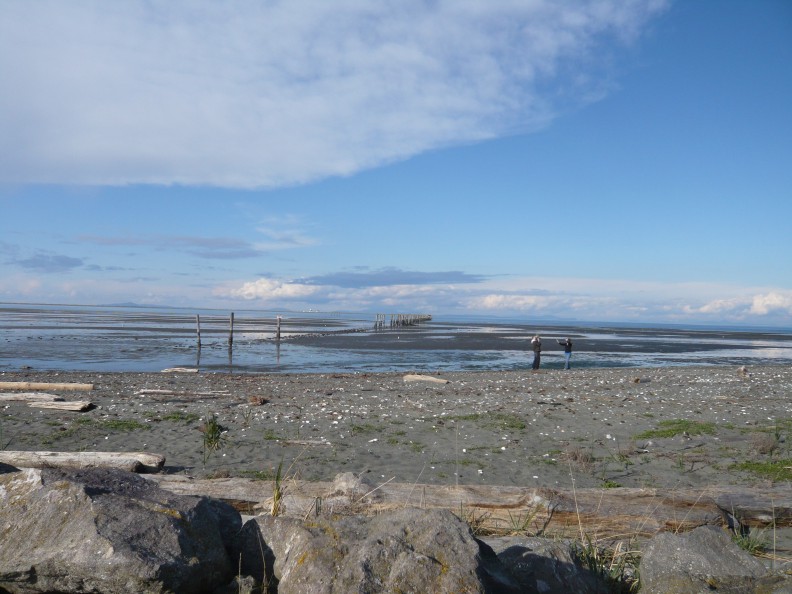
The pilings going out are from the original pier (if you search around for Sequim-related sites, there are probably some historic photos of it). This was a pretty low tide and the seagulls were having a field day; there was a young bald eagle perched on one of the pilings (not in this photo). There's quite a few around the area; one had his own little perch in a tree just down the road from the motel and was sitting there nearly every morning when we drove by.
Full image here.
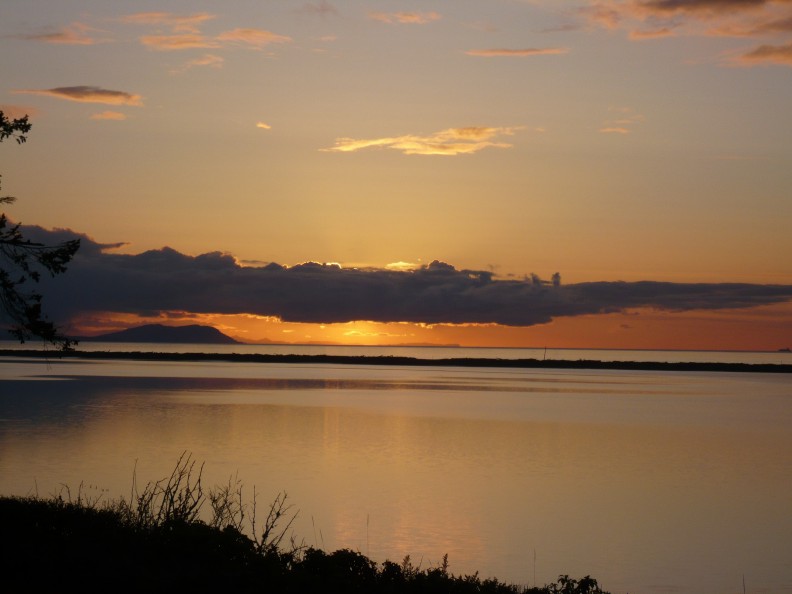
And the usual sunset photo.
Shroud of Turin
Kris provides a link describing what they did here:
They found nothing. Seems like kind of a waste of time since they also note that No contamination like this has been detected before, even on very old samples (up to the 50,000 year limit of radiocarbon) which would be much more severely affected.
But it's a film so it will no doubt be mercilessly hyped and the show will consist of 95% background on the "controversy" with a little bit at the end saying they found nothing BUT IT'S STILL POSSIBLE THAT IT'S THE REAL THING.
The discovery that all five radiocarbon dates were in the 14th century was a setback for those who believe in its direct association with Jesus; and some have argued that the dates were affected by a fire which added carbon monoxide to the fabric. John Jackson, director of the Turin Shroud Center of Colorado and the University of Oxford Radiocarbon Accelerator Unit conducted additional work in an attempt to identify if carbon monoxide might have been a factor in the dates
Kris provides a link describing what they did here:
The hypothesis put forward in the film is that the linen of the Shroud might have been contaminated by carbon monoxide. Unlike most contaminants, carbon monoxide is naturally enriched in radiocarbon when found in the environment and would therefore in principle be able to alter the radiocarbon age significantly. A relatively small amount of carbon monoxide (roughly 2% of the carbon in the linen) could alter the age of the sample by a thousand years. This is the only contamination hypothesis which could affect the radiocarbon age of the Shroud enough to allow it to be 2000 years old.
They found nothing. Seems like kind of a waste of time since they also note that No contamination like this has been detected before, even on very old samples (up to the 50,000 year limit of radiocarbon) which would be much more severely affected.
But it's a film so it will no doubt be mercilessly hyped and the show will consist of 95% background on the "controversy" with a little bit at the end saying they found nothing BUT IT'S STILL POSSIBLE THAT IT'S THE REAL THING.
Archaeologists Find Evidence of Origin of Pacific Islanders
China had a sea-faring civilization as long as 7000 years ago. Archaeologist Tianlong Jiao says, one day, these mariners sailed their canoes into the vastness of the Pacific Ocean, and stayed. He points out, "Most scientists, archaeologists, historical linguists and human biologists agree that today's southeast China, Taiwan and Northern Philippines, the whole region is the ultimate homeland of the Austronesian people." The Austronesians include today's Polynesian, Micronesian, Melanesian, and the indigenous people in Philippines, in the Southeast Asia archipelago, and in Taiwan.
Archaeologists Find 4,000-Year-Old Gold Necklace in South Peru
Archaeologists discovered a 4,000-year-old necklace in a burial pit near Peru's Lake Titicaca, the oldest gold artifact ever found in the Americas, according to a study published today.
The nine gold beads were dated to between 2155 B.C. and 1936 B.C., about 600 years older than previous finds, according to the study in the Proceedings of the National Academy of Sciences.
The necklace, made from tube-like beads of gold and stones, was found with skull and neck fragments from an elderly person and a child in Jiskairumoko, a settlement of hunter-gatherers, wrote lead author Mark Aldenderfer, an anthropologist with the University of Arizona, Tucson.
Archaeologists Start Stonehenge Dig
That should be interesting, but association will be a problem, since you can't directly date the stones or stone fragments.
Some of England's most sacred soil was disturbed Monday for the first time in more than four decades as archaeologists worked to solve the enduring riddle of Stonehenge: When and why was the prehistoric monument built?
. . .
Scientists believe the bluestones were first put in place about 2600 B.C., but they concede the date is only an approximation at best. The original bluestones were removed about 200 years later and scientists hope to find bits of them embedded in the earth.
Darvill said the excavation marks the first opportunity to bring the power of modern scientific archaeology to bear on a problem that has taxed the minds of so many experts since medieval times: Why were the bluestones so important to have warranted bringing them from so far away?
The excavation goal is to find remnants of the original bluestones, or related materials, that can be subjected to modern radiocarbon dating techniques to establish a more precise timeline for the construction of Stonehenge, said Dave Batchelor, an archaeologist with English Heritage, which oversees the Stonehenge site.
That should be interesting, but association will be a problem, since you can't directly date the stones or stone fragments.
Tuesday, April 01, 2008
Blogging update After a few posts. . . .back from mini-vacation. Good trip, mostly. started out kind of iffy as the furnace decided to quit working THE MORNING WE WERE LEAVING. Happily, it was just a tweaky motor so it was only a 3-hour delay. But it was snowing. Cold the whole time, too. Eh, not too bad. Saw a bunch of wildlife -- seals, elk, eagles, deer, not to mention various invertebrate fauna -- and ate a ot of food. And read a lot. I brought along A Salty Piece of Land by Jimmy Buffett. Good read and perfect for a seaside setting, even if it's in a far northern clime.
Of course, now I have a wild urge to sell all my belongings and move to the Caribbean. . . .
Will post a bunch of pictures later.
Of course, now I have a wild urge to sell all my belongings and move to the Caribbean. . . .
Will post a bunch of pictures later.
The need to preserve documentation grows
Nail, head. He brings up an interesting point about the documentation, which has been batted about in other circles as well: Electronic media. Not only the media itself (tapes, floppy disks, etc.) can degrade but you can lose the equipment to read it with as well. Anyone who's been around computers for more than a decade or so knows all about having to schlep files from various forms of memory to another. And that doesn't even begin to hit the issue of software; there are a lot of old files floating around in things like WordStar; I got a lot of files from a former professor that were in what was an unknown format. Turned out they were WordStar and I was fortunate to have a copy of WordPerfect which had the right import formats.
There are also two large reel-to-reel tapes that has something about some Fayum excavation data on them; no one knows what the data is, but the university says they have an old tape machine they've maintained for just such situations. Of course, reading it and understanding the data are different things.
I got into some arguments with people about this probably 15 years ago, mostly having to do with the permanence of different forms of media. I suggested that perhaps some documents and data really ought to be committed to something of a more permanent nature. After all, we're still reading stuff written on stone tablets after 5,000 years. Obviously, it's not for everything, but there's a range of options available and we should really start thinking about the long term.
The 19th-century physicist Michael Faraday famously offered a young scientist three words of advice: "Work, finish, publish."
This admonition still applies, but for archaeologists, at least, it's incomplete. You must add "curate" to the list of fundamental scientific responsibilities.
Nail, head. He brings up an interesting point about the documentation, which has been batted about in other circles as well: Electronic media. Not only the media itself (tapes, floppy disks, etc.) can degrade but you can lose the equipment to read it with as well. Anyone who's been around computers for more than a decade or so knows all about having to schlep files from various forms of memory to another. And that doesn't even begin to hit the issue of software; there are a lot of old files floating around in things like WordStar; I got a lot of files from a former professor that were in what was an unknown format. Turned out they were WordStar and I was fortunate to have a copy of WordPerfect which had the right import formats.
There are also two large reel-to-reel tapes that has something about some Fayum excavation data on them; no one knows what the data is, but the university says they have an old tape machine they've maintained for just such situations. Of course, reading it and understanding the data are different things.
I got into some arguments with people about this probably 15 years ago, mostly having to do with the permanence of different forms of media. I suggested that perhaps some documents and data really ought to be committed to something of a more permanent nature. After all, we're still reading stuff written on stone tablets after 5,000 years. Obviously, it's not for everything, but there's a range of options available and we should really start thinking about the long term.
The Lourdes of ancient Britain? Dig aims to reveal Stonehenge's purpose
The first excavation for more than a generation at Stonehenge began yesterday, looking for evidence that the most famous prehistoric monument in the world was the Lourdes of the bronze age, where the sick and troubled sought healing from the supernatural power of bluestones brought from west Wales.
Although the trench will be only 3.5 metres long and a metre deep, archaeologists expect to find the foundation holes of the very first stone circle, built more than 4,500 years ago and then altered over centuries. With luck they will find enough organic material, including pollen grains, snail shells and fragments of the antler tools of the builders, using techniques developed since the last excavations, to allow them to date the monument accurately.
Intact Colossus of Egypt's Queen Tiye Found
This has been making the rounds of Egyptology circles. Pics are at that link.
This intact statue of Queen Tiye, a powerful queen from ancient Egypt's 18th dynasty, was recently discovered at the site of the mortuary temple of powerful pharaoh Amenhotep III, as seen in this photograph taken March 27, 2008.
The 12-foot-tall (3.6-meter-tall) quartzite figure was found attached to the broken-off leg of a much larger colossus—a 50-foot-tall (15-meter-tall) likeness of Amenhotep III seated at his throne.
Experts said the statue is one of the best preserved at the site, ancient Egypt's largest temple complex that most believe was decimated in antiquity by massive earthquakes.
This has been making the rounds of Egyptology circles. Pics are at that link.
Researchers: Asteroid Destroyed Sodom and Gomorrah
Another article on it here. Seems awfully exacting to be able to ascribe a specific trajectory to pinpoint its impact location that specifically.
A clay tablet that has baffled scientists for 150 years has been identified as a witness's account of the asteroid suspected of being behind the destruction of Sodom and Gomorrah.
Researchers who cracked the cuneiform symbols on the Planisphere tablet believe that it recorded an asteroid thought to have been more than half a mile across.
The tablet, found by Henry Layard in the remains of the library in the royal place at Nineveh in the mid-19th century, is thought to be a 700 B.C. copy of notes made by a Sumerian astronomer watching the night sky.
Another article on it here. Seems awfully exacting to be able to ascribe a specific trajectory to pinpoint its impact location that specifically.
Thursday, March 27, 2008
Blogging update

No blogging for a few days as I am out doing nothing that involves a computer. For your interest and enjoyment, here is a link to Sequim, WA where I will be. Eating at least twice at the 3 Crabs; YUM.
Posting will resume on or about April 1. No foolin'!
No blogging for a few days as I am out doing nothing that involves a computer. For your interest and enjoyment, here is a link to Sequim, WA where I will be. Eating at least twice at the 3 Crabs; YUM.
Posting will resume on or about April 1. No foolin'!
Paleoanth update Human Ancestor Fossil Found
A small piece of jawbone unearthed in a cave in Spain is the oldest known fossil of a human ancestor in Europe and suggests that people lived on the continent much earlier than previously believed, scientists say.
The researchers said the fossil found last year at Atapuerca in northern Spain, along with stone tools and animal bones, is up to 1.3 million years old. That would be 500,000 years older than remains from a 1997 find that prompted the naming of a new species: Homo antecessor, or Pioneer Man, possibly a common ancestor to Neanderthals and modern humans.
Early Egyptians Revered Lowly Donkeys
There's a few good bits in there, notably regarding domestication. They indicate that the critters were not distinguishable from wild forms which sort of, but does not entirely, undercut one of those Signs of Domestication (morphologically different, out of natural range, etc.); they're not really mutually inclusive.
Too bad it's not the same today. One thing I just hate hate HATE about working in Egypt is the poor quality of the animals. Donks (homar) are widely abused, not necessarily intentional physical abuse -- though that does happen -- but they don't receive the best care, generally.
When archaeologists excavated brick tombs outside a ceremonial site for an early king of Egypt, they expected to find the remains of high officials who had been sacrificed to accompany the king in his posthumous travels.
Instead, they found donkeys.
No other animals have ever been found at such sites. Even at the tombs of the kings themselves, the only animals buried alongside were ones full of symbolism like lions.
But at this funerary complex, overlooking the ancient town of Abydos on the Nile about 300 miles south of Cairo, the archaeologists discovered the skeletons of 10 donkeys that had been buried as if they were high-ranking human officials.
There's a few good bits in there, notably regarding domestication. They indicate that the critters were not distinguishable from wild forms which sort of, but does not entirely, undercut one of those Signs of Domestication (morphologically different, out of natural range, etc.); they're not really mutually inclusive.
Too bad it's not the same today. One thing I just hate hate HATE about working in Egypt is the poor quality of the animals. Donks (homar) are widely abused, not necessarily intentional physical abuse -- though that does happen -- but they don't receive the best care, generally.
Remains of rare Roman roundhouse found during sewer works
One of the most important archaeological finds for decades has been uncovered during a sewer improvement project in Poulton.
The remains of a Roman roundhouse, thought to date back to the second century, have been discovered on grazing land close to the town.
The find was made by workers from United Utilities who were involved in preliminary excavations at the start of a £10 million sewer improvement scheme for the area.
Subscribe to:
Posts (Atom)