Two archaeologists say an ancient Big Island site listed on the National Register of Historic Places has been bulldozed.
Paul Rosendahl's firm surveyed the North Kona property for its owners in 2005.
He says the site included a suspected heiau, agricultural terraces and other features.
According to Rosendahl, it was likely destroyed between 1985 and 2005.
Monday, May 14, 2007
Say, speaking of bulldozers Archaeologists say ancient Big Island site was bulldozed
Egypt's top archaeologist says he will fight for Nefertiti bust in Germany
Egypt's antiquities chief told The Associated Press in an interview that if persuasion does not work, he will fight for an ancient bust of Nefertiti now in a Berlin museum that Germany says is too fragile to loan to Egypt.
Zahi Hawass rattled the world's museums last week with requests to hand over masterpieces of ancient Egypt, including the Rosetta Stone — some for loans, others permanently.
Hawass said in the interview Wednesday that the goal is to display the pieces in two new museums, particularly the Grand Museum, which is opening in 2012 next to the Great Pyramids of Giza and it to be Egypt's main antiquities showcase.
400-year-old weapons found at Jamestown
Archaeologists working at the site of historic James Fort have unearthed the first pieces of what appears to be a large cache of armor and arms buried in an early 17th-century well.
The artifacts include numerous tassets - small pieces of armor used to protect the wearer's thighs - as well as a rapier hilt, an iron pole and a nearly complete broadsword with an intact basket hilt.
William Kelso, director of the Jamestown Rediscovery excavation, believes the objects may have been discarded by the colonists as early as June 1610, when the survivors of a particularly brutal winter known as the "Starving Time" trashed much of the settlement's armory before temporarily abandoning the fort.
The Abu El-Haj controversy continues An alert reader sends along a link to this article: Bulldozer archaeology?
It's largely critical of Abu El-Haj. It provides a plausible explanation of the whole bulldozer controversy, which seemed kinda hinky to me from the start, being a 3rd-party report in the first place. Harrington provides this quote by David Usshiskin on the origin of the Bulldozer Incident:
I think I mentioned in previous posts on this that large earth-moving equipment is not unknown archaeologically, though not often used for obvious reasons. It could feasibly start an urban legend of heinous archaeologists ripping up valuable archaeological remains. But, you know, that's the danger when you throw out "I heard from someone that. . . ." as part of an academic treatise.
The notion of bulldozer archaeology is so shocking largely because the classic image of archaeologists at work is one of painstaking care, precision and slowness: the earth delicately probed with hand-held trowels, soil gently cleaned from each find with brushes, every stage of the excavation carefully recorded with notes, drawings and photography. As an arena of human activity an archaeological dig would seem to be conceptually closer to an operating theatre than to a construction or demolition site. Yet large-scale as well as small-scale operations have their place in archaeology, and the carefully planned archaeological use of mechanized earth moving techniques, including bulldozing, is an established and accepted practice.
It's largely critical of Abu El-Haj. It provides a plausible explanation of the whole bulldozer controversy, which seemed kinda hinky to me from the start, being a 3rd-party report in the first place. Harrington provides this quote by David Usshiskin on the origin of the Bulldozer Incident:
I believe the use of a JCB to determine the line of the rock-cut Iron Age moat was justified. It was essential to establish the size of the Iron Age enclosure in order to understand properly the site … A JCB with a long arm working delicately under archaeological supervision was the right solution: it can do useful work without damaging ancient remains, and I believe that this was the case here.
I think I mentioned in previous posts on this that large earth-moving equipment is not unknown archaeologically, though not often used for obvious reasons. It could feasibly start an urban legend of heinous archaeologists ripping up valuable archaeological remains. But, you know, that's the danger when you throw out "I heard from someone that. . . ." as part of an academic treatise.
Sunday, May 13, 2007
Car-blogging update
As I mentioned below, I recarpeted my Mustang this weekend. I suppose all totalled it took about 7 hours. That includes going to the hardware store for various wrenches that I didn't have. Anyway, this is what it looked like prior to beginning:
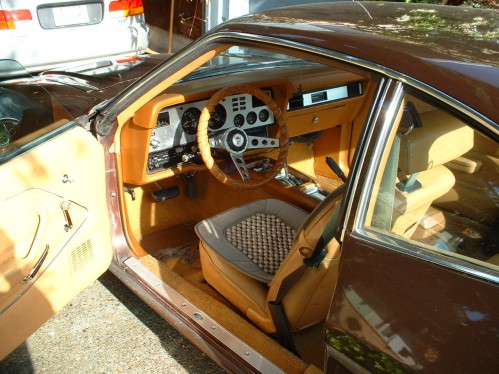
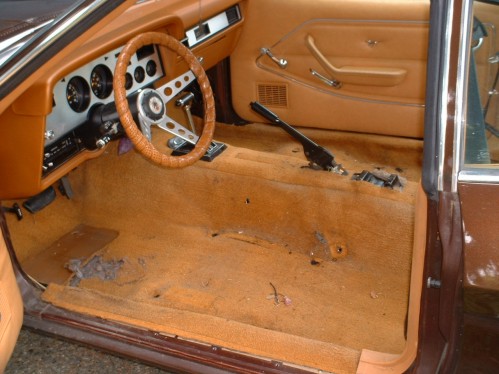
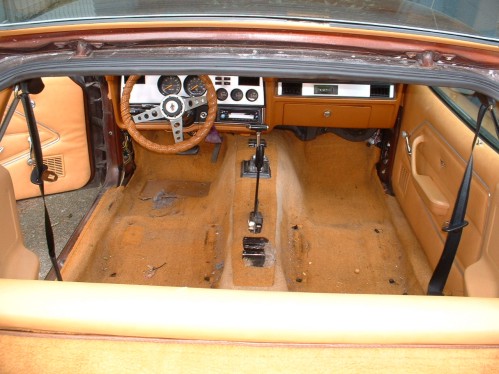
You can see it's all chewed up on the driver's side and the backing is poking through. Also faded. It's the original carpet put down in 1978 so it really hasn't worn too badly.
These two are after I pulled it all out:
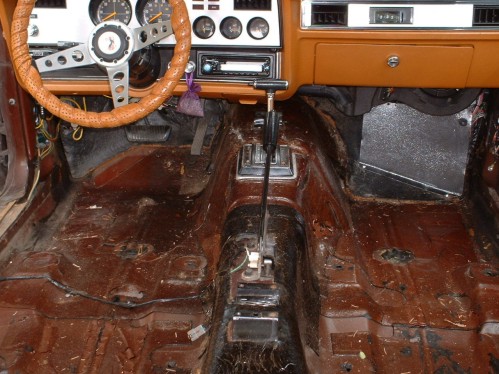
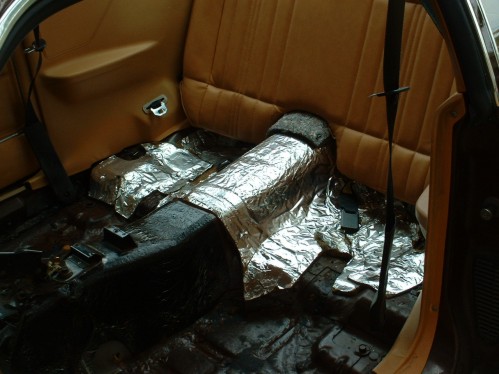
The wire going across to the left is the seat belt warning. Which I disconnected. The plate on the passenger side was put in when I put the new EFI engine in it (see here).
Then I laid the old one on top of the new one and traced the openings in the center console. Note the color difference.
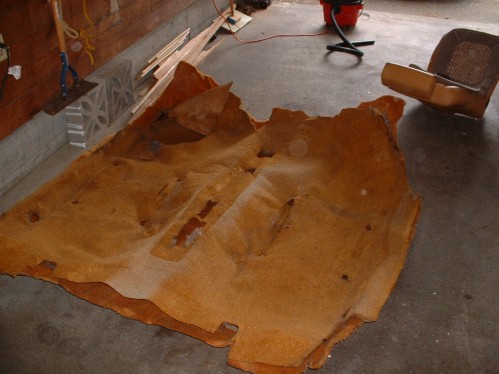
Note: Only do the front three holes this way. Those are the ones that have to be open before you can put it down; the other ones can be cut once you get it laid in place. I discovered it needed adjusting and the back hole -- where the little compartment is -- was cut a little too far back and I needed to cut some more. Fortunately, the console cover went over the excess hole, as in this picture:
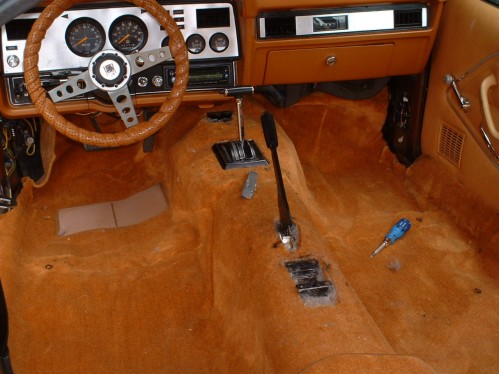
This next one just shows it almost done, with the driver's side all in:

Unfortunately, I'll probably have to buy another carpet and do it again, or rather, have it done by a professional. It looks okay, but there are a few (large) wrinkles in it. Worse, however, the side parts that go onto the door sill are too short so they don't go under the panel and stick out. This is apparently something with the manufacturer because two other people had the same thing happen. Oddly, they are okay in the front where I didn't fit it too well, but in the back where it did fit well, it's too short. So, eh.
As I mentioned below, I recarpeted my Mustang this weekend. I suppose all totalled it took about 7 hours. That includes going to the hardware store for various wrenches that I didn't have. Anyway, this is what it looked like prior to beginning:
You can see it's all chewed up on the driver's side and the backing is poking through. Also faded. It's the original carpet put down in 1978 so it really hasn't worn too badly.
These two are after I pulled it all out:
The wire going across to the left is the seat belt warning. Which I disconnected. The plate on the passenger side was put in when I put the new EFI engine in it (see here).
Then I laid the old one on top of the new one and traced the openings in the center console. Note the color difference.
Note: Only do the front three holes this way. Those are the ones that have to be open before you can put it down; the other ones can be cut once you get it laid in place. I discovered it needed adjusting and the back hole -- where the little compartment is -- was cut a little too far back and I needed to cut some more. Fortunately, the console cover went over the excess hole, as in this picture:
This next one just shows it almost done, with the driver's side all in:
Unfortunately, I'll probably have to buy another carpet and do it again, or rather, have it done by a professional. It looks okay, but there are a few (large) wrinkles in it. Worse, however, the side parts that go onto the door sill are too short so they don't go under the panel and stick out. This is apparently something with the manufacturer because two other people had the same thing happen. Oddly, they are okay in the front where I didn't fit it too well, but in the back where it did fit well, it's too short. So, eh.
Blogging update Sorry about the lack of posting. I've been putting new carpet in my Mustang. It went okay, except I discovered too late that the pattern makes the side flaps by the door sill too short so it's kind of sticking up there. So, it's either buy new stuff from a new company or find some way of fixing it. Pictures to follow.
Friday, May 11, 2007
Ancient Peruvians Used Dismemberment as Power Tool
Ancient Peruvian aristocrats dismembered their less well-off neighbors as a scare tactic, new archaeological finds suggest.
Several deformed corpses were found during recent excavations at the burial necropolis of El Trigal, a once-downtrodden community located in the Nazca province of Peru and dating to the 1st century A.D.
Members of nearby, wealthier communities looking to send a message about their power may have been responsible for the mutilations, say archaeologists.
The Ahmes code
It's a long article on Egyptian mathematics.
The mathematical system in ancient Egypt was application-oriented, devised -- complete with fractions -- to manage practical matters. Assem Deif sums up the old methods
It's a long article on Egyptian mathematics.
Thursday, May 10, 2007
And now. . . .the news from the EEF
Press report: "Archaeological Find in Southern Sinai"
http://www.ansamed.info/en/egypt/news/ME03.@AM12580.html
"Egyptian archeologists have uncovered a 2200-year old
port in the Red Sea city of Dahab (..) At another section
of the port, archaeologists found what looks to have
been 24 storage rooms."
-- Another press report, with the same scanty details:
http://snipurl.com/1k30e
[http://www.sis.gov.eg/En/EgyptOnline/Culture/000001/
0203000000000000000750.htm]
Press report: "Prehistoric stones unearthed in Aswan"
http://snipurl.com/1k30k
[http://www.sis.gov.eg/En/EgyptOnline/Culture/000001/02030000
00000000000749.htm]
"An archaeological team from Belgium, working in the Upper
Egyptian town of Kom Ombo, near Aswan, have unearthed
three stones engraved with inscriptions 15,000 years ago.
"There are engravings of cows, hippopotami, giraffes and fish
on the stones, as well as other symbolic and abstract inscriptions"."
[INSCRIPTIONS FROM 15,000 YEARS AGO??? Ed.]
Press report: "A pictorial dream: ‘Saqqara Under Sand’
will tour the world"
http://www.dailystaregypt.com/article.aspx?ArticleID=7104
"In cooperation with the Cultural Development Fund, the
Alexandria Library, the Ars Latina Society and the Louvre
Museum's Egyptian Antiquities Department, "Saqara Under
Sand" that was staged in Jan. 2007 at the Alexandria Library
and last month at the French Cultural Center, Cairo, is currently
on at Prince Taz Palace. However, due to the significance of
the exhibition that showcases the fruit of 16-years' excavations
conducted by the Louvre's French archaeological team, "Saqara
Under Sand" is scheduled to tour the US as well as many Arab
countries and South America."
Press report: "Spanish museum said to be exhibiting stolen
Egyptian antiquity"
http://snipurl.com/1k30w
[http://www.iht.com/articles/ap/2007/05/09/europe/EU-
GEN-Spain-Egyptian-Statuette.php]
"The limestone artwork — a 43-centimeter-tall (17-inch)
depiction of a princess named Nefert — is on display at the
Egypt Museum of Barcelona, which says it will return the
piece if it turns out to have been stolen (..) before being
purchased legally by the museum."
Trivia in the category of the more bizarre kind of 'Egyptomania'
(if not plain 'maniacal'):
1) Press reports: "Egyptian goddess inspires a psychedelic
burst of Czech creativity"
http://snipurl.com/1k31d
[http://www.praguepost.com/articles/2007/05/02/bromovas-
magic-mushroom-temple.php]
http://www.expats.cz/prague/event.php?id=4684
"Bromová's (..) current exhibition at Hunt Kastner Artworks
[till May 22], “HaHathor’s Handbag,” was inspired by her
travels in Egypt, and in particular by the mythical goddess Hathor.
In 2003 Bromová (born in Prague in 1966) was traveling around
Egypt, where, at the ancient temple of Dender[a], she was struck
by the visual and spiritual mystery of Hathor (..). There was a
relief on a stone that especially captivated her: It showed a
woman carrying something resembling an amphora, but of
an unusual shape — it resembled a woman’s handbag, and
looked as if it had mushrooms sprouting out of its sides. This
image became the basis of five digitally manipulated psychedelic
self-portraits, or inner journeys."
-- Exhibition photos [not really 18+ rated]:
http://snipurl.com/1k31f
Press report: "Egyptians, not Greeks were true fathers of medicine"
http://www.eurekalert.org/pub_releases/2007-05/uom-eng050907.php
"The research team from the KNH Centre for Biomedical Egyptology
at The University of Manchester discovered the evidence in medical
papyri written in 1,500BC – 1,000 years before Hippocrates was born.
"When we compared the ancient remedies against modern pharmaceutical
protocols and standards, we found the prescriptions in the ancient
documents not only compared with pharmaceutical preparations of
today but that many of the remedies had therapeutic merit." "
[For this project, see also EEF NEWS (447) and (443).]
-- Another press report on this:
http://snipurl.com/1k31k
[http://www.manchestereveningnews.co.uk/news/s/1006/
1006599_egypt_was_mummy_of_medicine_.html]
Press report: "French theory on Pyramids building refuted"
http://snipurl.com/1k321
[http://www.sis.gov.eg/En/EgyptOnline/Culture/000001/02030
00000000000000755.htm]
"Egyptian, US and German experts have refuted French archaeologist
Jean-Pierre Houdin's theory about how the Pyramids were built."
[According to the Egyptian Gazette, Mark Lehner and Rainer
Stadelman. were two of the experts.]
Abdel-Hafez, Tarek Mahmoud Mohamed, Geophysical
and geotechnical studies in pharaonic and urban Egypt.
Diss. phil.nat. Bern, 2004
abstract:
http://www.zb.unibe.ch/download/eldiss/04abdel-hafez_tabs.pdf
"(..) Geophysical, geotechnical and geochemical investigations
in the urban center of 15th May City and Al-Mokattam area in
great Cairo and in the Osireion of Abydos. Ground penetrating
radar (GPR) with 100 MHz antenna was applied in both areas.
In Abydos the radargrams show a channel underneath the
Temple of Seti I. (..)"
text: 7,57 MB
http://www.zb.unibe.ch/download/eldiss/04abdel-hafez_t.pdf
-- Gerber, Manuel, Predictive site detection and reconstruction:
a data-driven approach to the detection, analysis, reconstruction
and excavation of ancient Near Eastern monumental architecture
Diss. phil.hist. Bern, 2003
abstract:
http://www.zb.unibe.ch/download/eldiss/03gerber_mabs.pdf
text: 11,4 MB
http://www.zb.unibe.ch/download/eldiss/03gerber_m.pdf
Digitized book from the Internet Archive
-- E. A. Wallis Budge, A Guide to the Egyptian Collections in
the British Museum, Printed by Order of the Trustees, [London],
1909. xiv, 325 pp., 53 pls. - pdf-file (245 MB)
http://www.archive.org/details/guidetoegyptianc00brituoft
"The Collection of Egyptian Antiquities in the British Museum
comprises nearly fifty thousand objects, and many of its sections
are unrivalled in completeness ... The present Guide has been
prepared with the view of providing the visitor to the British
Museum with information of a more general character than can
be conveniently given in the Guides to the several Galleries and
Rooms of the Department. An attempt has here been made to
present a sketch of the origin, the manners and customs, the
language, the writing, the literature, the religion, and the burial
rites of the peoples of Egypt, and of their history under the
successive dynasties; embodying references to the several
objects of the Collection which illustrate the different branches
of the subject. The text is supplemented by an abundant selection
of cuts and plates of the most important of the antiquities."
Anthony J. Cagle, "Human Burials at Kom el-Hisn" (2004),
15 pp. (PDF, 107 kB)
http://www.acagle.net/KeHBurials.pdf [Hey, I didn't know that was there. . .Ed.]
-- The dissertation of the author was mentioned in EEF NEWS (359):
Anthony J. Cagle, The Spatial Structure of Kom el-Hisn: An Old
Kingdom Town in the Western Nile Delta, Egypt. Online at:
http://www.acagle.net/dissertation/disspage.html
-- Some other online material on the author's site:
---"University of Washington 1994 Fayum Project. NARCE Report"
http://www.acagle.net/fayum94/narce.html
"The purpose of this research was to study certain aspects
of artifact variability during the so-called "Epipaleolithic-
Neolithic transition" in the Fayum region of Egypt."
http://www.acagle.net/fayum94/narce.html:
--- "Differential Consumption of Pig vs. Sheep/Goats at the
Old Kingdom Site of Kom el-Hisn"
http://www.acagle.net/ARCE2002/PigPaper2Refs.html
"Recently, I performed an extensive spatial analysis of the
material recovered from two seasons, 1986 and 1988 and
I was able to clarify the structure and function of a good
portion of the excavated areas. This paper deals with one
aspect of that structure, the differential distribution of faunal
remains and its implications for social differences in subsistence;
namely, the role of pig versus sheep/goat in the diet of different
segments of Kom el-Hisn’s residents."
--- "Kom el-Hisn monograph: Tentative Table of Contents"
http://www.acagle.net/kehmonograph/toc.html
Some sections are online.
End of EEF news
Press report: "Archaeological Find in Southern Sinai"
http://www.ansamed.info/en/egypt/news/ME03.@AM12580.html
"Egyptian archeologists have uncovered a 2200-year old
port in the Red Sea city of Dahab (..) At another section
of the port, archaeologists found what looks to have
been 24 storage rooms."
-- Another press report, with the same scanty details:
http://snipurl.com/1k30e
[http://www.sis.gov.eg/En/EgyptOnline/Culture/000001/
0203000000000000000750.htm]
Press report: "Prehistoric stones unearthed in Aswan"
http://snipurl.com/1k30k
[http://www.sis.gov.eg/En/EgyptOnline/Culture/000001/02030000
00000000000749.htm]
"An archaeological team from Belgium, working in the Upper
Egyptian town of Kom Ombo, near Aswan, have unearthed
three stones engraved with inscriptions 15,000 years ago.
"There are engravings of cows, hippopotami, giraffes and fish
on the stones, as well as other symbolic and abstract inscriptions"."
[INSCRIPTIONS FROM 15,000 YEARS AGO??? Ed.]
Press report: "A pictorial dream: ‘Saqqara Under Sand’
will tour the world"
http://www.dailystaregypt.com/article.aspx?ArticleID=7104
"In cooperation with the Cultural Development Fund, the
Alexandria Library, the Ars Latina Society and the Louvre
Museum's Egyptian Antiquities Department, "Saqara Under
Sand" that was staged in Jan. 2007 at the Alexandria Library
and last month at the French Cultural Center, Cairo, is currently
on at Prince Taz Palace. However, due to the significance of
the exhibition that showcases the fruit of 16-years' excavations
conducted by the Louvre's French archaeological team, "Saqara
Under Sand" is scheduled to tour the US as well as many Arab
countries and South America."
Press report: "Spanish museum said to be exhibiting stolen
Egyptian antiquity"
http://snipurl.com/1k30w
[http://www.iht.com/articles/ap/2007/05/09/europe/EU-
GEN-Spain-Egyptian-Statuette.php]
"The limestone artwork — a 43-centimeter-tall (17-inch)
depiction of a princess named Nefert — is on display at the
Egypt Museum of Barcelona, which says it will return the
piece if it turns out to have been stolen (..) before being
purchased legally by the museum."
Trivia in the category of the more bizarre kind of 'Egyptomania'
(if not plain 'maniacal'):
1) Press reports: "Egyptian goddess inspires a psychedelic
burst of Czech creativity"
http://snipurl.com/1k31d
[http://www.praguepost.com/articles/2007/05/02/bromovas-
magic-mushroom-temple.php]
http://www.expats.cz/prague/event.php?id=4684
"Bromová's (..) current exhibition at Hunt Kastner Artworks
[till May 22], “HaHathor’s Handbag,” was inspired by her
travels in Egypt, and in particular by the mythical goddess Hathor.
In 2003 Bromová (born in Prague in 1966) was traveling around
Egypt, where, at the ancient temple of Dender[a], she was struck
by the visual and spiritual mystery of Hathor (..). There was a
relief on a stone that especially captivated her: It showed a
woman carrying something resembling an amphora, but of
an unusual shape — it resembled a woman’s handbag, and
looked as if it had mushrooms sprouting out of its sides. This
image became the basis of five digitally manipulated psychedelic
self-portraits, or inner journeys."
-- Exhibition photos [not really 18+ rated]:
http://snipurl.com/1k31f
Press report: "Egyptians, not Greeks were true fathers of medicine"
http://www.eurekalert.org/pub_releases/2007-05/uom-eng050907.php
"The research team from the KNH Centre for Biomedical Egyptology
at The University of Manchester discovered the evidence in medical
papyri written in 1,500BC – 1,000 years before Hippocrates was born.
"When we compared the ancient remedies against modern pharmaceutical
protocols and standards, we found the prescriptions in the ancient
documents not only compared with pharmaceutical preparations of
today but that many of the remedies had therapeutic merit." "
[For this project, see also EEF NEWS (447) and (443).]
-- Another press report on this:
http://snipurl.com/1k31k
[http://www.manchestereveningnews.co.uk/news/s/1006/
1006599_egypt_was_mummy_of_medicine_.html]
Press report: "French theory on Pyramids building refuted"
http://snipurl.com/1k321
[http://www.sis.gov.eg/En/EgyptOnline/Culture/000001/02030
00000000000000755.htm]
"Egyptian, US and German experts have refuted French archaeologist
Jean-Pierre Houdin's theory about how the Pyramids were built."
[According to the Egyptian Gazette, Mark Lehner and Rainer
Stadelman. were two of the experts.]
Abdel-Hafez, Tarek Mahmoud Mohamed, Geophysical
and geotechnical studies in pharaonic and urban Egypt.
Diss. phil.nat. Bern, 2004
abstract:
http://www.zb.unibe.ch/download/eldiss/04abdel-hafez_tabs.pdf
"(..) Geophysical, geotechnical and geochemical investigations
in the urban center of 15th May City and Al-Mokattam area in
great Cairo and in the Osireion of Abydos. Ground penetrating
radar (GPR) with 100 MHz antenna was applied in both areas.
In Abydos the radargrams show a channel underneath the
Temple of Seti I. (..)"
text: 7,57 MB
http://www.zb.unibe.ch/download/eldiss/04abdel-hafez_t.pdf
-- Gerber, Manuel, Predictive site detection and reconstruction:
a data-driven approach to the detection, analysis, reconstruction
and excavation of ancient Near Eastern monumental architecture
Diss. phil.hist. Bern, 2003
abstract:
http://www.zb.unibe.ch/download/eldiss/03gerber_mabs.pdf
text: 11,4 MB
http://www.zb.unibe.ch/download/eldiss/03gerber_m.pdf
Digitized book from the Internet Archive
-- E. A. Wallis Budge, A Guide to the Egyptian Collections in
the British Museum, Printed by Order of the Trustees, [London],
1909. xiv, 325 pp., 53 pls. - pdf-file (245 MB)
http://www.archive.org/details/guidetoegyptianc00brituoft
"The Collection of Egyptian Antiquities in the British Museum
comprises nearly fifty thousand objects, and many of its sections
are unrivalled in completeness ... The present Guide has been
prepared with the view of providing the visitor to the British
Museum with information of a more general character than can
be conveniently given in the Guides to the several Galleries and
Rooms of the Department. An attempt has here been made to
present a sketch of the origin, the manners and customs, the
language, the writing, the literature, the religion, and the burial
rites of the peoples of Egypt, and of their history under the
successive dynasties; embodying references to the several
objects of the Collection which illustrate the different branches
of the subject. The text is supplemented by an abundant selection
of cuts and plates of the most important of the antiquities."
Anthony J. Cagle, "Human Burials at Kom el-Hisn" (2004),
15 pp. (PDF, 107 kB)
http://www.acagle.net/KeHBurials.pdf [Hey, I didn't know that was there. . .Ed.]
-- The dissertation of the author was mentioned in EEF NEWS (359):
Anthony J. Cagle, The Spatial Structure of Kom el-Hisn: An Old
Kingdom Town in the Western Nile Delta, Egypt. Online at:
http://www.acagle.net/dissertation/disspage.html
-- Some other online material on the author's site:
---"University of Washington 1994 Fayum Project. NARCE Report"
http://www.acagle.net/fayum94/narce.html
"The purpose of this research was to study certain aspects
of artifact variability during the so-called "Epipaleolithic-
Neolithic transition" in the Fayum region of Egypt."
http://www.acagle.net/fayum94/narce.html:
--- "Differential Consumption of Pig vs. Sheep/Goats at the
Old Kingdom Site of Kom el-Hisn"
http://www.acagle.net/ARCE2002/PigPaper2Refs.html
"Recently, I performed an extensive spatial analysis of the
material recovered from two seasons, 1986 and 1988 and
I was able to clarify the structure and function of a good
portion of the excavated areas. This paper deals with one
aspect of that structure, the differential distribution of faunal
remains and its implications for social differences in subsistence;
namely, the role of pig versus sheep/goat in the diet of different
segments of Kom el-Hisn’s residents."
--- "Kom el-Hisn monograph: Tentative Table of Contents"
http://www.acagle.net/kehmonograph/toc.html
Some sections are online.
End of EEF news
Fight! Fight! Antiquities Authority manhandled Leviticus scroll, says archaeologist
Professor Hanan Eshel, the archaeologist who two years ago uncovered scroll fragments of the Book of Leviticus, says the Israel Antiquities Authority, which now has the finds, has cut out large chunks of the scroll on the pretext that its dating needed to be examined.
This was not a necessary procedure, says Eshel, since "experts say it was possible to test the dating without an intrusive examination and in the worst case scenario by cutting a tiny, peripheral portion of the scroll."
Relying on internal sources in the Antiquities Authority, Eshel says "there had even been plans to cut letters from the scroll but the employees that were asked to do so refused."
Greek archaeologists discover rare example of 2,700-year-old weaving
True dat. My first tomb was in the wet wet wet Delta of Egypt, but the lady inside had a copper/bronze mirror that preserved some of the burial material.
Archaeologists in Greece have recovered a rare section of 2,700-year old fabric from a burial imitating heroes' funerals described by the poet Homer, officials said Wednesday.
The yellowed, brittle material was found in a copper urn during a rescue excavation in the southern town of Argos, a Culture Ministry announcement said.
"This is an extremely rare find, as fabric is an organic material which decomposes very easily," said archaeologist Alkistis Papadimitriou, who headed the dig. She said only a handful of such artifacts have been found in Greece.
True dat. My first tomb was in the wet wet wet Delta of Egypt, but the lady inside had a copper/bronze mirror that preserved some of the burial material.
Ruins identical to Mohenjodaro, Harappa possibly exist in Pakistan
A team of American, Pakistani and Japanese archaeologists has claimed the discovery of rare objects in the Cholistan Desert, raising hopes of the presence of ruins identical to the civilisations of Mohenjodaro and Harappa.
Archaeologists from Wisconsin, the Research Institute of Humanities and Nature, Tokyo and the Department of Archaeology, Punjab University, say they have discovered a rare copper seal, a terracotta block, three wedge-shaped bricks, pottery with distinct potter marks and four unicorns from the dried-out channel of the Hakra river.
Wednesday, May 09, 2007
Herod's tomb(?) update
More from the LA Times and EurekAlert. The latter has more detail on the dig and why they think it really is Herod's. The main documentary evidence that he was buried there is Josephus: The body was thus conveyed for a distance of two hundred furlongs to Herodium, where, in accordance with the directions of the deceased, it was interred.
Probably doesn't seal the deal quite yet, but it's a good start.
More from the LA Times and EurekAlert. The latter has more detail on the dig and why they think it really is Herod's. The main documentary evidence that he was buried there is Josephus: The body was thus conveyed for a distance of two hundred furlongs to Herodium, where, in accordance with the directions of the deceased, it was interred.
Probably doesn't seal the deal quite yet, but it's a good start.
Inca Leapt Canyons With Fiber Bridges
Conquistadors from Spain came, they saw, and they were astonished. They had never seen anything in Europe like the bridges of Peru. Chroniclers wrote that the Spanish soldiers stood in awe and fear before the spans of braided fiber cables suspended across deep gorges in the Andes, narrow walkways sagging and swaying and looking so frail.
Yet the suspension bridges were familiar and vital links in the vast empire of the Inca, as they had been to Andean cultures for hundreds of years before the arrival of the Spanish in 1532. The people had not developed the stone arch or wheeled vehicles, but they were accomplished in the use of natural fibers for textiles, boats, sling weapons — even keeping inventories by a prewriting system of knots.
So bridges made of fiber ropes, some as thick as a man's torso, were the technological solution to the problem of road building in rugged terrain. By some estimates, at least 200 such suspension bridges spanned river gorges in the 16th century.
Critters drifting the ocean!
Poor things, drifting alone in the middle of the ocean. . . .
Actually, it's a pretty cool article.
. . .one frog washed ashore in Scotland, and a duck turned up near Maine. However, most of the drifters have remained stuck in the Pacific Subarctic Gyre, a set of deepwater and surface currents spanning an area the size of the continental United States that generally flows counterclockwise around the northern Pacific Ocean.
Poor things, drifting alone in the middle of the ocean. . . .
Actually, it's a pretty cool article.
Pocahontas update Back in this post I linked to an article that didn't think much of the NOVA program "Pocahontas Revealed" that aired last night. Turns out, I must disagree with its assessment.
I really liked it. As that reviewer noted, there isn't a whole lot one can say about Pocahontas the person, since no new documentary evidence has come to light recently that relates specifically to her. Nevertheless, the program's intent was clearly devoted to providing more context to the entire Pocahontas story that recent archaeological work has helped to uncover. In this, it succeeded quite well.
They didn't really overdramatize what new! exciting! stuff they were going to divulge, which is the usual schtick for these sorts of things. The dramatizations weren't too cheesy and overdramatized either, which is a complicated way of saying I never cringed while watching. The archaeology was straightforward and again, not overdramatized. We're all familiar with what can be done -- "Is THIS a lock of Nefertiti's hair??? We'll never TRULY know, but archaeologists say that this might indicate that she was. . . .MURDERED!" -- but they kept it low key. Ferinstance, they explained the problem of agricultural re-use of sites, and how even with the top 12" or so of disturbance -- they did use the term "plow zone"! -- you can still usually find postholes and undisturbed soil beneath it. They also did a fair job of showing how certain pottery traits -- cord stamping and temper -- are used to tie ceramic collections to particular groups, in this case the Powhatans.
Most of the Pocahontas-specific stuff was probably not new to anyone who has studied this bit of history in any detail, but to those of us who just have a vague recollection of what we were taught in school and what has made it through to popular culture, it did away with some of the mythology and produced a more complex, but believable story. It seems likely that there wasn't a romantic relationship between the two, more like a brother-sister sort of thing. Otherwise, Smith probably would have gone back to get her after being sent back to England to recuperate. But, who knows.
So, I give it a thumbs up and recommend seeing it the next time it comes on.
I really liked it. As that reviewer noted, there isn't a whole lot one can say about Pocahontas the person, since no new documentary evidence has come to light recently that relates specifically to her. Nevertheless, the program's intent was clearly devoted to providing more context to the entire Pocahontas story that recent archaeological work has helped to uncover. In this, it succeeded quite well.
They didn't really overdramatize what new! exciting! stuff they were going to divulge, which is the usual schtick for these sorts of things. The dramatizations weren't too cheesy and overdramatized either, which is a complicated way of saying I never cringed while watching. The archaeology was straightforward and again, not overdramatized. We're all familiar with what can be done -- "Is THIS a lock of Nefertiti's hair??? We'll never TRULY know, but archaeologists say that this might indicate that she was. . . .MURDERED!" -- but they kept it low key. Ferinstance, they explained the problem of agricultural re-use of sites, and how even with the top 12" or so of disturbance -- they did use the term "plow zone"! -- you can still usually find postholes and undisturbed soil beneath it. They also did a fair job of showing how certain pottery traits -- cord stamping and temper -- are used to tie ceramic collections to particular groups, in this case the Powhatans.
Most of the Pocahontas-specific stuff was probably not new to anyone who has studied this bit of history in any detail, but to those of us who just have a vague recollection of what we were taught in school and what has made it through to popular culture, it did away with some of the mythology and produced a more complex, but believable story. It seems likely that there wasn't a romantic relationship between the two, more like a brother-sister sort of thing. Otherwise, Smith probably would have gone back to get her after being sent back to England to recuperate. But, who knows.
So, I give it a thumbs up and recommend seeing it the next time it comes on.
Tuesday, May 08, 2007
Here lies the start of her Commonwealth
Standing on the site of America’s birthplace, scraped clean by archaeologists, Queen Elizabeth II peered down at a well shaft that revealed the beginnings of the British Commonwealth.
Fifty years ago, when she was last on Jamestown Island, no one knew evidence existed of the first permanent English settlement in the New World. The queen came Friday to stand where Englishmen in 1607 built a fort and to see what had been unearthed there by the team of archaeologists at Historic Jamestowne directed by William M. Kelso.
"Bring out yer dead. . . mammoth!" An ancient bathtub ring of mammoth fossils
Pacific Northwest National Laboratory geologists have put out a call for teeth tusks, femurs and any and all other parts of extinct mammoths left by massive Ice Age floods in southeastern Washington.
The fossils, in some cases whole skeletons of Mammathus columbi, the Columbian mammoth, were deposited in the hillsides of what are now the Yakima, Columbia and Walla Walla valleys in southeastern Washington, where the elephantine corpses came to rest as water receded from the temporary but repeatedly formed ancient Lake Lewis. PNNL geologists are plotting the deposits to reconstruct the high-water marks of many of the floods, the last of which occurred as recently as 12,000 to 15,000 years ago.
TV Review: Nova - "Pocahontas Revealed"
EXCUSE ME?
Actually, the defining quote seems to be: It does not however, as one might have hoped, reveal terribly much new information, but rather dispels clearly incorrect mythology that has sprung up around her story.
Which will probably turn out to be correct. In the absence of extensive documentation, it's tough to get anything really definitive. But dispelling some myths is productive anyway.
The NOVA site has more. The Images page has a bunch of representations of Pocahontas.
But who needs that anyway, I met her:

Archaeology is not a hard science. It is speculation melded with myth, legend, wishes, hopes, and a few facts tossed in for good measure. Nothing makes this more clear than Nova’s latest episode, “Pocahontas Revealed.”
EXCUSE ME?
It is not that the uncovering of these two sites isn’t interesting. It is not that hearing that the truth about Pocahontas’s life might be more mundane than novels, films, songs, and other forms of communication might lead us to believe is uninteresting. But, the fact of the matter is that this episode does not reveal anything about Pocahontas that was unknown (save that we may now know the exact site of two towns she lived in).
Actually, the defining quote seems to be: It does not however, as one might have hoped, reveal terribly much new information, but rather dispels clearly incorrect mythology that has sprung up around her story.
Which will probably turn out to be correct. In the absence of extensive documentation, it's tough to get anything really definitive. But dispelling some myths is productive anyway.
The NOVA site has more. The Images page has a bunch of representations of Pocahontas.
But who needs that anyway, I met her:
Subscribe to:
Posts (Atom)