Friday, February 29, 2008

Shroud of Turin Gets High-Def Scrutiny
The Turin shroud, the 14- by 4-foot linen long believed to have been wrapped around Jesus' body after the crucifixion, has entered the digital age.

A huge 12.8 billion-pixel image was made of the linen, on which the smudged outline of the body of a man is indelibly impressed. The image was made following a Vatican request to obtain the most detailed reproduction of the yellowing ancient cloth. The technology allows a level of scrutiny of the linen as never achieved before.

"The Shroud has been photographed in high definition for the first time. We have stitched together 1,600 shots, each the size of a credit card, to create a huge photo which is almost 1,300 times stronger than a picture taken with a 10 million pixel digital camera," Mauro Gavinelli, technical supervisor at HAL9000, a company specializing in art photography, told Discovery News.


It's got some stuff on the C14 dating "controversy" that's been filtering in over the years.
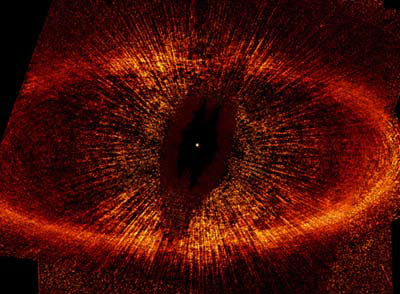
Lost civilization Eye of Sauron. . . .found Hubble peers into the Great Eye of Sauron
Astronomers at the University of California, Berkeley, and NASA's Goddard Space Flight Center have released a rather remarkable Hubble image of a ring of dust around star Fomalhaut, described by New Scientist as resembling "the Great Eye of Sauron".


Just as long as it doesn't blink. . . .

Thursday, February 28, 2008

Will Huntington Beach homes sit on ancient burial ground?
Archaeologists have unearthed 174 ancient American Indian remains, half of them found over the past 18 months on a site at Bolsa Chica Mesa slated to become a residential community, according to California Native American Heritage Commission officials.

The discovery of hundreds of mysterious cogged stones and now human bone fragments that are up to 8,500 years old confirms decades-long rumors that the Brightwater Hearthside Homes site is an ancient burial ground of international importance, said Dave Singleton, a program analyst with the Native American Heritage Commission.


I dunno, kind of a weird article and issue. Apparently half of the fragments were found over a period of 30 years and the others during the last 18 months. They talk about an "association" of the fragments with certain features, but don't really specify what that association is. Or what the features are. Then it gets kinda goofy with an activist linking this stuff with. . . .Chile. Hard to say what the significance of the fragments are; depending on what fragments they represent and how fragmented they are it might or might not be a "burial ground".

So, who knows. Seems like an interesting area; one hopes the monitors are not letting too much stuff be destroyed without proper mitigation.
Mummy alert

Mummified nuns found
The mummified remains of two nuns, the head of one lying on the shoulder of the other, have been found in the walls of a Sao Paulo convent in Brazil, media reported on Wednesday.

The bodies were discovered in one of six burial niches bricked over in the 234-year-old Mosteiro da Luz, that continues to be the home of the reclusive Order of the Conceptionist Sisters as well as a museum of sacred art.

An official at the University of Sao Paulo's archeology department, Sergio Monteiro da Silva, said it appeared the nuns had been put in the niche sometime between 1774 and 1822, when the room they were in was used as a cemetery.
ANCIENT TOMBS ADD TO ROAD TOLL
Archaeologists have unearthed an ancient burial ground at the site of a major new road.

Evidence of two Bronze Age tombs dating back some 4,000 years were found during work on the Earl Shilton bypass.

They were spotted after an archaeological survey of the site uncovered what would have been mounds of earth, or barrows, on the route between Thurlaston Lane and Mill Lane outside the town.
China blasts U.S. role in illegal relics trade
China has labeled the United States the world's largest importer of smuggled Chinese relics, and demanded the country do more to combat the trade, state media reported on Wednesday.

China has repeatedly called on museums in Western countries to return artifacts taken by European and American archaeologists and adventurers, often crudely hacked out of caves and tombs.

Shan Jixiang, director of the State Administration of Cultural Heritage, called on the United States to sign a memorandum of understanding with China to speed up cooperation in preventing relics' theft and illegal trade.
Landfill could disguise graves: archaeologist
The archaeologist at the centre of the dispute over the findings of land surveys on the site of the Boggo Road Busway says there were "anomalies" between the introduced clays from "fill" and the "underlaying basal clays".

In a statement from his report into the results of the survey, the archaeologist, Dr Jon Prangnell from the University of Queensland, says "no graves or human remains were found".

However, he suggested to students at the university in February that landfill cover prevented graves from being detected during ground penetrating radar surveys.
Illness update

I'm watching A Mighty Wind. Gawd, what a riot. Rent it if you get the chance. Fred Willard is brilliant, as usual.
This is cool: Order your own telescope images:
Now you can go online to access high-quality scopes at dark-sky sites worldwide and order them to take photos for you — cheaply or for free, and at decent resolution.


I tried it at the third listed site just now! I ordered an image of galaxy M101. Will update when it comes in.

Wednesday, February 27, 2008

Blogging update

Light posting for the next day or so. I finally caught The Cold that's been making the rounds. I count myself lucky that at least it's not the flu. I think it's been in Seattle but no one I know has gotten it yet. Not an awful cold, but not a light one either. It's kind of been building for a week now; I could feel my sinuses getting a little freaky last week and had something of a headache a lot. Hit Monday evening. I could tell something was going on because Monday morning I woke up and was all hot and sweaty and then I went and had an awesome workout. I've learned that when I have a really good workout (this is at 6:15 am) it usually means I've caught something.

Anyway, lots of stress lately so that might have brought it on, or maybe kept it at bay. You see, I am changing jobs in the near future and it's been an incredibly stressful decision. I spent 15 years at one place but then had to leave in 2005. I was a "temp" for all 15 years, which was mostly okay because I was working myself through grad school and the flexibility (you know, to pop off to Egypt for 2-3 months at a time) was ideal. But then I got my degree and. . . .didn't know what to do. I stayed on but eventually I was sitting on grant money at only 50% and the rules then were that one could not combine more than one temp position into one full time one. I tried to find a way to stay but couldn't. I spent one year at a bank creating predictive models, but that bored me silly.

Then I ended up at an internationally recognized non-profit managing data for a large study in India and China. That was great fun, BUT the grant ran out last December. I managed to secure funding for 2008 but doing a lot of stuff that doesn't really interest me and that I'm not all that skilled in either, such as cost models. I applied for another 2-year grant-funded position at my old shop and after haggling over the salary for a while had to make a decision whether to stay or go.

Toughest.Decision.Of.My.Life. Stay, where I have to constantly sell myself to get on other people's projects and do mostly everything I'm not that good at, or go, and do something really interesting but has a 2-year life span? Yeesh. I finally decided that if I want to do anything research-related, grant money is almost a prerequisite. So whichever place I ended up at, securing funding was just part of the landscape. I decided to go back to my old place for a few reasons; I know people there so easier to network; a regular permanent position is possible where it isn't at the place I'm at. And more opportunity to work with, um, dead people.

I don't know how I did it 20 years ago, just casually flipping from job to job, nary a care in the world. Somehow I always manage to stay (mostly) employed. Now deciding between two roughly equal job durn near kills me. I should just stay in grad school my whole life. . . .

Will try to post some tomorrow.

Addendum: I downloaded Vivaldi's Gloria along with Bach's Magnificat on the same CD. Truly excellent. Vivaldi was my first real love in classical music and still mostly is although I have ventured more into sacred polyphony the last few years. Vivaldi still just makes me happy. If you don't like the choral stuff, try l'estro Armonico. Anything done by the Academy of St. Martin in the Fields will be a good performance. I haven't tried it, but this site seems to have a bunch available for download.
Feeling blue? Not like a Maya sacrificial victim
"The interest in Maya blue stems from the fact that it is a very durable pigment -- more durable than most natural dyes and pigments. It also stems from the fact it wasn't immediately obvious how it was made and what the key ingredients were."

The pigment resists age, acid, weathering, biodegradation and modern chemical solvents. Previous research had identified two ingredients as extract from the leaves of the indigo plant and an unusual white clay mineral called palygorskite.

These researchers did microscopic analysis on material found in a three-footed pottery bowl in the museum's collection dating from A.D. 1400 that had been used as an incense burner.


I'd thought someone figured out Maya blue a while ago, but I guess not. The blue goo at the bottom of the cenote is way cool. Feinman was one of my perfessers at the U of Wisconsin.

Tuesday, February 26, 2008

City honors Washington's slave - and 'power of archaeology'
Oney Judge died 160 years ago yesterday, 52 years after she cast off her bonds, 52 years after fleeing Philadelphia to escape the man and woman who owned her and who wanted to give her away as a wedding bauble - George and Martha Washington.

Oney Judge was about 75 when she died in New Hampshire on Feb. 25, 1848. Her husband was dead. Her three children were dead. But she died a free woman - if still legally a fugitive - one who had defied the first president of the United States.

Mayor Nutter recognized her tenacity by issuing an official city tribute in honor of the anniversary, and Councilwoman Blondell Reynolds Brown, with Council President Anna C. Verna, issued a similar citation in the name of City Council.
Storms Dig Up Historic Secrets Along Oregon Coast
he storms that have lashed Oregon's scenic coast this winter have dredged up an unusual array of once-buried secrets: old shipwrecks, historic cannons, ghost forests — even strangely shaped iron deposits.

One of the first ships to emerge from the sands was recently identified as the George L. Olson, which ran aground at Coos Bay's North Jetty on June 23, 1944.

The shipwreck has become a tourist attraction on the southern Oregon coast. Interest became so great that authorities had to reroute traffic around the ship and post signs warning visitors to leave it alone because it is now an archaeological site.

The curiosities began showing up after December when Pacific storms pummeled the state, damaging thousands of homes and causing an estimated $60 million in damage to roads, bridges and public buildings.
Archaeological treasures found in Roscrea Roscrea notes
A 'beautiful' Bronze Age axe and a number of ancient burial grounds have been unearthed near Roscrea during the construction of the new Dublin-Limerick motorway in the area.

The bronze axe was found in Camblin, south of Roscrea. Archaeologists say the find dates to the later Bronze Age and appears to have been hidden in a shallow pit and never recovered by the person who concealed it.

On a second site in Camblin a medieval iron 'bearded' axe was discovered while two Bronze Age enclosed settlements with two ancient houses were found near the N62 Templemore Road.
False Doors for the Dead Among New Egypt Tomb Finds
Three false doors that served as portals for communicating with the dead are among ancient burial remains recently unearthed in a vast Egyptian necropolis, an archaeological team announced.

The discoveries date back to Egypt's turbulent First Intermediate Period, which ran roughly between 2160 and 2055 B.C.

The period is traditionally thought to have been a chaotic era of bloodshed and power struggles, but little is known based on archaeological evidence.

In addition to the false doors, the Spanish team found two funerary offering tables and a new tomb in the former ancient capital of Herakleopolis—today referred to by its Arabic name Ihnasya el-Medina—about 60 miles (96 kilometers) south of Cairo.

Monday, February 25, 2008

The Lost Treasure of Machu Picchu
SURE, it seemed like a great idea when, last September, President Alan GarcĂ­a of Peru reached a preliminary agreement with Yale about the disposition of more than 350 artifacts taken from Machu Picchu. Everyone hoped the settlement might be a break for cultural understanding in the cloudy skies of international cooperation. News reports suggested that Yale would return more than 350 museum-quality artifacts, plus several thousand fragments thought to be of interest mainly to researchers — all of which were taken from the mountaintop Inca archaeological complex nearly a century ago — and that legal title to all the artifacts, even those to be left at Yale for research, would be held by Peru.

But having finally obtained a copy of the agreement, I can see that Yale continues to deny Peru the right to its cultural patrimony, something Peru has demanded since 1920.


It's an opinion piece, so take it for what it's worth.

UPDATE: Some replies from Yale here. Actually, not much in the way of replies, just a few statements. They are apparently working on a formal reply.
Cleopatra's Cosmetics And Hammurabi's Heineken: Name Brands Far Predating Modern Capitalism
From at least Bass Ale's red triangle--advertised as "the first registered trademark"--commodity brands have exerted a powerful hold over modern Western society. Marketers and critics alike have assumed that branding began in the West with the Industrial Revolution. But a pioneering new study in the February 2008 issue of Current Anthropology finds that attachment to brands far predates modern capitalism, and indeed modern Western society.

In "Prehistories of Commodity Branding," author David Wengrow challenges the widespread assumption that branding did not become an important force in social and economic life until the Industrial Revolution. Wengrow presents compelling evidence that labels on ancient containers, which have long been assumed to be simple identifiers, as well as practices surrounding the production and distribution of commodities, actually functioned as branding strategies. Furthermore, these strategies have deep cultural origins and cognitive foundations, beginning in the civilizations of Egypt and Iraq thousands of years ago.
Antarctic may hold the future of archaeology
It is a truism that archaeology begins yesterday, and now with only the archaeology of the future to plan for, the discipline has been expanding into areas of the globe where material culture has hitherto played little part.

Antarctica is one of these new areas: more than two centuries of human occupation have left plentiful traces. At least five successive and partly overlapping phases of activity can be defined: sealing, whaling, polar exploration, scientific investigation and tourism.

Sealing began in the late 18th century, when Captain James Cook’s account of his voyages in the Southern Ocean, published in 1777, included his discovery of South Georgia with its enormous population of fur seals. Sealers from England and the eastern United States swarmed to raid the seal rookeries.


Kind of a neat article exploring the various periods that human presence in the Antarctic went through.
Neolithic artefacts discovered in church
PLANNED repairs to the central heating of a church have uncovered remains suggesting it may have been used as a place of worship in prehistoric times.

Archaeologists now believe the medieval church of St Michaels and All Angels, in Houghton-le-Spring, Wearside, is on the site of earlier places of worship, possibly dating from the Neolithic period.

Old burial grounds have been unearthed during work by the Archaeology Practice, but it has also revealed foundations of previous churches on the site.
Royals weren't only builders of Maya temples, archaeologist finds
An intrepid archaeologist is well on her way to dislodging the prevailing assumptions of scholars about the people who built and used Maya temples.

From the grueling work of analyzing the “attributes,” the nitty-gritty physical details of six temples in Yalbac, a Maya center in the jungle of central Belize – and a popular target for antiquities looters – primary investigator Lisa Lucero is building her own theories about the politics of temple construction that began nearly two millennia ago.

Her findings from the fill, the mortar and other remnants of jungle-wrapped structures lead her to believe that kings weren’t the only people building or sponsoring Late Classic period temples (from about 550 to 850), the stepped pyramids that rose like beacons out of the southern lowlands as early as 300 B.C.


Doesn't go into much detail on what the evidence is that leads to these conclusions.