Sunday, August 12, 2007

What I bought this weekend


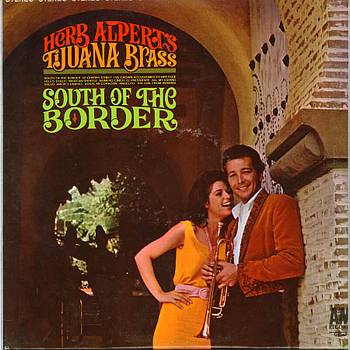
Note the similarity in dress between the two jacket covers. I picked them both up for $2 at an estate sale this weekend. Both seemingly in good shape.

Yes, that's Herb Alpert and the Tijuana Brass. Not the most famous album cover by him ever. That's this one:


The woman on the cover lives in Washington state, but I've never met her. (Heh) My parents had that album, though it had disappeared and/or gotten tame by the time I discovered that girls were all cool and stuff. Besides, Elton John had NAKED chicks on his covers. I really liked the music though. I was a trumpet player and Herb is still my favorite. He might not be as technically good as others (Al Hirt, Doc Severinson) but he had a good ear for a melody and, like Santana on guitar, really knew how to work a note for all it was worth. Plus it has that south of the border wild 1960s thang going on. I don't have Whipped Cream, but I snagged it off of iTunes. Probably should have bought the LP there, too.

Sadly, my turntable is only picking up probably 20% on the right channel, so I can't give them a good listen. Grrrrr. But I urge either one's purchase.

BTW, search on the web for the album cover and the model. There's a web site or newspaper article somewhere with outtakes of the photo shoot.
New evidence: modern civilization began in Iran
Archaeologists worldwide are having hissy fits (!!!) because numerous sites in modern-day Iran and the surrounding region are giving up evidence that a vast network of societies constituted the first cities, redefining the origins of modern civilization.

Residents of the cities traded goods across hundreds of miles and forged parallel but strikingly independent cultures. The social structures, wealth and technologies of this society slowly spread along the Nile and then the Indus rivers in the 3rd millennium B.C.

Archaeologists have thought modern civilization began in Mesopotamia, where the large Tigris and Euphrates rivers bounded a fertile valley that nurtured an increasingly complex society.


This article sure is getting wide play.
Alexandria Archaeologists Discover Ancient Artifact
Archaeologists working at Freedmen's Cemetery in Alexandria have unearthed a stone tool believed to be about 13,000 years old.

The artifact was discovered during a dig last week, officials said.

Although the tip of the spear point is broken, archaeologists from Alexandria and Fairfax have identified it as a reworked Clovis point. Clovis points are recognized by their distinctive shape and serve as one of the diagnostic markers for an era known to archaeologists as the Paleoindian period that lasted from as early as 18,000 to about 12,000 years ago.


Hmmm. Don't know where they got the 18k form.

There's video, too.
Archaeologists + Beer. Again. Archaeologists Recreate Ancient Irish Beer
Billy Quinn and Declan Moore, two archaeologists with Moore Archaeological & Environmental Services (Moore Group) in Galway, believe that an extensive brewing tradition existed in Ireland as far back as 2500 BC. In an article to be published in Archaeology Ireland next month, they detail their experiments and research into the enigmatic site that is the fulacht fiadh. These monuments (of which there are approx. 4500), which present in the landscape as small, horseshoe shaped grass covered mounds, have been conventionally thought of by archaeologists as ancient cooking spots. However, Quinn and Moore believe that they may have also been used as breweries.


On the one hand, beer was probably ubiquitous so this isn't very far fetched. OTOH, the admit it's all circumstantial and vaguely Kon Tiki-esque. Need something actually linking the sites to beer-brewing specifically.

There's a link to the beer project, too.
State spurns funding for Beckett Point archaeology; Kessler 'surprised'
The state Department of Ecology denied Jefferson County a $250,000 grant to help fund an archaeological study and other work related to a Beckett Point septic system project where Native American remains were found in late May.

The three county commissioners had agreed to fund up to $250,000 of the archaeological study and costs related to the delay in construction on the $2.8 million Jefferson County Public Utility District community septic system.

The grant would have reimbursed that amount.

"It's disappointing, and frankly, I'm surprised," said Rep. Lynn Kessler, the state House majority leader from Hoquiam.


Apparently, the grants in question only apply to pilot projects with applications elsewhere, which Ecology didn't think this was.
Archaeologists uncover body at Carlow site
A body was uncovered in Carlow this week but it appears it will spark an archaeological investigation rather than a criminal one.

The remains of the body, believed to date back several hundreds of years, were discovered during the course of an archaeological dig in the county earlier this week.
Alexander's Gulf outpost uncovered
Beneath the sun-baked sands of Failaka, archaeologists hope to unearth the secrets of an earlier conquest - a settlement established by Alexander's general, Nearchus, in the 4th Century BC.

The excavations will focus on the ruins of an ancient citadel and cemetery, the general secretary of the Greek culture ministry, Christos Zahopoulos, told the BBC News website.

Earlier work by French archaeologists has uncovered the remnants of a temple to Artemis, the Greek goddess of hunting, as well as several Greek coins and idols.
Hot Women of Archaeology CHRISTENSEN CONSIDERS CAREER AS ARCHAEOLOGIST
Supermodel HELENA CHRISTENSEN was bound for a career in archaeology before becoming one of the world's top catwalk stars. While Christensen enjoys her modelling career, the brunette beauty has confessed fossils, not fashion, were her first love. She says, "It (modelling) was damn great, all the way. Had I not become one, I might have been an archaeologist. I was always interested in the past and intrigued by ancient history in school and had planned to study archaeology."


Have your people contact my people, Helena, and we'll set up a meeting.

Saturday, August 11, 2007

Blogging update

Light blogging AGAIN. Lots of stuff to do that hath been put off. Like getting an older computer back operating decently again. Note: I hate hate HATE applications that demand insertion of the installation disk before they will uninstall themselves.

On another note, if you like geology, catch Discovery's Faces of Earth. Gorgeous photography all around, lots of good information, and the best animations of geological processes around.

Friday, August 10, 2007

Cool (semi-)non-archaeological web site update I just perused a bit of the USC Digital Archive site. Via Patterico, who highlighted the Examiner collection. I searched on 'archaeology' but only found one photo (a Viking ship), but there are others of some archaeological interest. I searched for 'La Brea' as well, and there are a few of the tar pits -- one of a guy covered in tar who had gone in to rescue a dog (successfully!). Also a neat stratigraphic section from 1938 for the geology around the pits.
Breaking news Stone Age Settlement Found Under English Channel
Erosion on the floor of the English Channel is revealing the remains of a busy Stone Age settlement, from a time when Europe and Britain were still linked by land, a team of archaeologists says.

The site, just off the Isle of Wight, dates back 8,000 years, not long before melting glaciers filled in the Channel and likely drove the settlement's last occupants north to higher ground.

"This is the only site of its kind in the United Kingdom," said Garry Momber, director of the Hampshire and Wight Trust for Maritime Archaeology, which led the recent excavations. "It is important because this is the period when modern people were blossoming, just coming out of the end of the Ice Age, living more like we do today in the valleys and lowlands."


Kind of amazing they found it, though some industrious lobsters apparently had a hand claw in it. We need to train them some more and toss them off the west coast of the US so we can find all those boat-people sites we keep hearing about.

Thursday, August 09, 2007

"I love goooooooold!"

Ancient Ruler's Tomb, Gold Trove Found in Bolivia Pyramid
A 1,300-year-old skeleton buried with a cache of gold artifacts has been found in a Bolivian pyramid, archaeologists say.

The remains are believed to belong to an elite member of the ancient Tiwanaku culture, which thrived on the shores of Lake Titicaca from about A.D. 400 to 1200 (see Bolivia map).

Scientists found the bones and offerings this spring in the upper reaches of the Akapana pyramid, a heavily looted temple experts say is one of the largest pre-Hispanic structures in South America.

The condition of the artifacts and the skeleton's location inside the pyramid lead researchers to believe the individual held high status.

"We believe the individual was a priest or a government figure in the Tiwanaku civilization," Danilo Villamor Encinas, an official with Department of Archaeology of Bolivia, said.


That place (Tiwanaku) could be a gold mine (figurative) for archaeology. The engineer who did most of the surveying data collection in the Valley of the Kings (John "Ruther-Hotep" Rutherford) was thinking seriously about going there to start mapping the place.
Queen Nefertiti: More than a pretty face
Maybe wrinkles are not so bad, after all, some German scientists have discovered.

In ancient times, such laugh lines and wrinkles around the mouth improved the face of Nefertiti, the Egyptian queen acclaimed as the world's most beautiful woman.

X-ray pictures of the bust by a computer tomography machine at the nearby Charite Hospital in Berlin revealed that the sculpture is a piece of limestone with details added using four outer layers of plaster of Paris.
Study blames Europe for bison mass killings
North Americans have always taken the heat for killing off millions of American bison during the early 1800s. A new study, however, pins the blame on Europeans.

Europe's advanced tanning expertise drove the large, iconic mammal to near extinction in the United States, according to a a review of international trade records, diaries and other historical documents conducted by University of Calgary environmental economist M. Scott Taylor.

"The story of the buffalo slaughter is surprisingly not, at bottom, an American one," Taylor said.


No doubt it was those rapacious Dutch.
Neanderthal DNA will help to unlock the secrets of humanity
NEANDERTHAL Man has begun to give up his genetic secrets almost 30,000 years after he last walked the Earth, providing critical insights into the genes that make human beings what they are today.

DNA extracted from a Neanderthal bone has been analysed in detail for the first time and the genetic code of humanity’s closest cousin will be mapped completely within two years, scientists announced yesterday.

The development will allow scientists to compare the human genome with that of our nearest living and extinct relatives — the chimpanzee and the Neanderthal — to tease out the differences between the three. These variations will in turn reveal the genes that make us human.
Ancient human fossils show women much smaller
Homo erectus, long viewed as a crucial evolutionary link between modern humans and their tree-dwelling ancestors, may have been more ape-like than previously thought, scientists unveiling new-found fossils said on Thursday.

Revealing an ancient skull and a jawbone from two early branches of the human family tree -- Homo erectus and Homo habilis -- a team of Kenyan scientists said they were surprised to find that early female hominids were much smaller than males.

The skull was the first discovery of a female Homo erectus.


Which isn't really the big news here:
Both fossils were found in 2000 east of Lake Turkana. But the Homo erectus skull, dating back 1.55 million years, was slightly older than the Homo habilis jawbone, which was found to be 1.44 million years old, the scientists said.


Not sure you can decide sexual dimorphism when your N=1, but it's at least one data point.
And now. . . .the news from the EEF

Press report: "Mummy's Log: Visited Scan God in Land of the Dead"
http://www.nytimes.com/2007/08/06/arts/06mumm.html
About the CT scan of "Demetrios, a 2,000-year-old Egyptian mummy
belonging to the Brooklyn Museum. (..) Dr. Boxt immediately dismissed
one hypothesis. These were not the bones of an 89-year-old man, as
some had inferred from the number inscribed, along with Demetrios'
name, on the ancient red shroud encasing his body. He was certainly
far younger when he died: in his 50s at most, the radiologist said. (..)
The museum curators and conservators were especially curious to know
whether an ibis, a bird sacred to the Egyptians, would be spotted inside
the mummy's cavity. The J. Paul Getty Museum in Los Angeles recently
found the remains of such a bird wrapped inside its own red-shroud
mummy - one of only 10 in the world - and curators were looking for
similarities. (...) No ibis was found inside Demetrios. (..) The CT scan
showed that Demetrios rested on an embalming board [wrapped into
the mummy]. Dr. Boxt also spotted a tiny mass in the mummy's abdominal
captivity measuring about 1.2 inches across. Curators and conservators
suggested that it was a scarab. (..) Also unusual was the absence of
a heart. "
Note the link to a fascinating slide show on the left of page:
http://snipurl.com/1pdy0
[http://www.nytimes.com/slideshow/2007/08/03/arts/20070
806_MUMMY_SLIDESHOW_index.html]

Press report: "Minister of Culture: 8 mummies of birds received from
weaving company for display"
http://snipurl.com/1pdy2
[http://www.sis.gov.eg/En/EgyptOnline/Culture/000001/020300000
0000000000806.htm]
"Culture ministry received eight mummies of birds from the Al-Mahallah
Spinning and Weaving Company to be displayed at the Egyptian Museum
(..) three of ibises (..) and five mummies of falcons."

Press report: "The tale of the mummy"
http://snipurl.com/1pdy4
[http://www.kcchronicle.com/articles/2007/08/06/news/
local/doc46b6e7d6b5b05309289299.txt]
"The Fabyan Villa Museum [Geneva, Illinois ] mummy is a fake that
contains one bone – from a dog. (...) The fake mummy originally
was owned by George Fabyan, a wealthy Chicago businessman
who used the villa as a summer retreat. (..) The museum now uses
the fake mummy as a tie-in to lessons about Egyptian history and
its practices of mummification. "
[For some more info on Fabyan and his collection, see:
http://snipurl.com/1pdy6
[http://www.remodeling.hw.net/industry-news.asp?sectionID=
153&articleID=509617]
"Turned out this is an ersatz mummy, crafted of common steel
nails, a wood frame, straw and cloth. There is a real bone
showing in part of the leg of the adult, but it is believed to
be a dog bone."]

Another press report about the Saite burial in Abusir:
http://snipurl.com/1pdy9
[http://www.sis.gov.eg/En/EgyptOnline/Culture/000001/
0203000000000000000805.htm]
One new bit: "The Czech excavation team has also discovered
pots, seals and mummification tools."
-- Another English report:
http://english.people.com.cn/90001/90777/6230743.html

Digitized book from the Internet Archive
-- F. Ll. Griffith, Karanòg. The Meroitic Inscriptions of Shablûl and
Karanòg, Philadelphia, 1911. - VIII, 181 pp., 30 pls. - pdf-file (78 MB)
http://www.archive.org/details/karangmeroitic00grifuoft
"In this volume will be found not only the edition of the inscriptions
announced on the title-page, but also an Introduction in which proofs
are given for the readings and decipherment of Meroitic writing so
far as they have proceeded to the present time, together with some
evidence of the age of the inscriptions and the nature of the Meroitic
language."

Egyptologist Dr Kara Cooney has put some of her articles online.
Apart from links to several PalArch articles, these are:
-- "An Informal Workshop: Textual Evidence for Private Funerary
Art Production in the Ramesside Period," in: Living and Writing in
Deir el Medine, Andreas Dorn and Tobias Hoffmann, eds. (Basel 2005).
-- A Review of Private Life in New Kingdom Egypt by Lynn Meskell,
American Journal of Archaeology 107 (2003).
-- "The Edifice of Taharqa: Ritual Function and the Role of the King,"
Journal of the American Research Center in Egypt 37 (2000).
http://www.karacooney.com/articles.php

Review of the "The Lost Queen" TV show, about the
presumed mummy of Hatshepsut:
http://www.egypttoday.com/article.aspx?ArticleID=7611

Interview with Susan James about the "Nefertiti and The Lost
Dynasty" TV show, about the presumed mummy of Nefertiti:
http://snipurl.com/1pdyh
[http://www.lacanadaonline.com/articles/2007/08/02/
entertainment/lap-susanjames0802.txt]

End of EEF news
Blogging update

I have now added a PayPal donation button!


Smart people should donate to ArchaeoBlog.

Attractive people should donate to ArchaeoBlog.

So should ugly and dumb people. None of the latter read this blog though.

Seeing as this is in its experimental stages, I suggest all readers should conduct extensive empirical testing of said button. A valuable strategy would be for each and every user to donate multiple times, during different times of the day and days of the week in different amounts. Must get an adequate sampling, donchaknow.

I can just see that new Jag now. . . . . .
Not archaeology, but cool Ancient forest discovered in Hungary
Archaeologists have found an eight-million-year old forest of cypresses, well preserved and not fossilised, in Bukkabrany in north-eastern Hungary.

"The discovery is exceptional as the trees kept their wooden structure, they neither turned into coal nor were petrified," Tamas Pusztai, the deputy director and head of the archaeological department at the local Otto Herman museum who oversaw the excavation, told AFP.

Archaeologists announced the find last week after uncovering the mysterious forest of taxodiums, a kind of swamp cypress, after a few days of digging.


No pictures, unfortunately. Apparently, they disintegrate very quickly, too.

Update: Mostly the same article here but they have a video of something else embedded in the page.
Sixth-century mosaic floor discovered near Palmahim
A floor mosaic dating back to the sixth century, depicting trees and fruit baskets, was uncovered this week at the Yavneh-Yam archaeological site near Kibbutz Palmahim. The floor, discovered during excavations by Tel Aviv University's Institute of Archaeology, decorated the dining room of a Byzantine villa, containing unbroken pottery.

The Yavneh-Yam site, 15 kilometers south of Jaffa, served as a seaport from the middle of the second millennium B.C.E. until the ancient Islamic period. The numerous artifacts uncovered at the site point to extensive cultural and trade ties with Egypt, Lebanon, Cyprus and the Greek Isles.