As a child, Klaus Schmidt used to grub around in caves in his native Germany in the hope of finding prehistoric paintings. Thirty years later, as a member of the German Archaeological Institute, he found something infinitely more important: a temple complex almost twice as old as anything comparable.
"This place is a supernova," said Mr. Schmidt, standing under a lone tree on a windswept hilltop 35 miles north of the Syrian border.
Wednesday, April 23, 2008
Turkish site a Neolithic 'supernova'
Terracotta army has egg on its face
Very neat. I wonder if that counts as tempera. It'll be neat if someone ever does some reconstructions of what the statues would have looked like painted.
China's terracotta army, a collection of 7000 soldier and horse figures in the mausoleum of the country's first emperor, was covered with beaten egg when it was made, scientists say.
According to German and Italian chemists who have analysed samples from several figurines, the egg was as a binder for colourful paints, which went over a layer of lacquer.
"Egg paint is normally very stable, and not soluble in water ... This makes it less sensitive to humidity and moisture," says German co-author Catharina Blaensdorf, a scientist at the Technical University of Munich.
Very neat. I wonder if that counts as tempera. It'll be neat if someone ever does some reconstructions of what the statues would have looked like painted.
Lost civilization turf wall. . .found Ancient finds unearthed
THE Romans certainly knew how to build well.
Archaeologists have discovered the remains of the original turf wall built on the edge of the River Medway in about 70AD.
Their discoveries, found in the winter but kept secret until now, were made while they were exploring the flint-and-brick wall that eventually replaced it.
Owning up to history
At the same time that Ohio State University is preparing to send the remains of American Indians back to West Virginia, the school is returning tissue and blood samples from Yanomamo tribes, at the request of the Brazilian government.
In northeastern Ohio, the Cleveland Museum of Natural History has received a letter from Odawa Indians requesting the return of two wooden ceremonial bowls. The Cleveland Museum of Art is talking with Italian authorities who want several antiquities returned.
Similar requests for human remains, artifacts and art are on the rise nationwide, museum officials say.
Monday, April 21, 2008
Album recommendation Okay, in my irregular series of music reviews, I hereby once again put my reputation on the line by recommending a slightly. . . .well, okay, weird, album. This time it's Neil Diamond's Hot August Night:
Even if you don't particularly care for his music generally, this is worthwhile. He gives an excellent performance and it's also a darn good recording. It's actually the only Diamond album I've ever bought. Most every performer is better live than in-studio and Diamond proves the point well. I got the remastered version from iTunes and I saw on Amazon a remastered one with extra tracks. Definitely worth the money.
Double-live albums weren't yet an industry staple when Neil Diamond unleashed this ignore-me-at-your-peril statement of serious artistic intent in 1972. Hot August Night effects a meld of Vegas-era Elvis and Diamond's pretensions to singer-songwriter greatness. High drama carries the day, whether on rearranged versions of his early hits ("Solitary Man," "Cherry Cherry") or epic showstoppers such as the "Soolaimon"-"Brother Love" medley. The roots of Diamond's supersized live productions of the '90s are right here.
Even if you don't particularly care for his music generally, this is worthwhile. He gives an excellent performance and it's also a darn good recording. It's actually the only Diamond album I've ever bought. Most every performer is better live than in-studio and Diamond proves the point well. I got the remastered version from iTunes and I saw on Amazon a remastered one with extra tracks. Definitely worth the money.
Indiana Jones: Saving History or Stealing It?
No, it was "fortune and glory".
"They come in thinking that they are going to talk about pyramids and gold and serious cool stuff," says Creamer. "Instead, people want to talk about tree-ring dating and radiocarbon dating and the atmosphere, so some are really turned off by it. Others are intrigued by puzzling out an answer and the problem-solving aspect of it, and some of them stick around."
No, it was "fortune and glory".
Archaeologists in city centre dig
Archaeologists have started digging up a site in the centre of Birmingham to try and find out more about the city's industrial heritage.
The dig is taking place at the home of the new city centre library, between Baskerville House and the Birmingham Repertory Theatre in Centenary Square.
Experts said they hoped to uncover the remains of an old canal, a mill and a brass works.
NAGPRA update Back to the earth?
Sounds like the archaeologists would have a good case to block any repatriation as the remains have already been judged to be culturally unaffiliated, hence NAGPRA doesn't even come into play.
They lived, died and were buried along the banks of the Kanawha River. But the American Indians' skeletons wouldn't stay under the soil forever.
In 1963, West Virginia's first state archaeologist began a two-year excavation in Buffalo, less than a mile from the present-day Toyota plant. Crews unearthed countless artifacts and the outlines of homes and a stockade - remnants of a village where people had lived 400 to 500 years before.
Sounds like the archaeologists would have a good case to block any repatriation as the remains have already been judged to be culturally unaffiliated, hence NAGPRA doesn't even come into play.
Archaeologists find stunning crystal skull under Stonehenge

"Just like this only purple and hewn from precious amethyst"
Salisbury Plain - (Paleolithic Mess): Archaeologists excavating Stonehenge have stumbled on what has been described as a stunning human life-sized amethyst crystal skull believed to date from circa 5,000 BC.
"This is part of the fabled Atlantis treasure trove spoils," Prof V Smart of the Royal Archaeological Society said today, "potentially worth hundreds of millions of dollars.
"Just like this only purple and hewn from precious amethyst"
Archaeology and Identity
It's an essay.
It is now well accepted that archaeology and education are inextricably linked and that the past is often represented as mirrored by the dominant groups in a given society. The late Brazilian educator Paulo Freire in an interview, in 1988, with McLaren magazine warned that educators "need to use their students' cultural universe as a point of departure, enabling students to recognize themselves as possessing a specific and important cultural identity." Both education and archaeology deal thus with the manipulation of present and past to forge identities useful for people in power and archaeologists and educators have been active promoters of critical approaches.
It's an essay.
Army of Davids update Site stewards help preserve Kodiak Island archaeology
Volunteers in the program are often setnetters, pilots, guides and others who have access to the more remote areas of the archipelago. In 2007, volunteers helped study 72 archaeological sites. Since 1998, stewards have helped evaluate and describe 332 sites in six regions of the archipelago, nearly a quarter of all known sites, Saltonstall said. Through stewards, 224 new sites have been identified.
Time Team archaeologists dig deep to find ancient village
THE site of a North-East medieval village is to be the subject of a television programme.
The Channel 4 archaeology documentary Time Team spent three days excavating in Ulnaby, on the outskirts of Darlington.
The series, which is presented by Tony Robinson, who played Baldrick in the comedy series Blackadder, was trying to establish when the village was founded.
A saint in our midst. . . Archaeologists dig Annie's on-site gourmet cooking!
God bless her and all decent cooks who feed us our daily comestibles while in the field. If there's one thing project PIs need to pay some attention to, it's feeding the troops. Even lack of showers and flushies are secondary miseries compared to crappy food. Ya just can't dig or survey properly when your stomach is growling and you're NOT looking forward to the next meal. The two best cooks I ever had in the field were by former restaurateurs who cooked for excavations after retiring from the business. One was the famous San Juan Island field school -- thank you, Patty -- and another was the 1996 ARE field school at Memphis. The latter had a local Egyptian who did the cooking. Excellent stuff.
When all her children left home, Annie Evans of Myocum was sitting in bed one night contemplating her future, when husband Ian dropped a sheet of paper in her lap.
It was from the University of Glasgow and they were looking for a cook for an archaeological excavation in Cyprus.
"I didn't even know where Cyprus was," Annie said. I just knew that it was somewhere in the Mediterranean."
God bless her and all decent cooks who feed us our daily comestibles while in the field. If there's one thing project PIs need to pay some attention to, it's feeding the troops. Even lack of showers and flushies are secondary miseries compared to crappy food. Ya just can't dig or survey properly when your stomach is growling and you're NOT looking forward to the next meal. The two best cooks I ever had in the field were by former restaurateurs who cooked for excavations after retiring from the business. One was the famous San Juan Island field school -- thank you, Patty -- and another was the 1996 ARE field school at Memphis. The latter had a local Egyptian who did the cooking. Excellent stuff.
Harappan sites to be excavated after 50 years
After a gap of 50 years, a team of archaeologists will be excavating two sites near Noida and Meerut to determine when exactly the "eastern limit" of the Indus Valley civilisation flourished.
Alamgirpur village in Meerut-Baghpat and Bulandkhera village in Gautam Buddh Nagar districts "are believed to be the eastern most limits of the Harrappan culture" and the last time the area was surveyed was in 1957-58.
State archaeologist digs up history
How often do you get to dig up bones from a grave?
Dr. Nicholas Bellantoni gets to whenever he is needed. He has been the Conn. State Archaeologist for over 20 years.
Bellantoni came to Sacred Heart University on Monday, Apr. 14 to discuss his experience with digging up the grave of Hawaiian, Henry Opukaha'ia.
"This is just another piece of Connecticut and U.S. history that was lost and then rediscovered," said Dr. Charlotte Gradie, history professor.
What I did this weekend Sunday, I went to the Roman Art from the Louvre exhibit at the Seattle Art Museum. Well worth the money and the trip, so if you get the chance, I say go. I thought it was quite well presented. THey didn't have too much stuff that you could not hope to see it all, but enough that it was worthwhile. My only complaint is that it didn't contain enough everyday stuff; it was largely devoted to statuary and the Imperial lifestyle. That's really just a personal complaint since that wasn't really the point of it: it's art in an art museum.
I liked the selection of pieces and the layout. They grouped the items into sections that represented major themes, such as the imperial dyanasties, normal (but of course upper class) citizens, "everyday life", religion, military, etc. The first section you walk into, the imperial history, gives you a bit of a timeline so you can put the rest of it in some context. Much of it concentrated on full statues and busts which is what most people think of when they think of Roman art anyway. The cards next to the pieces were decent enough, usually giving the subject, when and where it was found, the material, and a short description of what it represented. I was surprised to find that many of the full statues were actually pieces of different sculptures that were combined later. There was even one that consisted of two statues that were separate works and later combined in the 17th century. I wish they had added a couple of illustrations showing what they had originally looked like, since in a few items pigment was still visible and the descriptions noted that.
I have to say, one of the busts of a female non-royal was rather captivating. I first noticed it because it seemed so realistic, as if it were representing a real person. The description said it was an idealized portrait, but she seemed quite distinct. Unfortunately, photographs weren't allowed so I couldn't snap one to post. I think she was in the hairstyles gallery. Quick, someone go to the exhibit and write down the piece!
I liked the selection of pieces and the layout. They grouped the items into sections that represented major themes, such as the imperial dyanasties, normal (but of course upper class) citizens, "everyday life", religion, military, etc. The first section you walk into, the imperial history, gives you a bit of a timeline so you can put the rest of it in some context. Much of it concentrated on full statues and busts which is what most people think of when they think of Roman art anyway. The cards next to the pieces were decent enough, usually giving the subject, when and where it was found, the material, and a short description of what it represented. I was surprised to find that many of the full statues were actually pieces of different sculptures that were combined later. There was even one that consisted of two statues that were separate works and later combined in the 17th century. I wish they had added a couple of illustrations showing what they had originally looked like, since in a few items pigment was still visible and the descriptions noted that.
I have to say, one of the busts of a female non-royal was rather captivating. I first noticed it because it seemed so realistic, as if it were representing a real person. The description said it was an idealized portrait, but she seemed quite distinct. Unfortunately, photographs weren't allowed so I couldn't snap one to post. I think she was in the hairstyles gallery. Quick, someone go to the exhibit and write down the piece!
Saturday, April 19, 2008
A new specialty? 'Earthquake Archaeology' Blends Two Histories
I was about to scoff at yet another subdiscipline, but it makes sense.
Do tomorrow's archaeologists a big favor: Always carry some change in your pocket. That way if you happen to be buried alive by an earthquake, any future researchers who unearth your bones from the quake debris can easily approximate the year of the quake.
That's one way that earthquakes in parts of the ancient Roman Empire have been dated.
But usually it's not so easy, say researchers who are pioneering the new field of archaeoseismology. Their aim is to clean up the seismological record by calling on geologists, engineers and seismologists to help archaeologists make better sense of ancient disasters.
"A better term is earthquake archaeology," said Manual Sintubin, a professor of geodynamics at Katholieke Universiteit Leuven in Belgium.
I was about to scoff at yet another subdiscipline, but it makes sense.
The Antiquities Trade, Museums, Legislation,and Borders: Central America as a Case Study
Long article on looting in the region and possible solutions.
Key paragraph: While some have argued that the trade in antiquities would be eradicated if regional poverty declined (Matsuda 1998), I have argued that the trade is endemic, able to flourish precisely because the collecting community values aesthetics over context (Luke and Brodie 2006; Luke 2006; Luke and Kersel 2005; Luke and Henderson 2006). In fact, an analysis of the sale of Maya materials at Sotheby's from 1970 to 1999 (Gilgan 2001) confirms that archaeological context (the horizontal and vertical position of an artifact) has never been a consideration for the trade: objects are bought and sold regardless of whether their archaeological context is known. Contrary to growing talk of the value of context by the trade, there does not appear to be a higher market value for objects from the Maya region.
I'd not really read anything much about collectors valuing context, though I've posted a few times about cooperation between US "relic hunters" and archaeologists, with the former doing more to record the locations of their finds. It strikes me as sensible that context doesn't matter nearly as much, if at all, to people who buy and sell this stuff.
UPDATE: And speaking of which, here's something on looting going on where the Iceman was found:
While archaeologists value context as an essential framework for site interpretation, art historians often pay scant attention to it. Since many museums have had policies of acquiring antiquities without much concern for context, this has effectively encouraged the antiquities trade, which runs directly counter to the interests of both archaeologists and the host countries of archaeological sites. One of the most acute examples of this is the illegal trade in Maya stelae (see below).
The looting of archaeological sites throughout the Maya region is consequently of grave concern. It is through regional education and more broad reaching legislative efforts that we can combat this illicit activity. Central America makes a good case study for a critical analysis of looting and the respective legislative efforts precisely because the culture most often touted – the Maya – is not confined to one modern nation state. . .
Long article on looting in the region and possible solutions.
Key paragraph: While some have argued that the trade in antiquities would be eradicated if regional poverty declined (Matsuda 1998), I have argued that the trade is endemic, able to flourish precisely because the collecting community values aesthetics over context (Luke and Brodie 2006; Luke 2006; Luke and Kersel 2005; Luke and Henderson 2006). In fact, an analysis of the sale of Maya materials at Sotheby's from 1970 to 1999 (Gilgan 2001) confirms that archaeological context (the horizontal and vertical position of an artifact) has never been a consideration for the trade: objects are bought and sold regardless of whether their archaeological context is known. Contrary to growing talk of the value of context by the trade, there does not appear to be a higher market value for objects from the Maya region.
I'd not really read anything much about collectors valuing context, though I've posted a few times about cooperation between US "relic hunters" and archaeologists, with the former doing more to record the locations of their finds. It strikes me as sensible that context doesn't matter nearly as much, if at all, to people who buy and sell this stuff.
UPDATE: And speaking of which, here's something on looting going on where the Iceman was found:
He said that mountain climbers and hikers would be asked to report any finds to the task force rather than removing them.
Related Links
“An object removed from its context loses 90 per cent of its historical importance,” he told La Repubblica, the Italian newspaper.
Some drowned, some buried
I liked Aswan. It's got a bit of the touristy atmosphere -- and enough western amenities because of it to make it comfortable -- but not too much, so you can just sorta of hang out and go see stuff without being constantly harassed to buy things. The Fayum is rather like that, too. Lots of nice local restaurants, too. Had a lovely dinner right on the water one evening.
It is surely in the quiet and relaxing city of Aswan that the Nile is at its most beautiful. The river flows through an amber desert, past granite rocks and round emerald islands smothered in palm groves and tropical plants. This peaceful scene, however, was disturbed last week by archaeologists shouting and yelling at one another from their moored yacht while they carried out the delicate task of hoisting a decorative object from the bed of the river where it had lain for more than 2,500 years.
I liked Aswan. It's got a bit of the touristy atmosphere -- and enough western amenities because of it to make it comfortable -- but not too much, so you can just sorta of hang out and go see stuff without being constantly harassed to buy things. The Fayum is rather like that, too. Lots of nice local restaurants, too. Had a lovely dinner right on the water one evening.
Medieval castle unearthed in Maenclochog
Note also the comment suggesting it's a more modern building.
A team of professional and voluntary archaeologists have uncovered what seem to be the remains of a medieval castle in a north Pembrokeshire car park.
The dig, organised by PLANED, Cambria Archaeology and the National Park, and funded by the EU Transnational project, is taking place at the castle site in Maenclochog, beneath the village's car park.
So far excavators have uncovered what look to be the outer walls of a medieval castle, as well as post holes, the hearth of a medieval house and fragments of medieval pottery.
Note also the comment suggesting it's a more modern building.
Homo hobbitus update Flores 'hobbit' walked more like a clown than Frodo
Didn't the "real" Hobbits have big feet? This seems a better argument for a non-diseased critter than much of the skull work done. But then, we'll probably get someone showing how pygmies have big feet, too.
Tolkien's hobbits walked an awful long way, but the real "hobbit", Homo floresiensis, would not have got far.
Its flat, clown-like feet probably limited its speed to what we would consider a stroll, and kept its travels short, says Bill Jungers, an anthropologist at the State University of New York in Stony Brook.
"It's never going to win the 100-yard dash, and it's never going to win the marathon," he says.
Didn't the "real" Hobbits have big feet? This seems a better argument for a non-diseased critter than much of the skull work done. But then, we'll probably get someone showing how pygmies have big feet, too.
http://www.nytimes.com/2008/04/18/arts/18arts-001.html?_r=6&ref=arts&oref=slogin&oref=slogin&oref=slogin&oref=slogin&oref=login&oref=login
Not much else there, but there will probably be more on it later.
The Italian Culture Ministry announced on Thursday the discovery of a late-second-century Roman sarcophagus on the outskirts of Rome. The find, by the national Revenue Guard Corps, took place while the corps’s Archaeological Heritage Safeguard Unit was safeguarding a protected area from thieves. The sarcophagus, probably once the property of an aristocratic family, was excavated in the area of the Isola Sacra Necropolis, a large Roman Imperial-era pagan cemetery in the town of Fiumicino, site of Rome’s main airport and a few miles from the famous ancient ruins of Ostia.
Not much else there, but there will probably be more on it later.
Thursday, April 17, 2008
Digging Arizona’s Past
Elden Pueblo, located on the eastern slope of Mount Elden in Flagstaff is one of very few sites in Arizona where the general public can work alongside professional archaeologists to actually excavate and analyze artifacts of an ancient pueblo civilization. The Elden Pueblo Archaeological Project is a cooperative effort between the Coconino National Forest, Northern Arizona University, Arizona Natural History Association and Arizona Archaeological Society, bringing to life story and culture of the Sinagua People who lived in the Flagstaff area between 700–1300.
Wednesday, April 16, 2008
What I'm reading
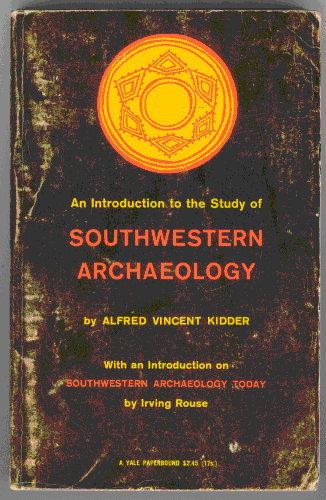
Picked it up at a library-benefit book sale last weekend. It's a classic work, but I've never read it all. This one is the second printing of the revised 1962 edition with an introduction by Irving Rouse. Some info on it here, or at least some info on the general body of work by Kidder from that time. I'm still on the Introduction at the moment, but it's interesting how nonchalant Rouse is when discussing possible pre-Clovis sites. This was only a few years after C14 dating had been invented so there are a lot dates well before 12.5k BP, but Rouse was careful to note that many had dubious associations. (Kidder bio here too)
Kidder was influential with this work, and his work at Pecos in general for a number of reasons. It wasn't the first stratigraphic excavation, nor was it the first time anyone had attempted to order ceramics by (absolute) frequency. But Kidder was the first to note the relative frequencies of ceramic types through time (via stratigraphy) as well. his interest in doing so probably resulted because he had trained under George Reisner the Egyptologist who had also trained under Petrie who had used a form of seriation in Egypt.
This has always been a connection that has fascinated me, but I've never been able to pin down exactly what influence Petrie's Sequence Dating scheme had on Americanist archaeology. I'm pretty sure that American archaeologists were aware of what Petrie was doing, but none of them seem to acknowledge any sort of direct borrowing of Petrie's methods, nor does the early work on seriation seem to have directly borrowed from it either. Lyman, O'Brien and Dunnell (1997) have this to say (refs edited out):
This is the impression I've had; that Petrie's methods were not really the same as that developed here though many were using similar techniques.
At any rate, I'll probably post more as I get into it.
Refs:
Kidder, A. V.
1924 An Introduction to Southwestern Archaeology. 2nd ed. Yale University Press, New Haven and London.
Lyman, R. L., M. J. O'Brien and R. C. Dunnell
1997 The rise and fall of culture history. Plenum Press, New York.
Picked it up at a library-benefit book sale last weekend. It's a classic work, but I've never read it all. This one is the second printing of the revised 1962 edition with an introduction by Irving Rouse. Some info on it here, or at least some info on the general body of work by Kidder from that time. I'm still on the Introduction at the moment, but it's interesting how nonchalant Rouse is when discussing possible pre-Clovis sites. This was only a few years after C14 dating had been invented so there are a lot dates well before 12.5k BP, but Rouse was careful to note that many had dubious associations. (Kidder bio here too)
Kidder was influential with this work, and his work at Pecos in general for a number of reasons. It wasn't the first stratigraphic excavation, nor was it the first time anyone had attempted to order ceramics by (absolute) frequency. But Kidder was the first to note the relative frequencies of ceramic types through time (via stratigraphy) as well. his interest in doing so probably resulted because he had trained under George Reisner the Egyptologist who had also trained under Petrie who had used a form of seriation in Egypt.
This has always been a connection that has fascinated me, but I've never been able to pin down exactly what influence Petrie's Sequence Dating scheme had on Americanist archaeology. I'm pretty sure that American archaeologists were aware of what Petrie was doing, but none of them seem to acknowledge any sort of direct borrowing of Petrie's methods, nor does the early work on seriation seem to have directly borrowed from it either. Lyman, O'Brien and Dunnell (1997) have this to say (refs edited out):
Kidder performed what Rowe later characterized as "ordering by continuity of features and variation in themes." This is precisely what John Evans had done in England sixty-five years earlier, and it differed markedly from Kroeber's and Spier's seriation technique, a patently American invention. Kidder probably learned the technique he used from Reisner who. . .had worked in Egypt. This was where Rowe's "ordering by continuity of features and variation in themes" was used by Petrie."
This is the impression I've had; that Petrie's methods were not really the same as that developed here though many were using similar techniques.
At any rate, I'll probably post more as I get into it.
Refs:
Kidder, A. V.
1924 An Introduction to Southwestern Archaeology. 2nd ed. Yale University Press, New Haven and London.
Lyman, R. L., M. J. O'Brien and R. C. Dunnell
1997 The rise and fall of culture history. Plenum Press, New York.
Tuesday, April 15, 2008
Earliest Mixtec Cremations Found; Show Elite Ate Dog
An ancient burial site in Mexico contains evidence that Mixtec Indians conducted funerary rituals involving cremation as far back as 3,000 years ago.
The find represents the earliest known hints that Mixtecs used this burial practice, which was later reserved for Mixtec kings and Aztec emperors, according to researchers who excavated the site.
Evidence from the site also suggests that a class of elite leaders emerged among the Mixtecs as early as 1100 B.C.
Pytheas visited the Isle of Man in 300BC - claim
I really don't know what to make of that.
AN Ancient Greek explorer's extraordinary voyage took him to the Isle of Man 300 years before the birth of Christ, new research claims.
Scientist and geographer Pytheas (pronounced Puth-e-as) is now believed to have visited the Island in about 325BC to take sun measurements during a three-year voyage – the first recorded circumnavigation of the British Isles.
I really don't know what to make of that.
European history in cod bones
Neat study. There's also another item on that page.
The catastrophic decline of North Sea cod as the result of over fishing has had an impact on all our menus, from the poshest restaurants to the corner chippie: the fish left are few and small, compared with those of less than a century ago. Cod more than a metre in length are rare these days, whereas archaeological remains show that fish several times that size were common.
A new study shows that cod were exploited in the Middle Ages from many, often distant, fishing grounds, with an international trade in dried stockfish. Some fish eaten in a Yorkshire village may have been some from off the coast of Sweden, while merchants in what is now northern Germany ate cod from Arctic Norway.
Neat study. There's also another item on that page.
Brad Lepper has an article up on the use of archaeological techniques in disaster areas. No quotes from it because it keeps crashing FireFox so beware.
DOOM, I tell you, DOOOOOOOOM Mayan Apocalypse, 2012
I posted about a History Channel program on this. I'm kind of jazzed about this one since it's all archaeological and stuff. Happily, however, we won't have barely literate computer schmucks telling os the world is going to end because of a Y2k1100 error. . . . .
The driver was taking me from Melbourne airport into the city. As we chatted, it came out that he was deeply worried. He had a wife and child, and a new baby on the way - but what was the use of living, he cried, if the world would end in 2012 as predicted by the Mayan prophecies, when his new baby would be just four years old.
Prophecies about the end of the world (or at the very least, civilisation as we know it) have been around forever. There was a flurry of them around 2000 AD, and another bunch for 5 May 2005, when all the planets were supposed to line up. (By the way, they didn't line up and yep, we're still here.)
I posted about a History Channel program on this. I'm kind of jazzed about this one since it's all archaeological and stuff. Happily, however, we won't have barely literate computer schmucks telling os the world is going to end because of a Y2k1100 error. . . . .
Indiana Jones update Legend of the Crystal Skulls
Interesting. The author thinks all of them are fakes. She also has a bit on the idol from the beginning of the first Indy movie:

I'd never seen a photo of it up close before. Interesting iconography.
Crystal skulls have undergone serious scholarly scrutiny, but they also excite the popular imagination because they seem so mysterious. Theories about their origins abound. Some believe the skulls are the handiwork of the Maya or Aztecs, but they have also become the subject of constant discussion on occult websites. Some insist that they originated on a sunken continent or in a far-away galaxy. And now they are poised to become archaeological superstars thanks to our celluloid colleague Indiana Jones, who will tackle the subject of our research in Indiana Jones and the Kingdom of the Crystal Skull.
. . .
These exotic carvings are usually attributed to pre-Columbian Mesoamerican cultures, but not a single crystal skull in a museum collection comes from a documented excavation, and they have little stylistic or technical relationship with any genuine pre-Columbian depictions of skulls, which are an important motif in Mesoamerican iconography.
They are intensely loved today by a large coterie of aging hippies and New Age devotees, but what is the truth behind the crystal skulls? Where did they come from, and why were they made?
Interesting. The author thinks all of them are fakes. She also has a bit on the idol from the beginning of the first Indy movie:
I'd never seen a photo of it up close before. Interesting iconography.
Neanderthal update Neanderthals speak out after 30,000 years
Eh, I dunno. Sounds like a duck.
Talk about a long silence – no one has heard their voices for 30,000 years. Now the long-extinct Neanderthals are speaking up – or at least a computer synthesiser is doing so on their behalf.
Robert McCarthy, an anthropologist at Florida Atlantic University in Boca Raton has used new reconstructions of Neanderthal vocal tracts to simulate the voice. He says the ancient human's speech lacked the "quantal vowel" sounds that underlie modern speech.
Quantal vowels provide cues that help speakers with different size vocal tracts understand one another, says McCarthy, who was talking at the annual meeting of the American Association of Physical Anthropologists in Columbus, Ohio, on April 11.
Eh, I dunno. Sounds like a duck.
Video update The Archaeology Channel has a new vid up:
It's about this story. I haven't watched it yet, will do so when I get home tonight.
Been going nuts getting taxes in and dealing with hiring a contractor.
In this interview, conducted at Paisley Five Mile Point Caves on June
13, 2007, by Rick Pettigrew of ALI, Dr. Dennis Jenkins describes the
remarkable discovery of human DNA in coprolites dated between 14,000
and 15,000 calibrated years ago. This evidence, reported in the 3
April 2008, issue of the journal Science, strongly supports the
proposition that human migrants to North America arrived at least
1000 years before the widespread Clovis complex appeared. The data
also support the conclusion that the first human population
originated in northeast Asia. Dr. Jenkins, standing in the very spot
where his field school team recovered the evidence, relates why and
how the excavation was carried out, explains the significance of the
find and shares his personal reflections on making a momentous
discovery. Images woven into the interview show the environment
surrounding the caves and the student archaeologists comprising the
field crew.
It's about this story. I haven't watched it yet, will do so when I get home tonight.
Been going nuts getting taxes in and dealing with hiring a contractor.
Monday, April 14, 2008
Aw hell, seeing as I'm not going to post anything serious the rest of the night anyway, enjoy this. Kills me. LOVE IT.
(Via Lina at TPW)
(Via Lina at TPW)
Saturday, April 12, 2008
Plio-Pleistocene butchery I just read a paper in the Journal of Archaeological Science by Braun, Pobiner, and Thompson titled An experimental investigation of cut mark production and stone tool attrition (see full ref below). My first thought was "Gee, another cut experimental mark paper? Didn't they do all of that 30 years ago?". Well, yes and no. A lot of work was done in the 1970s and '80s on identifying cut marks on bone that were a result of hominid activity and differentiating them natural sources. I even participated in a little experiment with Bunn when a young undergrad. We were asked to do various tasks on a carcass with stone tool flakes to see what sort of cut marks were produced. First we removed a leg quickly, as if we had stumbled upon a carnivore kill and wanted to grab a hunk of meat before said carnivore returned (all the while Bunn shouting stuff like "Hurry! The hyenas are at the top of the hill over there!"). Then we were able to take our time -- as if we had killed the critter -- and remove a leg carefully, getting all that we could. The idea was to differentiate scavenging from hunting just from the character of the cut marks.
This study is not looking at cut marks per se but at edge damage resulting from butchery. My second thought was "Nobody has done this before? I did that as a lab project in my second year of grad school." Really, I took a few flakes and measured edge damage after I had used them in different ways on different materials. Pretty interesting, I should try to find that and post the results.
Anyhoo, here is the abstract:
They are differentiating three activities: Skinning (self explanatory), disarticulation (removing limb bones from the axial skeleton and removing bones from one another), and deflishing (removing the meat from the bone). What they showed is that edge attrition -- wearing down of the cutting edge -- was not statistically associated with the number of cut marks observed on the bones. That is, cut marks are not predictive of edge damage and eventual discarding of the tools:
Their conclusion:
Thus, cut marks are not indicative in and of themselves of greater use wear and wastage of stone tools (and hence greater discard rates). They mention other possible sources of discard rate variation, prominently featuring raw material quality and availability. These have been shown to affect the degree to which stone tools were curated and discarded: rare and distant materials were more heavily conserved whereas abundant materials were used somewhat wastefully (I have some discussion and references of that here).
BTW, they used way more techy measures than I did in my little study. I weighed the flakes as they did but instead of calculating area with a fancy digital imaging technique, I drew a line parallel to the edge and measured the distance to the edge in several places. That way I could who the rate at which the edge was being ground down. I don't recall if I measured edge angle. . .but I did note the kind of wear that was being inflicted on it (flaking vs polishing vs crushing).
Ref: David R. Braun, Briana L. Pobiner, Jessica C. Thompson 2008 An experimental investigation of cut mark production and stone tool attrition. Journal of Archaeological Science 35:1216-1223.
This study is not looking at cut marks per se but at edge damage resulting from butchery. My second thought was "Nobody has done this before? I did that as a lab project in my second year of grad school." Really, I took a few flakes and measured edge damage after I had used them in different ways on different materials. Pretty interesting, I should try to find that and post the results.
Anyhoo, here is the abstract:
In discussions of Paleolithic hominin behavior it is often assumed that cut marks are an unwanted byproduct of butchery activities, and that their production causes the dulling of stone tool edges. It is also presumed that Paleolithic butchers would have refrained from making cut marks to extend the use life of their tools. We conducted a series of butchery experiments designed to test the hypothesis that cut marks affect the use life of tools. Results suggest cut marks are not associated with edge attrition of simple flake tools, and therefore it is unlikely that Paleolithic butchers would have avoided contact between bone surfaces and tool edges. Edge attrition is, however, significantly greater during skinning and disarticulation than during defleshing. This suggests that skinning and disarticulation activities would require more tool edges relative to butchery events focused purely on defleshing. Differences between the number of cut-marked bones relative to the number of stone artifacts deposited at taphonomically comparable archaeological localities may be explicable in terms of different types of butchery activities conducted there, rather than strictly the timing of carcass access by hominins. Archaeological localities with higher artifact discard rates relative to raw material availability may represent an emphasis on activities associated with higher edge attrition (e.g. skinning or disarticulation).
They are differentiating three activities: Skinning (self explanatory), disarticulation (removing limb bones from the axial skeleton and removing bones from one another), and deflishing (removing the meat from the bone). What they showed is that edge attrition -- wearing down of the cutting edge -- was not statistically associated with the number of cut marks observed on the bones. That is, cut marks are not predictive of edge damage and eventual discarding of the tools:
Given that two of the three measures of edge attrition show
highly significant differences between certain butchery activities,
we conclude that there are much higher attrition rates in
flakes used for skinning and disarticulation than those used for
defleshing only.
Their conclusion:
The results of our experiments provide no statistical support
for Bunn’s (2001) inference that hominins took measures
to reduce the likelihood of tool-bone contact because of potential
edge dulling caused by cut mark production. Our results also lead to the expectation that tool discard behavior should
not necessarily be associated with high frequencies of cutmarked
bone, and this expectation can be tested at a variety
of archaeological localities. A brief investigation of stone artifact
discard patterns at Early Stone Age sites suggest that
hominins are discarding artifacts at very high rates even at
sites when there is very little evidence of butchery activity
(Table 4). However, we still expect that stone tool discard rates
may be associated with the degree of edge attrition. Given the
differences in tool edge attrition described in this study, the
frequency of different types of tasks may have had a substantial
effect on rates of tool discard at different archaeological localities.
This raises the possibility that stone tool discard was
linked to butchery activities that did not always result in
high numbers of cut marks.
Thus, cut marks are not indicative in and of themselves of greater use wear and wastage of stone tools (and hence greater discard rates). They mention other possible sources of discard rate variation, prominently featuring raw material quality and availability. These have been shown to affect the degree to which stone tools were curated and discarded: rare and distant materials were more heavily conserved whereas abundant materials were used somewhat wastefully (I have some discussion and references of that here).
BTW, they used way more techy measures than I did in my little study. I weighed the flakes as they did but instead of calculating area with a fancy digital imaging technique, I drew a line parallel to the edge and measured the distance to the edge in several places. That way I could who the rate at which the edge was being ground down. I don't recall if I measured edge angle. . .but I did note the kind of wear that was being inflicted on it (flaking vs polishing vs crushing).
Ref: David R. Braun, Briana L. Pobiner, Jessica C. Thompson 2008 An experimental investigation of cut mark production and stone tool attrition. Journal of Archaeological Science 35:1216-1223.
Friday, April 11, 2008
Archaeology in popular culture Actually science in popular culture with some archaeology: Carl Zimmer's Science Tattoo Emporium. It's a blog, so you have to scroll around. A couple are the Uffington horse:

and the Iceman's tattoos:

and the Iceman's tattoos:
Thursday, April 10, 2008
A few items from the EEF
Press report: "Archaeological Discovery in Luxor's
Valley of the Kings"
http://www.ansamed.info/en/egypt/news/ME09.@AM16441.html
"Egypt announced today the discovery of a quartzite
ushabti figure (..) along with the cartouche of King Seti I
(..). They were found inside the corridor of the tomb of
Seti I (KV 17) (...) The discovery was made by the first
ever Egyptian mission working in the Valley of the Kings
(..) A number of clay vessels were also unearthed along
with fragments of the tomb's wall paintings which may
have fallen after its discovery. During the process of
cleaning the tomb, it was also revealed that the length
of the corridor measures 136 meters, and not 100 meters
as the tomb's discoverer, Giovanni Battista Belzoni,
originally mentioned in his report, Hawass said. "
Press report: "Mummy gets CT scan at facility Analysis advances Egypt study"
http://snipurl.com/240x5
[http://www.poughkeepsiejournal.com/apps/pbcs.dll/article?AID=/
20080409/NEWS01/804090325]
"(..) The mummy named Shep-(en)-min, a male priest who might
have died around 300 B.C., went in Tuesday for a CT scan so
the Akhmim Mummy Studies Consortium staff could study its
skeleton, age, birth defects, funeral preparation patterns and
other characteristics. (..) Last year, the consortium did a CT scan
done of Shep-(en)-min's father, Pahat, in Massachusetts. (..)
The hieroglyphs on Shep-(en)-min's coffin indicate the man was
a "wardrobe priest" who dressed and cleaned the cult image of
the fertility god Min, Elias explained. The priest lived in Akhmim.
A CT scan showed the mummy with its arms crossed over its chest.
The crossed arms relate to the priest's age and the hierarchy in his
temple, Elias said. He estimates the priest was 25 to 30 years old
at the time of death. (..) Elias said he noticed the body has brittle
bones. Another preliminary finding also showed the mummy has a
fracture in its right femur that probably happened around the time
of death, he said. (..)"
-- Another press report that adds nothing but corny jokes:
http://snipurl.com/240x9
[http://www.recordonline.com/apps/pbcs.dll/article?AID=/2008
0409/NEWS/804090351/-1/NEWS]
Press report: "Need to build an ancient Egyptian boat? Call this FSU expert"
http://snipurl.com/23xlt
[http://www.tallahassee.com/apps/pbcs.dll/article?AID=/20080405/
NEWS01/804050301]
"A filmmaker is re-creating a treasure-gathering voyage of Egypt's
greatest female pharaoh, and a Florida State archaeology professor
is designing the boat. FSU's Cheryl Ward spent last week in
Egypt as boat-builders laid the keel for a ship she and a documentary
crew will sail 1,000 miles on the Red Sea in December. (..) The
project is the work of French documentary producer Valerie Abita,
whose "Hatshepsut and the Land of Punt" is scheduled for
broadcast next spring. (..)"
Press report: "Snap shots- Temple of Buhen"
http://weekly.ahram.org.eg/2008/891/tr401.htm
"(..) The featured photograph captures one of the salvaged
walls of the Temple of Buhen. (..)"
Press report: "Archaeologists to Survey Nile for Sunken
Treasures"
http://www.ansamed.info/en/egypt/news/ME09.@AM15525.html
"An Egyptian archaeological team will survey the Nile river
between Luxor and Aswan in search for any sunken treasures
within the coming few months (..) This is its second survey
season of Nile River, Hawass added. In its first survey,
limited to the Nile River in Aswan, the team found important
archaeological pieces, including remains of temple columns
and Coptic, Roman and Pharanoic inscriptions. After the
artifacts were recovered from river, they were put in
museum warehouses in Aswan for restoration. "
-- So this confirms the item in EEF NEWS (504), about part of
a Khnum temple being found in the Nile at Assuan. See:
http://snipurl.com/23xm1
[http://www.sis.gov.eg/En/EgyptOnline/Miscellaneous/000002/
0207000000000000001804.htm]
[Whoa. It's unimaginable what kind of stuff is lying in the silt and mud at the bottom of that river. Ed.]
Thomas Young, An Account of Some Recent Discoveries in
Hieroglyphical Literature and Egyptian Antiquities, Incuding the
Author's Original Alphabet, As Extended by Mr. Champollion,
London, 1823 - pdf-file (4 MB)
http://books.google.com/books?id=TkAGAAAAQAAJ
Dr. Mike Jenkins has put up four academic papers dealing
with his research about Elephantine Island:
http://www.maat.com.au/Publications.html
-- "Recent Christian Period Finds on Elephantine Island: An
ostrakon of the lector Aurelios Papnouthis & A preliminary
report of a newly identified church"
http://www.maat.com.au/Christianfinds.html
-- "The Stele of Neferhotep from the Sanctuary of
Pepinakht-Heqaib on Elephantine Island"
http://www.maat.com.au/Neferhotep.html
-- "A Hoard from Elephantine Island"
http://www.maat.com.au/Hoard.html
-- "Notes on the Tomb of Setka at Qubbet el-Hawa, Aswan"
http://www.maat.com.au/Setka.html
Carney, Richard; "The Chariot: A Weapon that Revolutionized
Egyptian Warfare". 9 pp. PDF, 44 kB
http://snipurl.com/240xz
[http://www.historymatters.appstate.edu/documents
/egyptchariots_000.pdf]
* Høyrup, Jens; "Egyptian Mathematics" (Contribution to
The Cambridge History of Science, vol. I)
http://akira.ruc.dk/~jensh/Publications/Egyptian_math.pdf
-- See also his entry: "Mathematik. I. Mesopotamien.
II. Ägypten. III. Mesopotamische und ägyptische Einflüsse
auf die griechische Mathematik", pp. 1010b-1016b in
Der Neue Pauly. Enzyklopädie der Antike, Bd. 7. Stuttgart
& Weimar: Metzler, 1999. [According to the author, it is
"seriously maltreated by the editors"]
http://akira.ruc.dk/~jensh/Publications/Pauly.PDF
* Davidovits, Joseph and Ralph; "Why Djoser's blue Egyptian
faience tiles are not blue. Manufacturing Djoser's faience tiles at
temperatures as low as 250°C" (Paper presented at the
IX. International Congress of Egyptologists, Grenoble, France,
September 6-11, Session 12.2 for publication in the Proceedings).
7 pp. PDF, 218 kB.
http://www.gen17.com/dynamic/Tem/Geopolymer/F.egyptian-faience.pdf
End of EEF news
Press report: "Archaeological Discovery in Luxor's
Valley of the Kings"
http://www.ansamed.info/en/egypt/news/ME09.@AM16441.html
"Egypt announced today the discovery of a quartzite
ushabti figure (..) along with the cartouche of King Seti I
(..). They were found inside the corridor of the tomb of
Seti I (KV 17) (...) The discovery was made by the first
ever Egyptian mission working in the Valley of the Kings
(..) A number of clay vessels were also unearthed along
with fragments of the tomb's wall paintings which may
have fallen after its discovery. During the process of
cleaning the tomb, it was also revealed that the length
of the corridor measures 136 meters, and not 100 meters
as the tomb's discoverer, Giovanni Battista Belzoni,
originally mentioned in his report, Hawass said. "
Press report: "Mummy gets CT scan at facility Analysis advances Egypt study"
http://snipurl.com/240x5
[http://www.poughkeepsiejournal.com/apps/pbcs.dll/article?AID=/
20080409/NEWS01/804090325]
"(..) The mummy named Shep-(en)-min, a male priest who might
have died around 300 B.C., went in Tuesday for a CT scan so
the Akhmim Mummy Studies Consortium staff could study its
skeleton, age, birth defects, funeral preparation patterns and
other characteristics. (..) Last year, the consortium did a CT scan
done of Shep-(en)-min's father, Pahat, in Massachusetts. (..)
The hieroglyphs on Shep-(en)-min's coffin indicate the man was
a "wardrobe priest" who dressed and cleaned the cult image of
the fertility god Min, Elias explained. The priest lived in Akhmim.
A CT scan showed the mummy with its arms crossed over its chest.
The crossed arms relate to the priest's age and the hierarchy in his
temple, Elias said. He estimates the priest was 25 to 30 years old
at the time of death. (..) Elias said he noticed the body has brittle
bones. Another preliminary finding also showed the mummy has a
fracture in its right femur that probably happened around the time
of death, he said. (..)"
-- Another press report that adds nothing but corny jokes:
http://snipurl.com/240x9
[http://www.recordonline.com/apps/pbcs.dll/article?AID=/2008
0409/NEWS/804090351/-1/NEWS]
Press report: "Need to build an ancient Egyptian boat? Call this FSU expert"
http://snipurl.com/23xlt
[http://www.tallahassee.com/apps/pbcs.dll/article?AID=/20080405/
NEWS01/804050301]
"A filmmaker is re-creating a treasure-gathering voyage of Egypt's
greatest female pharaoh, and a Florida State archaeology professor
is designing the boat. FSU's Cheryl Ward spent last week in
Egypt as boat-builders laid the keel for a ship she and a documentary
crew will sail 1,000 miles on the Red Sea in December. (..) The
project is the work of French documentary producer Valerie Abita,
whose "Hatshepsut and the Land of Punt" is scheduled for
broadcast next spring. (..)"
Press report: "Snap shots- Temple of Buhen"
http://weekly.ahram.org.eg/2008/891/tr401.htm
"(..) The featured photograph captures one of the salvaged
walls of the Temple of Buhen. (..)"
Press report: "Archaeologists to Survey Nile for Sunken
Treasures"
http://www.ansamed.info/en/egypt/news/ME09.@AM15525.html
"An Egyptian archaeological team will survey the Nile river
between Luxor and Aswan in search for any sunken treasures
within the coming few months (..) This is its second survey
season of Nile River, Hawass added. In its first survey,
limited to the Nile River in Aswan, the team found important
archaeological pieces, including remains of temple columns
and Coptic, Roman and Pharanoic inscriptions. After the
artifacts were recovered from river, they were put in
museum warehouses in Aswan for restoration. "
-- So this confirms the item in EEF NEWS (504), about part of
a Khnum temple being found in the Nile at Assuan. See:
http://snipurl.com/23xm1
[http://www.sis.gov.eg/En/EgyptOnline/Miscellaneous/000002/
0207000000000000001804.htm]
[Whoa. It's unimaginable what kind of stuff is lying in the silt and mud at the bottom of that river. Ed.]
Thomas Young, An Account of Some Recent Discoveries in
Hieroglyphical Literature and Egyptian Antiquities, Incuding the
Author's Original Alphabet, As Extended by Mr. Champollion,
London, 1823 - pdf-file (4 MB)
http://books.google.com/books?id=TkAGAAAAQAAJ
Dr. Mike Jenkins has put up four academic papers dealing
with his research about Elephantine Island:
http://www.maat.com.au/Publications.html
-- "Recent Christian Period Finds on Elephantine Island: An
ostrakon of the lector Aurelios Papnouthis & A preliminary
report of a newly identified church"
http://www.maat.com.au/Christianfinds.html
-- "The Stele of Neferhotep from the Sanctuary of
Pepinakht-Heqaib on Elephantine Island"
http://www.maat.com.au/Neferhotep.html
-- "A Hoard from Elephantine Island"
http://www.maat.com.au/Hoard.html
-- "Notes on the Tomb of Setka at Qubbet el-Hawa, Aswan"
http://www.maat.com.au/Setka.html
Carney, Richard; "The Chariot: A Weapon that Revolutionized
Egyptian Warfare". 9 pp. PDF, 44 kB
http://snipurl.com/240xz
[http://www.historymatters.appstate.edu/documents
/egyptchariots_000.pdf]
* Høyrup, Jens; "Egyptian Mathematics" (Contribution to
The Cambridge History of Science, vol. I)
http://akira.ruc.dk/~jensh/Publications/Egyptian_math.pdf
-- See also his entry: "Mathematik. I. Mesopotamien.
II. Ägypten. III. Mesopotamische und ägyptische Einflüsse
auf die griechische Mathematik", pp. 1010b-1016b in
Der Neue Pauly. Enzyklopädie der Antike, Bd. 7. Stuttgart
& Weimar: Metzler, 1999. [According to the author, it is
"seriously maltreated by the editors"]
http://akira.ruc.dk/~jensh/Publications/Pauly.PDF
* Davidovits, Joseph and Ralph; "Why Djoser's blue Egyptian
faience tiles are not blue. Manufacturing Djoser's faience tiles at
temperatures as low as 250°C" (Paper presented at the
IX. International Congress of Egyptologists, Grenoble, France,
September 6-11, Session 12.2 for publication in the Proceedings).
7 pp. PDF, 218 kB.
http://www.gen17.com/dynamic/Tem/Geopolymer/F.egyptian-faience.pdf
End of EEF news
What? Good news from the Middle East?
Archaeologists broker Arab-Israeli deal
Archaeologists broker Arab-Israeli deal
Two Los Angeles archaeologists said they have drafted a settlement between Israelis and Palestinians regarding the fate of ancient artifacts.
Ran Boytner with the University of California, Los Angeles, and Lynn Swartz Dodd with the University of Southern California led a team of mediators to arrive at the first-ever agreement on the status of archaeological finds should there be an eventual independent Palestinian state, USC said in a press release Wednesday.
Was she the first European?
UPDATE: Link fixed.
A lower jawbone with a haggle of teeth.
That's all there was.
But its discovery in a limestone cave in northern Spain could be the holy grail long sought by anthropologists.
The fossil is by far the oldest skeletal evidence of a human presence in Europe. Dated at 1.3 million years, the find is not only exceptional in itself, but for the light it will shed on a question that's long been controversial: When did the earliest humans reach Europe?
UPDATE: Link fixed.
67 bodies secretly exhumed from NM grave
That's too bad. Kind of a sad article.
Working in secret, federal archaeologists have dug up the remains of dozens of soldiers and children near a Civil War-era fort after an informant tipped them off about widespread grave-looting.
The exhumations, conducted from August to October, removed 67 skeletons from the parched desert soil around Fort Craig — 39 men, two women and 26 infants and children, according to two federal archaeologists who helped with the dig.
They also found scores of empty graves and determined 20 had been looted.
That's too bad. Kind of a sad article.
'Breakthrough' at Stonehenge dig
There are three excellent videos at the site (well, the top and bottom ones re good; the middle, eh). I first posted about this here and while I remain skeptical of the Lourdes-ishness of the place, they seem to be really finding out a good deal. Also go here for much more. really a quite impressive job they've done.
UPDATE: But this really explains it!
Archaeologists carrying out an excavation at Stonehenge say they have broken through to a layer that may finally explain why the site was built.
The team has reached sockets that once held bluestones - smaller stones, most now missing or uprooted, which formed the site's original structure.
The researchers believe that the bluestones could reveal that Stonehenge was once a place of healing.
There are three excellent videos at the site (well, the top and bottom ones re good; the middle, eh). I first posted about this here and while I remain skeptical of the Lourdes-ishness of the place, they seem to be really finding out a good deal. Also go here for much more. really a quite impressive job they've done.
UPDATE: But this really explains it!
Rochdale's Stonehenge?
ARCHAEOLOGISTS have unearthed a "mini-Stonehenge"... on the moors of Rochdale.
The two nearby sites - an oval made up of collapsed slabs, and a 30-metre circle of rounded stones - are believed to be ancient burial sites dating back as far as 5,000 years.
They were spotted by archaeologist Stuart Mendelsohn during a walk on the hills in December and could now become a major tourist attraction.
Bay could reveal Viking secrets
Fortunately, they have a photo of the ancient Vikings to guide their search:

A bay in the far north of Scotland is to be searched by archaeologists in the hope of uncovering Viking artefacts.
Items have been found at opposite ends of Dunnet Bay in Caithness, but the links area have not been thoroughly investigated before.
Test pits will be dug and soil samples analysed by a new, community-owned archaeological research centre.
Fortunately, they have a photo of the ancient Vikings to guide their search:
Artifact may be ancient ax blade
Pretty good article. I think they mean "wheat pennies" though.
Ryan Bernard of Escanaba has found a lot of interesting things with his metal detector: an 1837 Quebec bank token, an 1861 penny, a 1916 buffalo nickel.
When he found a hunk of metal buried 2 feet beneath his Lakeshore Drive backyard last summer, he almost threw it in the trash.
Upon further examination, it may be an artifact from a prehistoric culture.
"I was about to throw it in the garbage, and I held it up and I saw the honed edge on it," he said.
Pretty good article. I think they mean "wheat pennies" though.
Ancient DNA: reconstruction of the biological history of Aldaieta necropolis
There's a few interesting tidbits in there, of uncertain importance.
A research team from the Department of Genetics, Physical Anthropology & Animal Physiology in the Faculty of Science and Technology at the Leioa campus of the University of the Basque Country (UPV/EHU), and led by Ms Concepción de la Rúa, has reconstructed the history of the evolution of human population and answered questions about history, using DNA extracted from skeleton remains.
Knowing the history of past populations and answering unresolved questions about them is highly interesting, more so when the information is obtained from the extraction of genetic material from historical remains. An example is the necropolis at Aldaieta (Araba) where some of these mysteries about these peoples have been answered – thanks to the study of their DNA.
There's a few interesting tidbits in there, of uncertain importance.
Archaeologist Helps Community By Keeping African Artifacts In Africa
It is common for professional archaeologists and paleoanthropologists working in Africa to populate western museums with foreign artifacts by excavating and permanently removing them from history rich communities in Africa. University of Calgary researcher Julio Mercader, along with University of Boston PhD student Arianna Fogelman are doing their part to stop this dated trend.
Mercader and his team have established the first museum of its kind in Mozambique and the second museum in the country’s province of Niassa, which will officially open in August. This museum—named Museu Local, meaning “local museum” in Portuguese—will help keep some of Africa’s treasures in Africa, and also make Western and African academic research relevant to the local population, two initiatives that should have started long ago, says Mercader, who collaborated with the Universidade Eduardo Mondlane and Universidade Pedagógica, in Mozambique, for this project.
Uncertain future for ancient spa
They're planning on covering the place up with clay. Does that mean infilling it with clay? If so, it might not be 'destroyed' as someone is quoted in the article, just lost. Which is not a bad thing.
Allianoi, an ancient site that was discovered just 10 years ago, will be submerged under the waters of Yortanli irrigation dam, which is much needed for the local farmers.
When construction of the dam began in 1998, the archaeologists, as a routine procedure, were asked to make a survey of the land.
Local people knew about and used a thermal spa centre called Pasa Ilicasi, which had been there since the Ottoman Empire.
They're planning on covering the place up with clay. Does that mean infilling it with clay? If so, it might not be 'destroyed' as someone is quoted in the article, just lost. Which is not a bad thing.
Roman soldier's gift found
HE was many miles from home - a Roman soldier posted to Manchester, perhaps feeling cold and lonely, longing for loved ones left behind.
He was called Aelius Victor. And now after 2,000 years an altar he built to keep a promise to the goddesses he prayed to has been unearthed in the middle of the city.
The altar - described by experts as being in 'fantastic' condition - was discovered during an archaeological dig at a site on Greater Jackson Street earmarked for development.
Poor little thing "Lyuba" gives scientists glimpse of mammoth insides
Russian scientists say they have obtained the most detailed pictures so far of the insides of a prehistoric animal, with the help of a baby mammoth called Lyuba found immaculately preserved in the Russian Arctic.
The mammoth is named after the wife of the hunter who found her last year. The body was shipped back to Russia in February from Japan, where it was studied using computer tomography in a process similar to one doctors use to scan patients.
"We could see for the first time how internal organs are located inside a mammoth. It is pretty important from a scientific point of view," said Alexei Tikhonov, deputy director of the Russian Academy of Science's Zoological Institute, who has been leading the project.
Liquor store archaeology
Okay, not really archaeology, but I found it interesting. (via Ronski at TPW)
My brother, Tyler, and I sometimes play a game we call Liquor Store Archaeology. The aim is to make a pith-helmeted visit to older, neglected liquor stores. Inside, we scour the dark bottom shelves and dank back corners of the place, looking for forgotten bottles of spirits that have been languishing, perhaps for decades.
More often than not, we indeed turn up something rare or just plain strange. Our finds span the world: caraway-flavored kummel from Germany, an Armenian brandy called Ararat, eaux-de-vie with all manner of fruit floating in them, a wasabi-flavored liqueur, even a honey liqueur bottled with a real honeycomb.
Found: Peanut Lolita
Okay, not really archaeology, but I found it interesting. (via Ronski at TPW)
Tuesday, April 08, 2008
Vanished: A Pueblo Mystery
Pretty good article so read the whole thing.
Perched on a lonesome bluff above the dusty San Pedro River, about 30 miles east of Tucson, the ancient stone ruin archaeologists call the Davis Ranch Site doesn’t seem to fit in. Staring back from the opposite bank, the tumbled walls of Reeve Ruin are just as surprising.
Some 700 years ago, as part of a vast migration, a people called the Anasazi, driven by God knows what, wandered from the north to form settlements like these, stamping the land with their own unique style.
“Salado polychrome,” says a visiting archaeologist turning over a shard of broken pottery. Reddish on the outside and patterned black and white on the inside, it stands out from the plainer ware made by the Hohokam, whose territory the wanderers had come to occupy.
Pretty good article so read the whole thing.
ILLINOIS STYLE: Much still to be learned about Cahokia Mounds
It's so much a part of the landscape that metro-east residents often don't even notice it, except when a visiting relative notices: "Look, there's the mound."
Rising from what once was an endless grass sea parted by the Mississippi River, Monks Mound isn't even named after the Native American Indians who built it centuries ago, but the Trappist monks who lived there for only five years in the 19th century.
No one knows what the long-vanished people who built the mounds called themselves, much less what they named their terraced mound. Archaeologists call them the Mississippians, and their lives continue to be a mystery whose clues are buried in the mounds scattered throughout the metro-east and far beyond.
More beer blogging Following onto this post: The day the beer flowed again
So I'm a day late. I didn't know the part about beer being immediately available while other alkyhol had to wait several months. Interesting how they did it:
At 12:01 a.m. on April 7, 1933, sirens, fire alarms and train whistles shrieked. In Chicago, harried bartenders scrambled to serve crowds that stood 12 deep. At Pabst Brewing Co. in Milwaukee, thousands of onlookers cheered as company employees hoisted barrels and crates onto trucks. About 800 people stood in the rain outside the White House, watching as a man hopped out of his vehicle and unloaded two cases of beer. Secret Service agents accepted the goods, a gift for the chief executive from one of the nation's brewers. "President Roosevelt," read a sign on the side of the truck, "the first real beer is yours."
After 13 dry years, legal beer had returned to the United States.
So I'm a day late. I didn't know the part about beer being immediately available while other alkyhol had to wait several months. Interesting how they did it:
The 18th Amendment merely banned "alcoholic" beverages; it did not identify what those were. That was spelled out in the Volstead Act, which defined an "alcoholic" and "intoxicating" drink as one containing more than 0.5% alcohol. Solution: Rewrite Volstead to categorize "nonintoxicating" beverages as ones containing up to 3.2% alcohol -- the same as most pre-Prohibition beer.
Monday, April 07, 2008
Experts bone up on grisly relics
Archaeologists now believe a dozen skeletons discovered in a mass grave in the centre of Oxford may have belonged to executed criminals from Saxon times.
A team of three archaeologists have been digging in the quadrangle of St John's College in Blackhall Road, off St Giles, for nearly two weeks since the discovery was made.
The bones of 12 or 13 bodies have gradually been uncovered after a body part was discovered 80cm below ground level by diggers excavating the plot before a new quadrangle is built.
South Georgia research team plans to dig for ancient artifacts
I supposedly have some Creek blood in me. My ancestry on my dad's side is rather murky, but that's the family legend -- an India Princess! -- and I think some people who do this sort of thing have largely confirmed at least the Indian part.
Before Muskogee (Creek) Indian tribes inhabited Georgia, a more mysterious native culture known only by its archaeological name, the Swift Creek, walked the same land. They left behind elaborate paddle-stamped ceramics, which represent the earliest complicated stamped pottery in the Southeast.
Now, a group of professional archaeologists hopes to find a few remaining traces of the Swift Creek culture in Glynn County. The South Georgia Archaeological Research Team plans to conduct a one-day dig in April or May on St. Simons Island at a site where the Swift Creek are believed to have once lived.
"To be able to do any kind of work in Glynn County any more is exciting to me," said team member Fred Cook, who had requested permission from the county to perform the dig.
I supposedly have some Creek blood in me. My ancestry on my dad's side is rather murky, but that's the family legend -- an India Princess! -- and I think some people who do this sort of thing have largely confirmed at least the Indian part.
Archaeologists get digging to uncover Prestonpans' secrets
A MAJOR new archaeological investigation was announced today to give historians a better understanding of what happened at the Battle of Prestonpans.
The £60,000 Heritage Lottery Fund boost will also be used to train local guides, create markers and help pay for a major conference and arts festival.
The battle saw Bonnie Prince Charlie's army defeat the government forces in less than 15 minutes, giving them confidence for their march towards London six weeks later.
Today the site lies almost unmarked, except for a memorial cairn, and one end is under housing.
In the reign of the Black Pharaohs
Good long article.
Historians have universally agreed that King Alara unified Upper Nubia around 780 BC, declaring Napata (near Jabal Barrkal, Karima, North Sudan) the capital. The job was completed by his successor King Kashata when Lower Nubia joined the crown. Nubia had been united and Kashata claimed for himself the title Pharaoh. But that was not the end of it; following suit was Pharaoh Piye, better known in history as Pharaoh Piankhy, conqueror of Thebes and founder of Egypt's 25th Dynasty, the dynasty of the Black Pharaohs.
Good long article.
Russian-American research team examines origins of whaling culture
From the description of the site it seems pretty darn solid. They have a couple of photos but you can't enlarge them at all, which is too bad because the engravings are worth a closer look.
Recent findings by a Russian-American research team suggest that prehistoric cultures were hunting whales at least 3,000 years ago, 1,000 years earlier than was previously known.
University of Alaska Museum of the North archaeology curator Daniel Odess presented the team's findings at the Society for American Archaeology annual meeting in Vancouver, British Columbia last week.
"The importance of whaling in arctic prehistory is clear. Prehistoric settlements were situated and defended so that people could hunt whales," says Odess. "Yet, as important as whaling is, we know very little about how, where and when it began."
From the description of the site it seems pretty darn solid. They have a couple of photos but you can't enlarge them at all, which is too bad because the engravings are worth a closer look.
Archaeological finds dated to 35,000 years
It's a long article with some decent info on the lithics found.
UPDATE: More here.
ANCIENT Aboriginal tools found on a Pilbara mine site in Western Australia have been dated at 35,000 years — among the oldest so far discovered in Australia.
Archaeologists believe the dig could yield material up to 40,000 years old, comparable with the internationally famous Lake Mungo Man discovery in NSW.
The prehistoric dwelling place is on the multibillion-dollar Hope Downs iron ore mine, site about 160 kilometres from the outback town of Newman and 310 kilometres south of Port Hedland. It is jointly run by international mining giant Rio Tinto and Gina Rinehart's Hancock Prospecting.
It's a long article with some decent info on the lithics found.
UPDATE: More here.
News of vital importance Original Schlitz to be bottled up once more
I have somewhat fond memories of Schlitz. Back in Wisconsin it was pretty popular in the '60s and early '70s; I recall my uncles drinking it (that and Hamm's). By the time I came of age it appears they had already changed the brewing process, so it had taken on 'cheap beer' status.
I hope some of the old midwestern names make something of a comeback, although it may be like putting the toothpaste back in the tube. IIRC, many of the old breweries reformulated in the latter half of the 20th century to be able to compete on price with the large players (A-B and Miller) and watched their market share drop anyway. One would hope that with the advent of microbreweries some of these old timey brands can go back to their original formulations and get some of that marketshare back, or at least get a comfortable enough share to stay around. That could be difficult after getting a rep as cheapie beer. It's possible, I suppose, to change that; used to be that Leinenkugels was 'cheap' but in the last decade or so they've managed to rebrand fairly successfully.
And, er, the archaeological significance of this is. . .well, archaeologists drink a lot of beer and beer is one of the oldest known alcoholic beverages, sooooo. . . . .
Boozing baby boomers, rejoice.
Schlitz beer, once the world's top-selling beer brand, has gone back to its original formula.
Woodridge-based Pabst Brewing Co. relaunches the formula -- packaged in the long-neck bottles it abandoned in the 1990s -- this week in Chicago.
I have somewhat fond memories of Schlitz. Back in Wisconsin it was pretty popular in the '60s and early '70s; I recall my uncles drinking it (that and Hamm's). By the time I came of age it appears they had already changed the brewing process, so it had taken on 'cheap beer' status.
I hope some of the old midwestern names make something of a comeback, although it may be like putting the toothpaste back in the tube. IIRC, many of the old breweries reformulated in the latter half of the 20th century to be able to compete on price with the large players (A-B and Miller) and watched their market share drop anyway. One would hope that with the advent of microbreweries some of these old timey brands can go back to their original formulations and get some of that marketshare back, or at least get a comfortable enough share to stay around. That could be difficult after getting a rep as cheapie beer. It's possible, I suppose, to change that; used to be that Leinenkugels was 'cheap' but in the last decade or so they've managed to rebrand fairly successfully.
And, er, the archaeological significance of this is. . .well, archaeologists drink a lot of beer and beer is one of the oldest known alcoholic beverages, sooooo. . . . .
Sunday, April 06, 2008
On blogging BTW, just so you know, I'm not getting all worked up over you guys like some bloggers:
Like I told my professor shortly after some grad student had killed himself and his academic advisor: "Rob, " I said, "you know, if I ever decide o go off half-cocked and take you out, I just want you to know I'm not going with you. I'll be laying on a beach in South America before the body's even cold."
Two weeks ago in North Lauderdale, Fla., funeral services were held for Russell Shaw, a prolific blogger on technology subjects who died at 60 of a heart attack. In December, another tech blogger, Marc Orchant, died at 50 of a massive coronary. A third, Om Malik, 41, survived a heart attack in December.
Other bloggers complain of weight loss or gain, sleep disorders, exhaustion and other maladies born of the nonstop strain of producing for a news and information cycle that is as always-on as the Internet.
Like I told my professor shortly after some grad student had killed himself and his academic advisor: "Rob, " I said, "you know, if I ever decide o go off half-cocked and take you out, I just want you to know I'm not going with you. I'll be laying on a beach in South America before the body's even cold."
My history of computers II Almost forgot about this post and its continuation. I'd left off with the Vax machines; this would have been in the mid-late '80s. The PC (I include Apple and others in this) had been around a while, but it hadn't made a whole lot of inroads into academia. Probably because most of the computers at universities were set up and run by the comp sci and engineering departments and they tended to like the far more powerful and complicated minis and mainframes. Plus it was probably more cost effective to buy some big central computers and a bunch of dumb terminals, the better to let loose on the student population.
I always liked the Vax line. I thought VMS was a good OS, not as inscrutable as Unix. But it was a pain to have to go somewhere to use a terminal and then to try to format something to actually print out as a term paper or whatever. I finally broke down and bought my first (actually second, see previous post) PC: A Leading Edge PC/XT:

See the full image here.
Only reason I chose this one was that other people in the department had them. I think it cost like $1400. The screen was probably 10" on the diagonal and was phosphor green, but it also came in amber. It mimicked a typical terminal in display and function. The keyboard was one of those IBM-type things where the key made a physical and aural click when depressed -- still my favorite. Mine had a 30MB hard drive (!!!) and I loaded it with a menuing system.
In truth, this was perhaps my most useful computer ever. I did a simply incredible amount of work on it. I had it during my 2-4th year of grad school so I had loads of papers to write, not to mention lecture notes to prepare. I also had a little Star dot matrix printer and an external 300 baud modem. It was DOS-based and Windows hadn't really become common yet, but I didn't mind since I was comfortable with a command-line interface. For software I used mostly WordPerfect 5.1 (still a classic piece of software). I don't recall using much else. . .I think I had FoxPro for data and a bootleg copy of SPSS. Kind of a moot point since I don't think I paid for any software back then. I used SPSS to analyze my MA thesis data. Lord knows how I ever got it done since it was only like 120 cases and it would take 45 minutes to do a simple clustering routine. So I'd start it, go off and do something else and come back and see what the results were.
There was a small Mac contingent in the department at that time as well. I will admit it: I didn't think much of those first Macs. Silly little monitor with its tiny toy keyboard and users who were obviously just too dumb to be able to use a computer without a "desktop" metaphor. While the OS was indeed way ahead of the curve, I still think it was a lame computer for the other reasons.
By that time, people were still kind of fascinated by the whole "computers in archaeology" idea, but it had started to wane. Archaeologists had been through systems theory which was ideal for computer simulations, but it had fallen out of favor. I tend to think people still had a vague idea that "analyzing the data" using a computer would somehow make the results "better" or "more precise" or let them see something that they couldn't ordinarily. But admittedly it also got more stuff published; anything whiz-bang will get you noticed. So you got a lot of papers published with seemingly complex computational models and technical jargon all aimed at demonstrating complicated nonintuitive hypotheses such as "people tend to live near sources of fresh water".
Really, back then just throwing a bunch of technical jargon together could get you published. Me and a grad school buddy used to make fun of the over-technicalization of archaeological jargon by rephrasing our daily tasks into archaeology-speak. Instead of "going for lunch" we would "devise a resource procurement strategy to maximize our caloric return on investment and then venture into our local catchment area to procure appropriate comestibles".
Yeah, we were geeks, too. But then, you already knew that.
Anyway, back to computers (you know, the subject of this post). If you go to this post you will see the Leading Edge in action, so to speak. I composed all of my preparation for my comps on that computer. Hundreds of pages of notes, outlines, and full answers typed out. Then after the exams, which I wrote out in longhand, I took them all back and transcribed them using the same computer. I also wrote my MA thesis on this.
I schlepped the thing around for several years and finally got rid of it in the 1990s. I gave it to a single-mom friend for her kid to play with. I don't know what happened to it after that, but I think it is probably my favorite old computer. I still have an IBM keyboard with the same clicky feel to it and still think that the soft green monochrome screen is far easier on the eyes than most modern CRTs (LCDs finally overtook them in ease of viewing).
Sometimes I think maybe I ought to go back to using WordPerfect 5.1. It really was something of a marvel. They chose to make an uncomplicated screen, more like you were typing on a clean sheet of paper, which I preferred to the more visually noisy Word format. It realy made you concentrate on what you were actually writing, which becomes something of a major theme for the next installment.
I always liked the Vax line. I thought VMS was a good OS, not as inscrutable as Unix. But it was a pain to have to go somewhere to use a terminal and then to try to format something to actually print out as a term paper or whatever. I finally broke down and bought my first (actually second, see previous post) PC: A Leading Edge PC/XT:
See the full image here.
Only reason I chose this one was that other people in the department had them. I think it cost like $1400. The screen was probably 10" on the diagonal and was phosphor green, but it also came in amber. It mimicked a typical terminal in display and function. The keyboard was one of those IBM-type things where the key made a physical and aural click when depressed -- still my favorite. Mine had a 30MB hard drive (!!!) and I loaded it with a menuing system.
In truth, this was perhaps my most useful computer ever. I did a simply incredible amount of work on it. I had it during my 2-4th year of grad school so I had loads of papers to write, not to mention lecture notes to prepare. I also had a little Star dot matrix printer and an external 300 baud modem. It was DOS-based and Windows hadn't really become common yet, but I didn't mind since I was comfortable with a command-line interface. For software I used mostly WordPerfect 5.1 (still a classic piece of software). I don't recall using much else. . .I think I had FoxPro for data and a bootleg copy of SPSS. Kind of a moot point since I don't think I paid for any software back then. I used SPSS to analyze my MA thesis data. Lord knows how I ever got it done since it was only like 120 cases and it would take 45 minutes to do a simple clustering routine. So I'd start it, go off and do something else and come back and see what the results were.
There was a small Mac contingent in the department at that time as well. I will admit it: I didn't think much of those first Macs. Silly little monitor with its tiny toy keyboard and users who were obviously just too dumb to be able to use a computer without a "desktop" metaphor. While the OS was indeed way ahead of the curve, I still think it was a lame computer for the other reasons.
By that time, people were still kind of fascinated by the whole "computers in archaeology" idea, but it had started to wane. Archaeologists had been through systems theory which was ideal for computer simulations, but it had fallen out of favor. I tend to think people still had a vague idea that "analyzing the data" using a computer would somehow make the results "better" or "more precise" or let them see something that they couldn't ordinarily. But admittedly it also got more stuff published; anything whiz-bang will get you noticed. So you got a lot of papers published with seemingly complex computational models and technical jargon all aimed at demonstrating complicated nonintuitive hypotheses such as "people tend to live near sources of fresh water".
Really, back then just throwing a bunch of technical jargon together could get you published. Me and a grad school buddy used to make fun of the over-technicalization of archaeological jargon by rephrasing our daily tasks into archaeology-speak. Instead of "going for lunch" we would "devise a resource procurement strategy to maximize our caloric return on investment and then venture into our local catchment area to procure appropriate comestibles".
Yeah, we were geeks, too. But then, you already knew that.
Anyway, back to computers (you know, the subject of this post). If you go to this post you will see the Leading Edge in action, so to speak. I composed all of my preparation for my comps on that computer. Hundreds of pages of notes, outlines, and full answers typed out. Then after the exams, which I wrote out in longhand, I took them all back and transcribed them using the same computer. I also wrote my MA thesis on this.
I schlepped the thing around for several years and finally got rid of it in the 1990s. I gave it to a single-mom friend for her kid to play with. I don't know what happened to it after that, but I think it is probably my favorite old computer. I still have an IBM keyboard with the same clicky feel to it and still think that the soft green monochrome screen is far easier on the eyes than most modern CRTs (LCDs finally overtook them in ease of viewing).
Sometimes I think maybe I ought to go back to using WordPerfect 5.1. It really was something of a marvel. They chose to make an uncomplicated screen, more like you were typing on a clean sheet of paper, which I preferred to the more visually noisy Word format. It realy made you concentrate on what you were actually writing, which becomes something of a major theme for the next installment.
Saturday, April 05, 2008
Scientists tantalize with 'iceman' findings
Scientists from around the world who have been studying the centuries-old human remains that melted out of a glacier in northwestern British Columbia in 1999 will gather for the first time in Victoria later this month to talk about what they've learned from the unnamed "iceman."
The Kwäday Dän Ts'ìnchi Symposium will be held April 24-27 at the University of Victoria.
It is being held in conjunction with the Northwest Anthropology Conference.
A hilltop look at history
A great archaeological site, like great art, challenges our provincialism and expands our horizons.
Tuzigoot National Monument, outside Clarkdale, does exactly that, sweeping visitors back in time and bringing them face to face with a larger reality.
Its rough-hewn, vaguely castlelike walls stand atop a small ridge near the Verde River, a conspicuous reminder of the ancient society that once thrived in the area.
Treasure! Swedes find Viking-era Arab coins
Ancient Arab coins found in Sweden (pic: Swedish National Heritage Board)
The Arab coins reveal where they were minted and the date
Swedish archaeologists have discovered a rare hoard of Viking-age silver Arab coins near Stockholm's Arlanda airport.
About 470 coins were found on 1 April at an early Iron Age burial site. They date from the 7th to 9th Century, when Viking traders travelled widely.
There has been no similar find in that part of Sweden since the 1880s.
Here's an experimental archaeology article on the concrete pyramid idea. I advocate this experimental sort of work to a limited degree, but there are so many limits on the "could they have done this?" hypothesizing.
And now for something completely different Researchers, Led by Archaeologist, Find Pre-Clovis Human DNA
Excellent study. It's kinda too bad this wasn't done ten years ago or it would have been as widely known as Monte Verde. Interesting -- odd is more like it -- how there are apparently no stone tools present; apparently, pre-Clovis people either didn't use them or could barely knock a couple of rocks together to make an Oldowan flake.
Human DNA from dried excrement recovered from Oregon's Paisley Caves is the oldest found yet in the New World -- dating to 14,300 years ago, some 1,200 years before Clovis culture -- and provides apparent genetic ties to Siberia or Asia, according to an international team of 13 scientists.
. . .
A lengthy analysis, including the collection of DNA samples from 55 UO students, supervisors, and site visitors and 12 Danish DNA researchers, was done to screen for modern DNA contamination. From that analysis, six coprolites containing the ancient DNA were radiocarbon dated using accelerator mass spectrometry and calendar calibrated to between 1,300 and 14,300 years ago.
“Of these, half date from the early arrival time,” Jenkins said. “All six coprolites containing ancient DNA underwent additional testing at two independent labs. Three of the six also contained DNA similar to red fox, coyote or wolf.” The researchers suggest that these early Americans ate the animals or that the animals urinated on the human feces during times of non-human habitation.
Excellent study. It's kinda too bad this wasn't done ten years ago or it would have been as widely known as Monte Verde. Interesting -- odd is more like it -- how there are apparently no stone tools present; apparently, pre-Clovis people either didn't use them or could barely knock a couple of rocks together to make an Oldowan flake.
Nerds only Aztec Math Used Hearts and Arrows
Also at Nat. Geo with this quote:
This is an interesting topic, IMO: Where did this idea that ancient peoples were "all about religion" come from? I've seen side discussions of it in various places, but I don't remember any extended treatises on the source. For whatever reason, the Maya and Egypt are the archetypal Total Religious Societies. In the latter, a somewhat empirical case can be made for it since they had such a tremendous building and epigraphic program devoted to the afterlife, an explicitly religious topic.
My gut feeling is that Egypt more or less set the program for interpreting ancient societies as hyper-religious. So when people started looking at the Maya they immediately saw pyramids and made the connection. OTOH, maybe the Egyptian case was already conditioned by Romanticism that saw the primitive as being bound up in the non-rational.
The Aztecs had more numbers than we do, or at least symbols denoting numerical concepts. When it came to measuring land—critical for levying the proper tax or tribute—these medieval Mesoamericans used arrows, hearts, hands and other units representing fractions, according to a new study in Science.
To figure this out, mathematician Maria del Carmen Jorge y Jorge of the National Autonomous University of Mexico (U.N.A.M) channeled the mind of an Aztec land surveyor. That meant retraining herself to use a different numerical system and combing through the Codex Vergara, one of two remaining books that record Aztec land surveying.
Working with geographer Barbara Williams and del Carmen Jorge y Jorge counted 367 fields in this book with both an overall area for the plot of land as well as the lengths of the sides. Roughly 60 percent of these fields had areas that matched the basic mathematical rule of length multiplied by width or other common surveying calculations.
Also at Nat. Geo with this quote:
"I think [the study] is neat because it shows that this sort of math and science was pretty practical in orientation," said Michael Smith, an archaeologist and Aztec expert at Arizona State University.
"We have the idea that ancient societies were dominated by religion. Yeah, religion was important, but they were also very practical people doing very practical things," Smith said.
This is an interesting topic, IMO: Where did this idea that ancient peoples were "all about religion" come from? I've seen side discussions of it in various places, but I don't remember any extended treatises on the source. For whatever reason, the Maya and Egypt are the archetypal Total Religious Societies. In the latter, a somewhat empirical case can be made for it since they had such a tremendous building and epigraphic program devoted to the afterlife, an explicitly religious topic.
My gut feeling is that Egypt more or less set the program for interpreting ancient societies as hyper-religious. So when people started looking at the Maya they immediately saw pyramids and made the connection. OTOH, maybe the Egyptian case was already conditioned by Romanticism that saw the primitive as being bound up in the non-rational.
Thursday, April 03, 2008
Trip report A few archy/geology and other photos. This was the third trip to Sequim see here, too) so not a lot of new stuff. First off, a bit of history:

Full image here.
And here's a topo map of the spit area:

Full image here.
The town of Sequim is situated a few miles inland from the spit. It's small, only about 5500 people in the town proper and much of the remainder is farmland, pastures, etc. Several years ago someone decided to revitalize the area by turning the place into a lavender mecca, so there are a lot of lavender farms. A lot of cows as well, though I don't know if they were used for meat or dairy or what. The area seems to be growing with a lot of retirees and a lot of farms seem to be turning into housing developments. Still, the downtown core is pretty livable and has quite a few decent little shops and restaurants, plus a bunch of hotels along the main strip.
We stayed out at a place right on the water called the Dungeness Bay Cottages. This is the view out the front:

Full image here.
It's kind of down near the base of the spit, which you can just see as a thin line out in the water. It was cold most of the weekend and snowing over most of the Puget Sound area, though not really sticking. Here's a semi-areal shot of the spit:

Full image here.
As noted in the former post linked above, the bluffs here are all glacial till, steadily eroding backwards. If you look at a map of the area (larger area than the one above), the islands off in the distance are the San Juans and if you straight across is the southern end of Vancouver Island. You can see Victoria from where we were.
Again, in the previous post I mentioned a visit to the local museum that houses some of the stuff from the Manis mastodon site. This time I remembered the camera! So here are a couple of shots of that:

Full image here.
I like the way they placed some of the skeleton on the painting so you can really see the scale of the critter. They have the tusks on-site in a water bath for preservation:
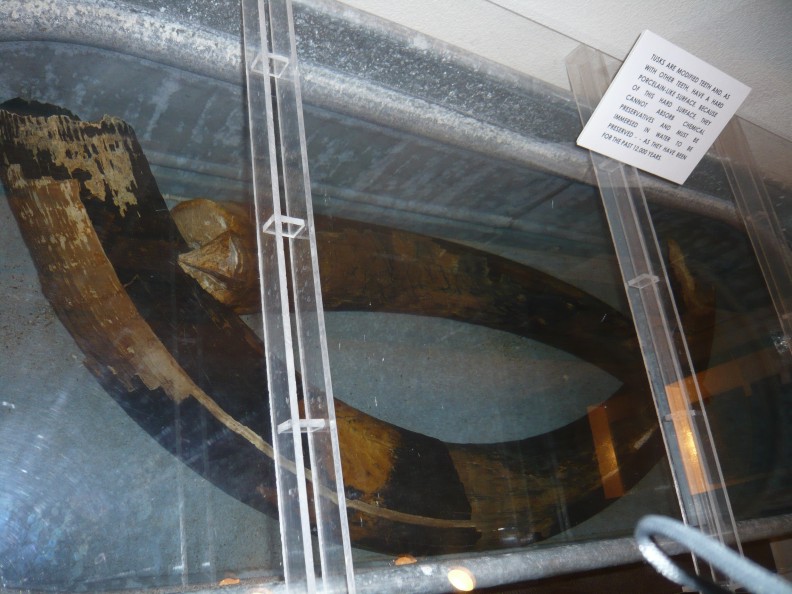
Full image here.
The old post has some links to both the museum (ergh: I now see two of the links are no longer valid; will check on those). Anyway, beach combing is a must:

Full image here.
This is a protected bay so oysters and numerous other molluscan species are abundant. In fact, the beach at low tide is littered with live oysters; no worries about starving. Dungeness crab is also abundant, but not nearshore enough to see any, except perhaps the young'uns which crowd under rocks at low tide. Also abundant are chiton:
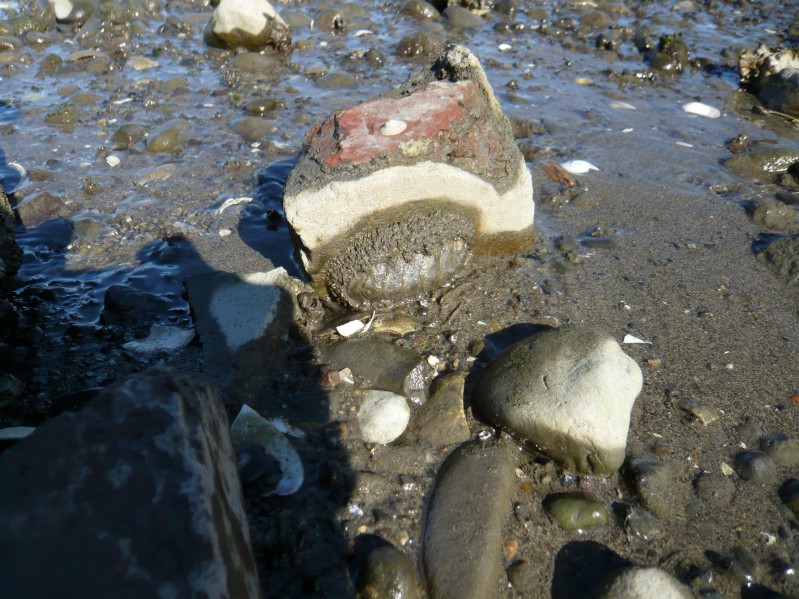
Full image here.
Not sure what these are:
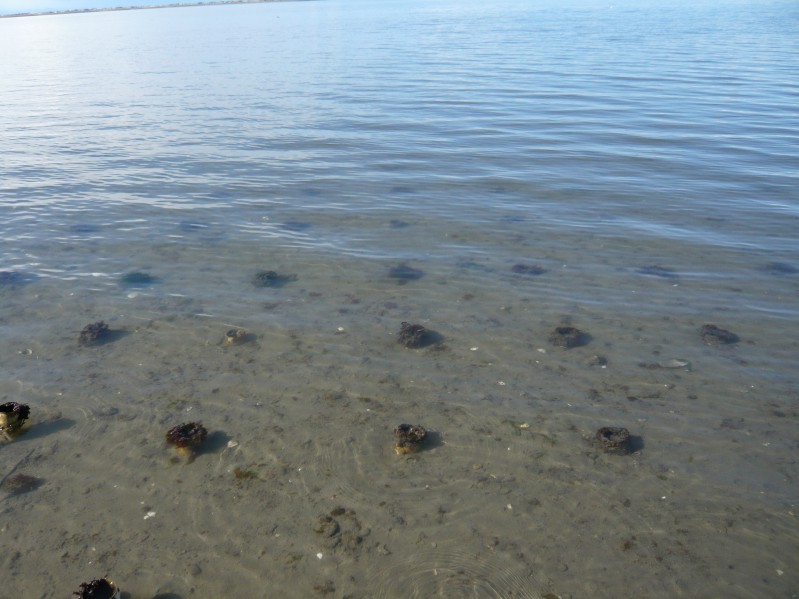
Full image here.
They're not posts, they're hollow pipes, look like PVC. This one has an oyster growing right next to it and another had an anemone growing within it:
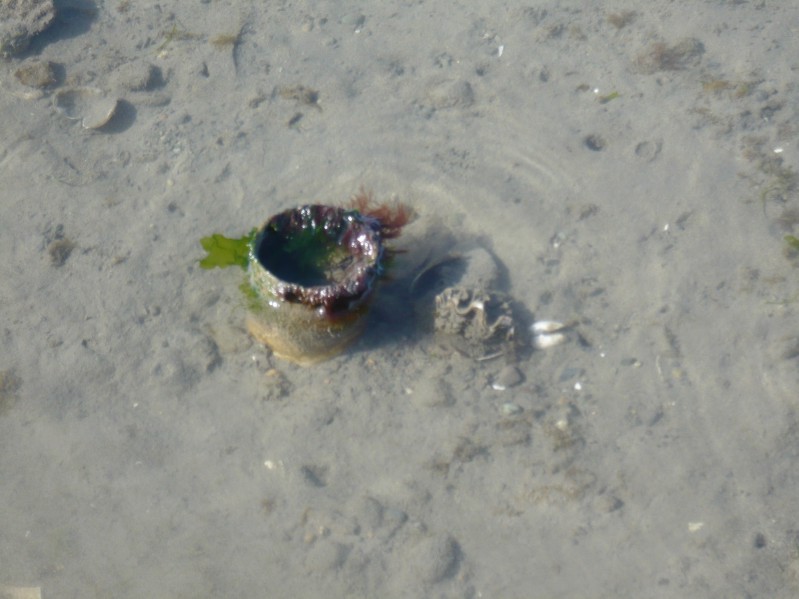
Full image here.
I'm wondering if this wasn't set up specifically to attract wildlife, something like the way artificial reefs are built. Other wildlife are deer, bald eagles, a herd of elk, seals, and, um, this fierce creature:

Full image here.
One more beach shot. This is at the 3 Crabs Restaurant which is my favorite place there. It's not the fanciest food, pretty basic fare, but perfectly done. I've never been disappointed by either the food or the service.
Full image here.
The pilings going out are from the original pier (if you search around for Sequim-related sites, there are probably some historic photos of it). This was a pretty low tide and the seagulls were having a field day; there was a young bald eagle perched on one of the pilings (not in this photo). There's quite a few around the area; one had his own little perch in a tree just down the road from the motel and was sitting there nearly every morning when we drove by.
Full image here.
And the usual sunset photo.
Full image here.
And here's a topo map of the spit area:
Full image here.
The town of Sequim is situated a few miles inland from the spit. It's small, only about 5500 people in the town proper and much of the remainder is farmland, pastures, etc. Several years ago someone decided to revitalize the area by turning the place into a lavender mecca, so there are a lot of lavender farms. A lot of cows as well, though I don't know if they were used for meat or dairy or what. The area seems to be growing with a lot of retirees and a lot of farms seem to be turning into housing developments. Still, the downtown core is pretty livable and has quite a few decent little shops and restaurants, plus a bunch of hotels along the main strip.
We stayed out at a place right on the water called the Dungeness Bay Cottages. This is the view out the front:
Full image here.
It's kind of down near the base of the spit, which you can just see as a thin line out in the water. It was cold most of the weekend and snowing over most of the Puget Sound area, though not really sticking. Here's a semi-areal shot of the spit:
Full image here.
As noted in the former post linked above, the bluffs here are all glacial till, steadily eroding backwards. If you look at a map of the area (larger area than the one above), the islands off in the distance are the San Juans and if you straight across is the southern end of Vancouver Island. You can see Victoria from where we were.
Again, in the previous post I mentioned a visit to the local museum that houses some of the stuff from the Manis mastodon site. This time I remembered the camera! So here are a couple of shots of that:
Full image here.
I like the way they placed some of the skeleton on the painting so you can really see the scale of the critter. They have the tusks on-site in a water bath for preservation:
Full image here.
The old post has some links to both the museum (ergh: I now see two of the links are no longer valid; will check on those). Anyway, beach combing is a must:
Full image here.
This is a protected bay so oysters and numerous other molluscan species are abundant. In fact, the beach at low tide is littered with live oysters; no worries about starving. Dungeness crab is also abundant, but not nearshore enough to see any, except perhaps the young'uns which crowd under rocks at low tide. Also abundant are chiton:
Full image here.
Not sure what these are:
Full image here.
They're not posts, they're hollow pipes, look like PVC. This one has an oyster growing right next to it and another had an anemone growing within it:
Full image here.
I'm wondering if this wasn't set up specifically to attract wildlife, something like the way artificial reefs are built. Other wildlife are deer, bald eagles, a herd of elk, seals, and, um, this fierce creature:
Full image here.
One more beach shot. This is at the 3 Crabs Restaurant which is my favorite place there. It's not the fanciest food, pretty basic fare, but perfectly done. I've never been disappointed by either the food or the service.
Full image here.
The pilings going out are from the original pier (if you search around for Sequim-related sites, there are probably some historic photos of it). This was a pretty low tide and the seagulls were having a field day; there was a young bald eagle perched on one of the pilings (not in this photo). There's quite a few around the area; one had his own little perch in a tree just down the road from the motel and was sitting there nearly every morning when we drove by.
Full image here.
And the usual sunset photo.
Shroud of Turin
Kris provides a link describing what they did here:
They found nothing. Seems like kind of a waste of time since they also note that No contamination like this has been detected before, even on very old samples (up to the 50,000 year limit of radiocarbon) which would be much more severely affected.
But it's a film so it will no doubt be mercilessly hyped and the show will consist of 95% background on the "controversy" with a little bit at the end saying they found nothing BUT IT'S STILL POSSIBLE THAT IT'S THE REAL THING.
The discovery that all five radiocarbon dates were in the 14th century was a setback for those who believe in its direct association with Jesus; and some have argued that the dates were affected by a fire which added carbon monoxide to the fabric. John Jackson, director of the Turin Shroud Center of Colorado and the University of Oxford Radiocarbon Accelerator Unit conducted additional work in an attempt to identify if carbon monoxide might have been a factor in the dates
Kris provides a link describing what they did here:
The hypothesis put forward in the film is that the linen of the Shroud might have been contaminated by carbon monoxide. Unlike most contaminants, carbon monoxide is naturally enriched in radiocarbon when found in the environment and would therefore in principle be able to alter the radiocarbon age significantly. A relatively small amount of carbon monoxide (roughly 2% of the carbon in the linen) could alter the age of the sample by a thousand years. This is the only contamination hypothesis which could affect the radiocarbon age of the Shroud enough to allow it to be 2000 years old.
They found nothing. Seems like kind of a waste of time since they also note that No contamination like this has been detected before, even on very old samples (up to the 50,000 year limit of radiocarbon) which would be much more severely affected.
But it's a film so it will no doubt be mercilessly hyped and the show will consist of 95% background on the "controversy" with a little bit at the end saying they found nothing BUT IT'S STILL POSSIBLE THAT IT'S THE REAL THING.
Archaeologists Find Evidence of Origin of Pacific Islanders
China had a sea-faring civilization as long as 7000 years ago. Archaeologist Tianlong Jiao says, one day, these mariners sailed their canoes into the vastness of the Pacific Ocean, and stayed. He points out, "Most scientists, archaeologists, historical linguists and human biologists agree that today's southeast China, Taiwan and Northern Philippines, the whole region is the ultimate homeland of the Austronesian people." The Austronesians include today's Polynesian, Micronesian, Melanesian, and the indigenous people in Philippines, in the Southeast Asia archipelago, and in Taiwan.
Archaeologists Find 4,000-Year-Old Gold Necklace in South Peru
Archaeologists discovered a 4,000-year-old necklace in a burial pit near Peru's Lake Titicaca, the oldest gold artifact ever found in the Americas, according to a study published today.
The nine gold beads were dated to between 2155 B.C. and 1936 B.C., about 600 years older than previous finds, according to the study in the Proceedings of the National Academy of Sciences.
The necklace, made from tube-like beads of gold and stones, was found with skull and neck fragments from an elderly person and a child in Jiskairumoko, a settlement of hunter-gatherers, wrote lead author Mark Aldenderfer, an anthropologist with the University of Arizona, Tucson.
Archaeologists Start Stonehenge Dig
That should be interesting, but association will be a problem, since you can't directly date the stones or stone fragments.
Some of England's most sacred soil was disturbed Monday for the first time in more than four decades as archaeologists worked to solve the enduring riddle of Stonehenge: When and why was the prehistoric monument built?
. . .
Scientists believe the bluestones were first put in place about 2600 B.C., but they concede the date is only an approximation at best. The original bluestones were removed about 200 years later and scientists hope to find bits of them embedded in the earth.
Darvill said the excavation marks the first opportunity to bring the power of modern scientific archaeology to bear on a problem that has taxed the minds of so many experts since medieval times: Why were the bluestones so important to have warranted bringing them from so far away?
The excavation goal is to find remnants of the original bluestones, or related materials, that can be subjected to modern radiocarbon dating techniques to establish a more precise timeline for the construction of Stonehenge, said Dave Batchelor, an archaeologist with English Heritage, which oversees the Stonehenge site.
That should be interesting, but association will be a problem, since you can't directly date the stones or stone fragments.
Tuesday, April 01, 2008
Blogging update After a few posts. . . .back from mini-vacation. Good trip, mostly. started out kind of iffy as the furnace decided to quit working THE MORNING WE WERE LEAVING. Happily, it was just a tweaky motor so it was only a 3-hour delay. But it was snowing. Cold the whole time, too. Eh, not too bad. Saw a bunch of wildlife -- seals, elk, eagles, deer, not to mention various invertebrate fauna -- and ate a ot of food. And read a lot. I brought along A Salty Piece of Land by Jimmy Buffett. Good read and perfect for a seaside setting, even if it's in a far northern clime.
Of course, now I have a wild urge to sell all my belongings and move to the Caribbean. . . .
Will post a bunch of pictures later.
Of course, now I have a wild urge to sell all my belongings and move to the Caribbean. . . .
Will post a bunch of pictures later.
The need to preserve documentation grows
Nail, head. He brings up an interesting point about the documentation, which has been batted about in other circles as well: Electronic media. Not only the media itself (tapes, floppy disks, etc.) can degrade but you can lose the equipment to read it with as well. Anyone who's been around computers for more than a decade or so knows all about having to schlep files from various forms of memory to another. And that doesn't even begin to hit the issue of software; there are a lot of old files floating around in things like WordStar; I got a lot of files from a former professor that were in what was an unknown format. Turned out they were WordStar and I was fortunate to have a copy of WordPerfect which had the right import formats.
There are also two large reel-to-reel tapes that has something about some Fayum excavation data on them; no one knows what the data is, but the university says they have an old tape machine they've maintained for just such situations. Of course, reading it and understanding the data are different things.
I got into some arguments with people about this probably 15 years ago, mostly having to do with the permanence of different forms of media. I suggested that perhaps some documents and data really ought to be committed to something of a more permanent nature. After all, we're still reading stuff written on stone tablets after 5,000 years. Obviously, it's not for everything, but there's a range of options available and we should really start thinking about the long term.
The 19th-century physicist Michael Faraday famously offered a young scientist three words of advice: "Work, finish, publish."
This admonition still applies, but for archaeologists, at least, it's incomplete. You must add "curate" to the list of fundamental scientific responsibilities.
Nail, head. He brings up an interesting point about the documentation, which has been batted about in other circles as well: Electronic media. Not only the media itself (tapes, floppy disks, etc.) can degrade but you can lose the equipment to read it with as well. Anyone who's been around computers for more than a decade or so knows all about having to schlep files from various forms of memory to another. And that doesn't even begin to hit the issue of software; there are a lot of old files floating around in things like WordStar; I got a lot of files from a former professor that were in what was an unknown format. Turned out they were WordStar and I was fortunate to have a copy of WordPerfect which had the right import formats.
There are also two large reel-to-reel tapes that has something about some Fayum excavation data on them; no one knows what the data is, but the university says they have an old tape machine they've maintained for just such situations. Of course, reading it and understanding the data are different things.
I got into some arguments with people about this probably 15 years ago, mostly having to do with the permanence of different forms of media. I suggested that perhaps some documents and data really ought to be committed to something of a more permanent nature. After all, we're still reading stuff written on stone tablets after 5,000 years. Obviously, it's not for everything, but there's a range of options available and we should really start thinking about the long term.
The Lourdes of ancient Britain? Dig aims to reveal Stonehenge's purpose
The first excavation for more than a generation at Stonehenge began yesterday, looking for evidence that the most famous prehistoric monument in the world was the Lourdes of the bronze age, where the sick and troubled sought healing from the supernatural power of bluestones brought from west Wales.
Although the trench will be only 3.5 metres long and a metre deep, archaeologists expect to find the foundation holes of the very first stone circle, built more than 4,500 years ago and then altered over centuries. With luck they will find enough organic material, including pollen grains, snail shells and fragments of the antler tools of the builders, using techniques developed since the last excavations, to allow them to date the monument accurately.
Intact Colossus of Egypt's Queen Tiye Found
This has been making the rounds of Egyptology circles. Pics are at that link.
This intact statue of Queen Tiye, a powerful queen from ancient Egypt's 18th dynasty, was recently discovered at the site of the mortuary temple of powerful pharaoh Amenhotep III, as seen in this photograph taken March 27, 2008.
The 12-foot-tall (3.6-meter-tall) quartzite figure was found attached to the broken-off leg of a much larger colossus—a 50-foot-tall (15-meter-tall) likeness of Amenhotep III seated at his throne.
Experts said the statue is one of the best preserved at the site, ancient Egypt's largest temple complex that most believe was decimated in antiquity by massive earthquakes.
This has been making the rounds of Egyptology circles. Pics are at that link.
Researchers: Asteroid Destroyed Sodom and Gomorrah
Another article on it here. Seems awfully exacting to be able to ascribe a specific trajectory to pinpoint its impact location that specifically.
A clay tablet that has baffled scientists for 150 years has been identified as a witness's account of the asteroid suspected of being behind the destruction of Sodom and Gomorrah.
Researchers who cracked the cuneiform symbols on the Planisphere tablet believe that it recorded an asteroid thought to have been more than half a mile across.
The tablet, found by Henry Layard in the remains of the library in the royal place at Nineveh in the mid-19th century, is thought to be a 700 B.C. copy of notes made by a Sumerian astronomer watching the night sky.
Another article on it here. Seems awfully exacting to be able to ascribe a specific trajectory to pinpoint its impact location that specifically.
Subscribe to:
Posts (Atom)