And now. . . . .the news from the EEF
Press report: "Egypt police bust antiquities traffickers"
http://metimes.com/storyview.php?StoryID=20061016-042000-5671r
"Egyptian police have broken up a trafficking ring that was trying
to sell stolen and highly valued ancient busts of Pharaohs
[incl. a "bust" of Ramses II] and mythical figures [gods]. "
Other reports speak of "five small statuettes":
http://www.iht.com/articles/ap/2006/10/15/africa/ME_GEN_Egypt_Antiquities.php
[Submitted by Michael Tilgner]
Press report: "Miroslav Verner, Egyptologist and Professor
at Charles University"
http://snipurl.com/zsye
[http://www.czech.cz/en/zpravy/news_detail.aspx?id=5393-Miroslav-
Verner%2c-Egyptologist-and-Professor-at-Charles-University]
"Egypt's ancient cultural treasures are under serious threat, not only
because of theft and development but because of Egypt's worsening
environment. Why makes Egyptology such a fascinating field of study?
What kind of challenges can Egyptologists expect in the coming years,
and what plans do Czech Egyptologists have for the future? What did
the ancient Egyptians give to Europe and the world? To answer these
and other questions, we bring you an interview with Miroslav Verner,
one of the most renowned experts on ancient Egypt."
Press report: "Tests begin to shed light on mummy in Barnum Museum"
http://snipurl.com/zb2u
[http://www.boston.com/news/local/connecticut/articles/2006/10/11/t
ests_begin_to_shed_light_on_mummy_in_barnum_museum/]
More on the tests on the mummy in the Barnum Museum [see
EEFNEWS 424].
"CT scans showed evidence of arthritis in the pelvic area, which is
common with women who have given birth. The examination
showed no external genitals, another indication the mummy
may have been female, he said. However, the remains were
severely dried out, making a definitive identification of the
gender difficult."
-- Another press report on this: "The Mummy Talks"
http://snipurl.com/zszj
[http://www.courant.com/features/lifestyle/hc-mummy.artoct
18,0,6859829.story?coll=hc-headlines-life]
Joel D.Irish, A 5,500 Year-Old Artificial Tooth rom Egypt: A Historical
Note, in: International Journal of Oral and Maxillofacial Implants, vol. 19,
pp. 645-647 (2004)
http://www.quintpub.com/userhome/omi/omi_19_5_Irish_2.pdf
"Archaeologic excavations at a Neolithic cemetery near Gebel Ramlah,
Egypt yielded, among other finds, a life-size shell carving of a human
tooth. Based on its spatulate crown and large conical root, the tooth
must closely emulates a maxillary incisor. The crown's lingual and
labial surfaces are suggestive of a left central incisor, whereas the
occlusal view is more reminiscent of a left lateral incisor. The
present report details the tooth's appearance and provides
several interpretations concerning its function, including the
possibility that it was intended to be a dental implant."
The "Echoes of Eternity" website includes most of the Egyptian art
currently displayed in the Nelson-Atkins galleries:
http://echoesofeternity.umkc.edu/index.htm
At times the entries do not only give information about the
individual objects, but also background information (and
bibliography) about the class of artefacts the objects
belong to; see e.g. about shabtis:
http://echoesofeternity.umkc.edu/Shabti.htm
Friday, October 20, 2006
Treasure! Archaeologists uncover treasure in Gloucester
All it took to excite the archaeologists were some black patches the size of serving platters in the red clay.
To the trained eyes of David Brown and Thane Harpole, these black patches marked spots where once, more than three hundreds years ago, there had been deep holes in the ground.
The scientists began digging, and soon confirmed their suspicions. The black soil they found told them they'd found postholes.
Remote sensing update Reader mikem requests any recent general books on remote sensing. Can't come up with any dealing specifically with that topic. I'd start by looking at Kris Hirst's About.Com pages: Remote Sensing which has some links to articles, papers, and some web sites, and maybe her remote sensing bibliography; this seems to have mostly journal articles which are not available online except through (expensive) subscriptions.
TV stuff Check out the homepage for PBS's Secrets of the Dead. Much of it isn't strictly archaeology, though even then it's interesting. I caught Death at Jamestown the other night and it was quite good. Upshot: Lots of them died while other settlements not too far away thrived. The "mystery" focusses on a guy name of Frank Hancock who proposes that they were poisoned with arsenic by rogue Catholics out to sabotage the (Protestant) English colonists. Apart from a list of symptoms derived from contemporary writings that seem to fit arsenic poisoning, it's all quite circumstantial. Unfortunately, those who don't exactly buy that theory either weren't given enough time to respond substantively or were unable to.
It was intriguing, I suppose, but what was provided in the program was too little to really judge by. How accurate are the descriptions of "symptoms"? Were all the supposed outbreaks really restricted to several days following visits by ships? And there is a great deal of other evidence that points to that particular colony being in a bad place and stocked with people more intent (and skilled at) making a profit than building a sustainable settlement. For instance, it was on an island with no fresh water other than a river, and it was during a period of extreme drought. Certainly drinking bad water swimming with numerous pathogens could bring on a host of ailments with a wide range of symptoms.
So, eh. Interesting.
It was intriguing, I suppose, but what was provided in the program was too little to really judge by. How accurate are the descriptions of "symptoms"? Were all the supposed outbreaks really restricted to several days following visits by ships? And there is a great deal of other evidence that points to that particular colony being in a bad place and stocked with people more intent (and skilled at) making a profit than building a sustainable settlement. For instance, it was on an island with no fresh water other than a river, and it was during a period of extreme drought. Certainly drinking bad water swimming with numerous pathogens could bring on a host of ailments with a wide range of symptoms.
So, eh. Interesting.
Thursday, October 19, 2006
Hmmmm. . . Jerry Bruckheimer and Danny Cannon are taking their new action adventure to CBS.
That's all there is. Never heard of this before. There haven't been a whole lot of strictly archaeological shows on. . .I can think of Relic Hunter with Tia Carerre (which makes it worthwhile in the first place, IMO), and of course, The Young Indiana Jones Chronicles. A short-lived one called Veritas: The Quest, too, which had Arnold Vosloo from The Mummy films. There's probably more from pre-1970s, but they are unknown to me.
Variety says the untitled show will be about a wealthy benefactor funding a team of archaeologists to find artifacts. Iron Man writers, Matt Holloway and Art Marcum, are putting the pen to paper for the pilot and will get a production credit; Cannon is also set to direct the show if it gets picked up.
That's all there is. Never heard of this before. There haven't been a whole lot of strictly archaeological shows on. . .I can think of Relic Hunter with Tia Carerre (which makes it worthwhile in the first place, IMO), and of course, The Young Indiana Jones Chronicles. A short-lived one called Veritas: The Quest, too, which had Arnold Vosloo from The Mummy films. There's probably more from pre-1970s, but they are unknown to me.
Discovery of Historic Floor Delays Interment Ceremony for Cinnamon Bay Remains
Cinnamon Bay has proved to be a wealth of historical artifacts, from human remains to the recent discovery of a 17th century floor — in fact, there is so much history at the site, archaeologists are having a hard time finding a place to reinter human remains that have washed up from their original burial site.
The 17th century floor was discovered while exploring a site designated for the reburial of the remains, which have been washing up from their original burial site, now underwater a few hundred yards from the beach due to erosion.
A reburial ceremony is in the works for the human remains, which have been surfacing at Cinnamon Bay for more than 30 years.
Non-archaeological news Ancient Fish Fossil May Rewrite Story of Animal Evolution
A fish that swam on an ancient barrier reef in Australia 380 million years ago had fins and nostrils remarkably similar to the limbs and ears of the first four-limbed creatures to walk on land, according to a new study.
Four-limbed land animals, also known as tetrapods, such as modern amphibians, reptiles, birds, and mammals, evolved from lobed-finned fish.
. . .
The new finding suggests that certain aspects of tetrapod ears and limbs can be traced much further back in "fishy looking" fish than had been previously known, says John Long, head of sciences at Museum Victoria in Melbourne, Australia.
Coptic language’s last survivors
Why did they stop speaking Coptic?
Probably a good strategy even today, meaning it probably wil go the way of Latin.
Considered an extinct language, the Coptic language is believed to exist only in the liturgical language of the Coptic Church in Egypt. The ancient language that lost in prominence thanks largely to the Arab incursion into Egypt over 1300 years ago remains the spoken language of the church and only two families in Egypt.
Coptic is a combination of the ancient Egyptian languages Demotic, Hieroglyphic and Hieratic, and was the language used by the Ptolemaic rulers of Egypt following the spread of Greek culture throughout much of the Near East. In essence, it is the language of the ancient Egyptians themselves.
Why did they stop speaking Coptic?
With the Arab conquest, Arabic began to be the language spoken in everyday life. After a period of religious turmoil in Egypt, Coptic leaders decided to use Arabic as their main means of conversation in order to show the Arab rulers that they were not conspirators of the European Crusaders.
Probably a good strategy even today, meaning it probably wil go the way of Latin.
Neanderthal update Bending the Branches
I'm still not sure about this whole business. The idea of evolution as an inverted bush rather than a tree -- meaning every species is a "side" branch -- seems a bit at odds with the characterization that H.s. is supposed to be thought of as some sort of pinnacle or end point. The bit about primitive and derived characters is certainly a common one in non-hominid evolution, so that's certainly worthwhile.
Most people think of humans as the top, the apex of the family tree. But new research suggests this quintessentially human infatuation with ourselves may have impaired our judgment. Erik Trinkaus, a paleontologist and Neandertal expert at Washington University in St. Louis, believes that modern human features are unusual enough, compared with ancestral members of the genus Homo, to make us a side branch of the family tree. Neanderthals have generally been seen as evolutionary outcasts, but through comparisons and analyses of unique and shared traits, published in the August issue of Current Anthropology, Trinkaus concludes that modern humans are morphologically more divergent from ancestral humans than Neanderthals. This leads to the question, then: Why are modern humans so different? ARCHAEOLOGY spoke with Trinkaus about his research and its implications concerning the ongoing story of human evolution.
I'm still not sure about this whole business. The idea of evolution as an inverted bush rather than a tree -- meaning every species is a "side" branch -- seems a bit at odds with the characterization that H.s. is supposed to be thought of as some sort of pinnacle or end point. The bit about primitive and derived characters is certainly a common one in non-hominid evolution, so that's certainly worthwhile.
More Althouse on blogging ("ArchaeoBlog has a crush on Althoooooouse! ArchaeoBlog has a crush on Althooooooouse!")
"The model of an eclectic, general interest blog is a less viable one."
Ann says this: "It's a longstanding theme here and is, if fact, what I wrote my paper about for the Bloggership conference last spring. The theme of most of the other papers was that lawprof bloggers should find ways to make blogging more ostensibly like legal scholarship, and I passionately took the contrary position."
Yeah, blogging as drafts of journal papers would be boring and too time-consuming. Besides, if you're just communicating with your discipline's peers just use email listservs rather than a publicly accessible blog.
But, who knows. Maybe this stuff will run its course and eventually we'll only have corporate-owned professional "blogs" dishing out over-produced content designed to appeal to a statistically average readership.
Blogging ought to be fun. One of the great things about doing this is seeing something during the day and thinking "Hey! I can post this!"
It's an obsession really. . . . .
"The model of an eclectic, general interest blog is a less viable one."
Ann says this: "It's a longstanding theme here and is, if fact, what I wrote my paper about for the Bloggership conference last spring. The theme of most of the other papers was that lawprof bloggers should find ways to make blogging more ostensibly like legal scholarship, and I passionately took the contrary position."
Yeah, blogging as drafts of journal papers would be boring and too time-consuming. Besides, if you're just communicating with your discipline's peers just use email listservs rather than a publicly accessible blog.
But, who knows. Maybe this stuff will run its course and eventually we'll only have corporate-owned professional "blogs" dishing out over-produced content designed to appeal to a statistically average readership.
Blogging ought to be fun. One of the great things about doing this is seeing something during the day and thinking "Hey! I can post this!"
It's an obsession really. . . . .
Wednesday, October 18, 2006
Off-topic post II: Speaking of ancient history. . . Althouse had a post relating to music and much of the commentary ended up being about old vs. new music and who all just listens to the stuff that they grew up with. Perhaps not "grew up with" but probably that which they liked in their late teens and 20s, which seems to be the time people end up fixating on as their best years. We all know the type. "Ain't nuthin' good since 1969. . . .". Or 1947 or whatever. Back then I swore I would never end up like that. I swore a lot of other things, too, like I would never be bald and fat. (still true, although #1 is gettin' a little close these days)
So anyway, I submit two photos for your approval:
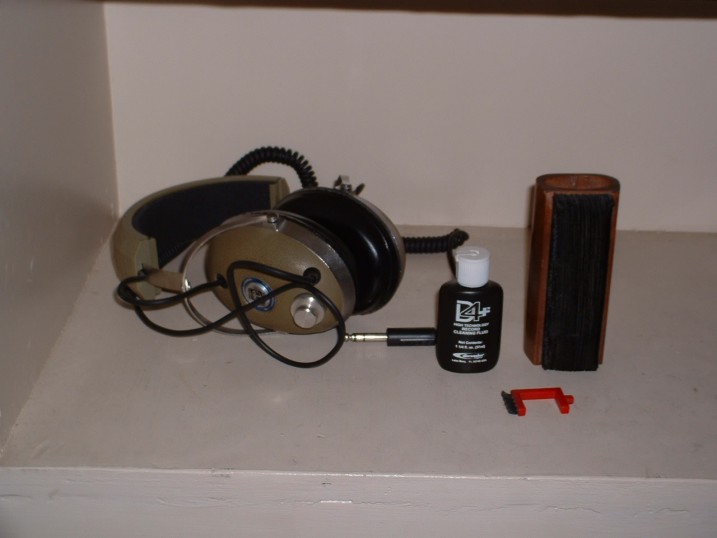
Anyone over the age of, oh, 35 or so ought to know what most of those are. The three objects to the left are, for those under that age, implements for cleaning what were called "records". Us audio geeks would religiously clean our LPs (those were the large 33-1/3 rpm ones) so they wouldn't become all knicked up and scratchy sounding. The liquid is called "D4" and what you did was take the little brush and brush the dust off of the black thing -- it's got a knobby-fabric pad for a top -- then rub some of the liquid onto the pad. Then you'd hold the pad onto the record and turn it around a couple of time with your finger (our records would end up with a dirty ring around the paper center where our fingers would rub while spinning it). It got the dust and other junk off.
The headphones are Koss Pro4-AAs which it seems Koss still sells. That's kind of amazing. I would wager at least half of the top records of the 1970s were mastered by a guy wearing these headphones. For a long time they were the standard. Interestingly, a few years ago this pair of mine were getting kind of ratty. The wire going in kept shorting out, one of the labels on the outside was missing, the rubber cups were all flat, etc. So I just boxed them up and sent them back to Koss with a note asking if they could fix them up and to just send an invoice and I'd pay for it.
Well.
Couple weeks later they came back in the mail good as new. I even bought a newer pair of moderately-priced headphones and, really, they sounded very inferior. These things have held up remarkably well, soundwise. You can't really wear them around with an iPod, but the sound quality is something to be heard. So heck, go buy a pair and see. Only $99.99!
Second pic. This may be the first album I ever purchased:
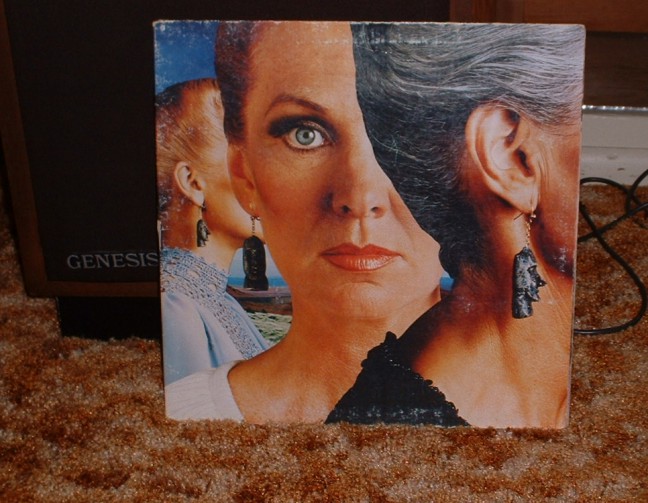
Yeah, it's Styx, Pieces of Eight. It's either that one, Hot Streets by Chicago, or perhaps Point of Know Return by Kansas. Memory from those days is a bit hazy. They're the first band I saw live, too (Styx). Played with a warm up group called New England.
My old college roommate -- still a good friend who moved out to Seattle (from Wisconsin/Illinois) too -- could go through his entire collection of records and tell you when he bought it, where he bought it, why he bought it, and probably how much he paid for it.
Ha! Check out the earrings for an archaeological connection. I didn't even think of that when I took the picture. Maybe that's what did it to me in the first place. . . .
So anyway, I submit two photos for your approval:
Anyone over the age of, oh, 35 or so ought to know what most of those are. The three objects to the left are, for those under that age, implements for cleaning what were called "records". Us audio geeks would religiously clean our LPs (those were the large 33-1/3 rpm ones) so they wouldn't become all knicked up and scratchy sounding. The liquid is called "D4" and what you did was take the little brush and brush the dust off of the black thing -- it's got a knobby-fabric pad for a top -- then rub some of the liquid onto the pad. Then you'd hold the pad onto the record and turn it around a couple of time with your finger (our records would end up with a dirty ring around the paper center where our fingers would rub while spinning it). It got the dust and other junk off.
The headphones are Koss Pro4-AAs which it seems Koss still sells. That's kind of amazing. I would wager at least half of the top records of the 1970s were mastered by a guy wearing these headphones. For a long time they were the standard. Interestingly, a few years ago this pair of mine were getting kind of ratty. The wire going in kept shorting out, one of the labels on the outside was missing, the rubber cups were all flat, etc. So I just boxed them up and sent them back to Koss with a note asking if they could fix them up and to just send an invoice and I'd pay for it.
Well.
Couple weeks later they came back in the mail good as new. I even bought a newer pair of moderately-priced headphones and, really, they sounded very inferior. These things have held up remarkably well, soundwise. You can't really wear them around with an iPod, but the sound quality is something to be heard. So heck, go buy a pair and see. Only $99.99!
Second pic. This may be the first album I ever purchased:
Yeah, it's Styx, Pieces of Eight. It's either that one, Hot Streets by Chicago, or perhaps Point of Know Return by Kansas. Memory from those days is a bit hazy. They're the first band I saw live, too (Styx). Played with a warm up group called New England.
My old college roommate -- still a good friend who moved out to Seattle (from Wisconsin/Illinois) too -- could go through his entire collection of records and tell you when he bought it, where he bought it, why he bought it, and probably how much he paid for it.
Ha! Check out the earrings for an archaeological connection. I didn't even think of that when I took the picture. Maybe that's what did it to me in the first place. . . .
Off-topic post Guess where this came from:
Pretty standard geological mumbo-jumbo, eh? Could be from anywhere on earth.
But it's for Mars.
Admittedly, I deleted a couple of words that would have given it away. But I was reading Science this afternoon, specifically Two Years at Meridiani Planum: Results from the Opportunity Rover by Squyres et al. (Science 8 September 2006: 1403-1407) and halfway through it occurred to me that this is the same sort of stuff that is done here all the time, but now they're doing it on a different.freakin'.planet.
I'm old enough (barely) to remember when it was still thought that there were 'canals' on Mars, because telescopes couldn't get enough detail to see any sort of land features other than dark smudges on the surface. I still remember as a kid one day watching TV as pictures from one of the Viking landers came in (live). I'm too young to remember the moon landing, but this really struck me: looking at pictures from the surface of another planet.
So now here we are 30 years later talking about the micro-stratification and grain characteristics of Martian rocks. Wow.
Rinds differ chemically from subjacent outcrop, notably showing enrichment of Na and Cl and depletion of S. They are particularly well developed where they have formed at the interface between outcrop surfaces and thin coverings of soils. This observation suggests that the rind formation process may be ubiquitous and ongoing on exposed or thinly covered outcrop surfaces, but that its rate is substantially slower than the eolian sandblasting of soft outcrop rock by saltating grains that is pervasive across the plains. In this model, only where rock surfaces have been protected from sandblasting, for example, when buried by a thin veneer of soil and only recently uncovered, is thick rind formation observed.
Fracture fills are erosionally resistant, often vertically oriented features associated with linear fractures of possible impact origin. These features are spectrally distinct from adjacent outcrop but differ chemically only in detail. APXS data indicate that fracture fills contain siliciclastic materials in amounts similar to or slightly greater than nearby outcrop lithologies; the fill is typically slightly enriched in Al and Si and depleted in Mg and S. Unlike rinds, fracture fills show no substantial Na or Cl enrichment. The high abundance of silicates means that the fills are not primarily precipitated, but the absence of basaltic minerals indicates that fractures are not filled by present-day soils. Instead, the close similarity of fracture fill and country rock lithologies suggests that fractures were filled primarily by intraclastic material derived from adjacent outcrops. The limited total volume of alteration rinds and fracture fill indicates very low aggregate rates of fluid flow and chemical weathering during the time since the outcrop rocks were deposited.
Pretty standard geological mumbo-jumbo, eh? Could be from anywhere on earth.
But it's for Mars.
Admittedly, I deleted a couple of words that would have given it away. But I was reading Science this afternoon, specifically Two Years at Meridiani Planum: Results from the Opportunity Rover by Squyres et al. (Science 8 September 2006: 1403-1407) and halfway through it occurred to me that this is the same sort of stuff that is done here all the time, but now they're doing it on a different.freakin'.planet.
I'm old enough (barely) to remember when it was still thought that there were 'canals' on Mars, because telescopes couldn't get enough detail to see any sort of land features other than dark smudges on the surface. I still remember as a kid one day watching TV as pictures from one of the Viking landers came in (live). I'm too young to remember the moon landing, but this really struck me: looking at pictures from the surface of another planet.
So now here we are 30 years later talking about the micro-stratification and grain characteristics of Martian rocks. Wow.
Iron Age remains hailed as crucial
THE remains of a 2000-year-old city have been discovered under Inverness and it is being hailed as one of the most important recent discoveries in Scotland.
The find near Inverness Royal Academy was uncovered by a team who spent almost a year excavating the remains of seven large roundhouses and almost a dozen iron kilns.
French explorer's bad luck in Syria avenged at last
First the 1920s French archaeologist ran out of money to uncover the treasures he suspected hidden under a Syrian castle, and then he ran out of time to see others finish the work.
Twelve years too late for Georges Ploix de Rotrou, a German team has now revealed the full glory of the 500 square metre (5,400 sq ft) Temple of the Storm God that lay under the vast citadel in Aleppo.
From dwarf humans to giant camels and back again Ancient Miniature Buffalo Discovered
Well, forget that last part about the dating. Article says something about 20,000 years ago, but that's it.
The bones of an extinct dwarf species of buffalo were recently unearthed on the Philippine island of Cebu.
Dubbed Bubalus cebuensis, the miniature buffalo stood at just more than two feet, three times smaller than today’s domestic buffalo, and weighed a mere 350 pounds. It probably lived during the Pleistocene (Ice Age) or Holocene Epochs, between 10,000 and 100,000 years ago.
Well, forget that last part about the dating. Article says something about 20,000 years ago, but that's it.
Ancient remains causing problems
It's a long article looking at what happens when remains are found on private property. This is an area I'm none too familiar with. The method described in the article seem fairly arbitrary and a bit confusing to me. Do tribes nominate a person as a "most likely descendent"? Can anyone register themselves as a descendent? It's actually kind of a disturbing article since much of what goes on in these cases is kept secret by the parties involved. There's a lot of stuff in there worth discussing though, but it's mostly terra incognita for me. A lot of these regulations and processes vary state by state a LOT, too.
State laws require landowners to contact California's Native American Heritage Commission when native remains are found. The commission then assigns a person known as the "most-likely descendant" to consult with the landowner.
But there's sometimes tenuous or no ancestral ties between the "descendant" and the uncovered bodies, scientists and American Indians said. Many remains found in eastern Contra Costa and Alameda counties, for example, are too old to be linked directly with any modern tribes.
It's a long article looking at what happens when remains are found on private property. This is an area I'm none too familiar with. The method described in the article seem fairly arbitrary and a bit confusing to me. Do tribes nominate a person as a "most likely descendent"? Can anyone register themselves as a descendent? It's actually kind of a disturbing article since much of what goes on in these cases is kept secret by the parties involved. There's a lot of stuff in there worth discussing though, but it's mostly terra incognita for me. A lot of these regulations and processes vary state by state a LOT, too.
Archaeologists find huge stash of Bronze Age anchors
CYPRUS’ reputation as an archeological gold mine has been given another boost, with an important underwater Bronze Age discovery.
A team of maritime archeologists from the UK has uncovered 120 stone anchors off the coast of Paphos. The anchors, some of which date back to the Bronze Age (2500-1125BC), are the second largest collection in the eastern Mediterranean.
The fact that so many anchors have been found at the same site suggests that the area may have once been an important port, serving the maritime traders on the busy trade routes to and from the east.
Tuesday, October 17, 2006
Found this link on Yahoo while looking around a bit for the previous post: Stonehenge makes list in new seven wonders vote
The entire list:
1 Acropolis, Athens, Greece
2 Alhambra, Granada, Spain
3 Angkor Wat temple, Cambodia
4 Chichen Itza Aztec site, Yucatan, Mexico
5 Christ the Redeemer, Rio de Janeiro, Brazil
6 Colosseum, Rome
7 Easter Island Statues, Chile
8 Eiffel Tower, Paris
9 Great Wall, China
10 Hagia Sophia church, Istanbul, Turkey
11 Kyomizu Temple, Kyoto, Japan
12 Kremlin/St.Basil's, Moscow
13 Machu Picchu, Peru
14 Neuschwanstein Castle, Fussen, Germany
15 Petra ancient city, Jordan
16 Pyramids of Giza, Egypt
17 Statue of Liberty, New York
18 Stonehenge, Amesbury, United Kingdom
19 Sydney Opera House, Australia
20 Taj Mahal, Agra, India
21 Timbuktu city, Mali
I bolded my quick-and-dirty choices. I had some difficulty beyond the pyramids, the Great Wall, Machu Picchu, and Stonehenge. Those seem to me to be works that were outstanding even in their own time; that is, the zenith of construction within each's particular time/culture context. The remainders just strike me as being emblematic structures that capture elements of design that are almost universally acknowledged to embody some sort of ideal form (e.g., Taj Mahal).
But frankly, I think the Channel Tunnel is a freakin' wonder. . . .
Only one of the ancient wonders of the world still survives -- now history lovers are being invited to choose a new list of seven.
Among 21 locations shortlisted for the worldwide vote is Stonehenge, the only British landmark selected.
The 5,000-year-old stones on Salisbury Plain, Wiltshire, will be up against sites including the Acropolis in Athens; the Statue of Liberty in New York; and the last remaining original wonder, the Pyramids of Giza in Cairo.
The entire list:
1 Acropolis, Athens, Greece
2 Alhambra, Granada, Spain
3 Angkor Wat temple, Cambodia
4 Chichen Itza Aztec site, Yucatan, Mexico
5 Christ the Redeemer, Rio de Janeiro, Brazil
6 Colosseum, Rome
7 Easter Island Statues, Chile
8 Eiffel Tower, Paris
9 Great Wall, China
10 Hagia Sophia church, Istanbul, Turkey
11 Kyomizu Temple, Kyoto, Japan
12 Kremlin/St.Basil's, Moscow
13 Machu Picchu, Peru
14 Neuschwanstein Castle, Fussen, Germany
15 Petra ancient city, Jordan
16 Pyramids of Giza, Egypt
17 Statue of Liberty, New York
18 Stonehenge, Amesbury, United Kingdom
19 Sydney Opera House, Australia
20 Taj Mahal, Agra, India
21 Timbuktu city, Mali
I bolded my quick-and-dirty choices. I had some difficulty beyond the pyramids, the Great Wall, Machu Picchu, and Stonehenge. Those seem to me to be works that were outstanding even in their own time; that is, the zenith of construction within each's particular time/culture context. The remainders just strike me as being emblematic structures that capture elements of design that are almost universally acknowledged to embody some sort of ideal form (e.g., Taj Mahal).
But frankly, I think the Channel Tunnel is a freakin' wonder. . . .
This just came over the EEF list:
The key word in the above is, of course, "plausible" which is really pretty meaningless.
Martin Bernal, Black Athena: The Afroasiatic Roots of Classical
Civilization, Volume III: The Linguistic Evidence. Oct. '06
http://rutgerspress.rutgers.edu/acatalog/__Black_Athena___Volume_3_2040.html
#2773
"This long-awaited third and final volume of the series is concerned with
the linguistic evidence that contradicts the Aryan Model of ancient Greece.
Bernal shows how nearly 40 percent of the Greek vocabulary has been
plausibly derived from two Afroasiatic languages-Ancient Egyptian and West
Semitic. He also reveals how these derivations are not limited to matters of
trade, but extended to the sophisticated language of politics, religion, and
philosophy. This evidence, according to Bernal, confirms the fact that in
Greece an Indo-European people was culturally dominated by speakers
of Ancient Egyptian and West Semitic."
The key word in the above is, of course, "plausible" which is really pretty meaningless.
Monday, October 16, 2006
Ancient Stonehenge Houses Unearthed
Nine Neolithic-era buildings have been excavated in the Stonehenge world heritage site, according to a report in the journal British Archaeology.
The structures, which appear to have been homes, date to 2,600-2,500 B.C. and were contemporary with the earliest stone settings at the site's famous megalith. They are the first house-like structures discovered there.
Julian Thomas, who worked on the project and is chair of the archaeology department at Manchester University in England, said Stonehenge could have been a key gathering place at the Neolithic era's version of a housing development.
1,800-year old painted coffin discovered in north China
Chinese archaeologists have discovered an ancient coffin painted with colored drawings dating back to the Eastern Han Dynasty (A.D. 25-220) in the Inner Mongolia Autonomous Region.
The funeral objects had already been robbed when the coffin was discovered from a tomb in Siziwang Banner. The coffin, in delicate appearance, was well preserved during excavation of the tomb.
"The color drawings, painted at inner sides of the coffin, feature daily life and hunting activities," said Wang Dafang, an official with the Inner Mongolia Autonomous Regional Cultural Relic Bureau
Remote sensing update Web lets UNC prof do armchair archaeology
Yup. Matter of fact, I went right to GE after reading about that and made an attempt to locate Kom el-Hisn in the Egyptian delta. Couldn't do it because I simply cannot find the lat-long coordinates of the place. I expect an abundance of work with this.
UPDATE: Still can't find the Kom el-Hisn lat/long but I found this site which seems to have those for a lot of other egyptian sites.
After 25 years of fieldwork abroad, UNC-Chapel Hill archaeologist Scott Madry has dug up a new way to hunt for ancient ruins -- without leaving home.
Last year, Madry read how an Italian man accidentally discovered the outline of an ancient Roman villa while looking at his house on Google Earth. Since then, with help from the French government, Madry has confirmed the free service's promise as a research tool. As the news spreads, other scientists are growing excited, too.
Yup. Matter of fact, I went right to GE after reading about that and made an attempt to locate Kom el-Hisn in the Egyptian delta. Couldn't do it because I simply cannot find the lat-long coordinates of the place. I expect an abundance of work with this.
UPDATE: Still can't find the Kom el-Hisn lat/long but I found this site which seems to have those for a lot of other egyptian sites.
Back to the Stone Age – How Did the First Farmers Live?
The people that established Central Europe’s first farms in the late 6th millennium BC were not behind the times. Indeed, a combination of arable agriculture and animal husbandry was already being operated in this period. However, until now, research on more detailed aspects of day-to-day agricultural practices in Austria has largely been sparse in comparison to work in other European countries.
A current project is set to change all that. Two agricultural settlements are being closely scrutinized in order to create a detailed picture of life as an "early farmer". Over the next two years, a team headed by project manager Doz. Dr. Eva Lenneis from the Institute for Pre- and Protohistory at the University of Vienna will be examining finds such as animal bones, plant remains, pottery and stone tools.
Piltdown's lessons for modern science
True dat.
Not a whole lot of analysis in the piece but it gives a nice outline of the Poltdown hoax, plus the Cricket Bat which I honestly hadn't heard of before.
Hopefully, the Piltdown saga has taught those of us who study the evolution of humans some important lessons that we should apply today.
Firstly, we mustn't let preconceived ideas run away with us. Secondly, specimens have to pass certain basic tests.
Science thrives on scepticism, which is why the extraordinary discovery of the "Hobbit" fossils in Indonesia has prompted a lively scientific debate over its status.
True dat.
Not a whole lot of analysis in the piece but it gives a nice outline of the Poltdown hoax, plus the Cricket Bat which I honestly hadn't heard of before.
Imperial-era tomb stops work at Beijing shooting venue
Work was halted at a Beijing Olympic shooting venue after workers unearthed an imperial-era tomb at the site, a Chinese newspaper reported on Monday.
The tomb was located about 100 meters from the site of several Ming Dynasty (1368-1644) tombs unearthed during construction of the Beijing Shooting Range Hall in May, the Beijing Times said.
Workers laying pipe at the site on Saturday night had discovered a "relatively large chamber with a structure" and subsequently informed authorities, the paper said.
Archaeologists study ancient Hohokam find
PHOENIX Archaeologist Mark Hackbarth had expected to find Hohokam ruins on the site for the new Phoenix Convention Center.
But he never imagined the immensity of the find. Over 30 days this summer, Hackbarth uncovered 40 of the earliest known Hohokam pithouses in the Phoenix metropolitan area. They are three thousand years old.
Now, thousands of artifacts from the dig rest in a Tempe laboratory.
Sunday, October 15, 2006
Marine archaeology update Lewes shipwreck, the Severn, gives up her secrets
Sometime during early May 1774, Capt. James Hawthorn made a decision to run the 200-ton cargo ship Severn aground just off Lewes Beach. A nor’easter was lashing the Cape Region, threatening the vessel and its crew of 20 or so men.
“They all made it to shore alive,” says Dan Griffith, director of the Lewes Maritime Archaeological Project.
Griffith, Secretary of State Harriet Smith Windsor and Tim Slavin, director of the state’s Division of Historical and Cultural Affairs, gathered at the University of Delaware’s College of Marine Studies in Lewes Wednesday, Oct., 11, eager to talk about the Severn and what’s been learned during the past several months.
The lost world on our doorstep
Neat (long) article.
The skids come down on the rock platform, then lift again to shuffle onto a flatter position before we can clamber out. Less than half an hour later the rest of the team also flies onto the rock.
A decade ago a party of bushwalkers exploring in this same area of the Wollemi wilderness just 100 kilometres from Sydney came across a staggering overhang wallpapered in rock art. The discovery was reported to the NSW parks service immediately. Oddly, not until 2003 did a team of archaeologists, Aborigines and bushwalkers revisit the cave and return to civilisation with a story that made headlines worldwide.
The site was named Eagle's Reach and contained hundreds of art motifs ranging in age from the time of European settlement to thousands of years. The galleries included vast anthropomorphised eagles, the likes of which had never been seen anywhere.
Neat (long) article.
Mexican monolith update Monolith Perhaps Largest Found in Mexico
Eh. Just a short discussion about its size compared to the "Aztec Caendar" stone.
UPDATE: mmm. More here: The scientists believe the monolith could cover the entrance to a chamber and may soon announce more finds.
"Most likely we will find an enormous offering below it. If there is a chamber, we will find a series of impressive offerings," he said.
Hard to know what to make of that. I haven't seen any other story raise the possibility that this thing is covering something. But maybe the guy is just speculating for effec.
Archaeologists announced Friday that a monolith discovered earlier this month near Mexico City's main square is perhaps the largest ever unearthed in the city's center.
The monolith, found on Oct. 2, is rectangular and measures nearly 13 feet on its longest side. The largest monolith from the city's center until this latest discovery _ the circular Piedra del Sol, or Aztec Calendar, unearthed in 1790 _ has a diameter of 12 feet.
Eh. Just a short discussion about its size compared to the "Aztec Caendar" stone.
UPDATE: mmm. More here: The scientists believe the monolith could cover the entrance to a chamber and may soon announce more finds.
"Most likely we will find an enormous offering below it. If there is a chamber, we will find a series of impressive offerings," he said.
Hard to know what to make of that. I haven't seen any other story raise the possibility that this thing is covering something. But maybe the guy is just speculating for effec.
Friday, October 13, 2006
And now. . . .the news from the EEF
Digitized book from the University of Michigan Digital
General Collection:
-- Arthur E. P. Brome Weigall, The Life and Times of Cleopatra,
Queen of Egypt; A Study in the Origin of the Roman Empire.
Edinburgh, London: W. Blackwood and sons, 1914.
Pages must be downloaded seperately, at:
http://name.umdl.umich.edu/AJL1424.0001.001
[Next two items submitted by Michael Tilgner]
Digitized book from "Google Book Search"
-- A. Henry Rhind, Thebes, Its Tombs and Their Tenants, Ancient
and Present, Including a Record of Excavations in the Necropolis,
London, 1862. xxi, 329 pp., [the plates are not present], some
newspaper clips are included - pdf-file: 14.2 MB
http://books.google.com/books?vid=LCCN59000440&id=3V1McZG_oeEC
"While describing the results of certain excavations which I made
at Thebes, I have endeavoured in this volume to offer, at the
same time, a general view of Egyptian sepulchral facts, as
represented in the Necropolis of that city."
Digitized book from the Travelers in the Middle East Archive (TIMEA)
-- E. A. Wallis Budge, The Nile. Notes for Travellers in Egypt,
8th ed., London / Cairo, 1902. xxvi, 674 pp. - HTML-file: 2.2 MB
http://dspace.rice.edu/xml/1911/9283/1702/BudNile.tei_full.html
"The short descriptions of the principal Egyptian monuments on each
side of the Nile between Cairo and Khartûm, printed in the following
pages, are not in any way intended to form a 'Guide to Egypt.' They
are drawn up for the use of those travellers who have a very few
weeks to spend in Egypt, and who wish to carry away from that
country some of the more important facts connected with the
fast-perishing remains of one of the most interesting and ancient
civilizations that has been developed on the face of the earth. The
existing guide books are too full, and they contain too many details
for such travellers."
Cheryl Haldane, "The Promise of Egypt's Maritime Legacy",
in: The Institute of Nautical Archaeology Quarterly, Volume 20,
No. 2 (Spring 1993), pp. 3-7; in PDF (1.62 MB):
http://ina.tamu.edu/quarterly/V20%20No2.pdf
About a shipwreck survey of the Red Sea, and providing an
overview of the nautical heritage of ancient Egypt.
By the same author: "A Pharaoh's Fleet: Early Dynastic
Hulls from Abydos", in: INA Quarterly Vol. 19. No. 2
(Summer 1992), pp. 12-13; in PDF (1.75 MB):
http://ina.tamu.edu/quarterly/V19%20No2.pdf
About "the world's most ancient planked hulls" found
in a funerary context in Abydos in 1991.
Richard Lobban, Emily Boisseau, "Cat Mummification Project",
in: ISAZ [International Society for Anthrozoology] Newsletter,
no. 29, June 2005, pp. 10-12 - pdf-file (whole issue): 1.2 MB
http://www.vetmed.ucdavis.edu/CCAB/isaznewsletterjune05.pdf
"This study recreates cat mummification by using the techniques
and objectives of ancient cat mummification in the late Egyptian
period."
[Submitted by Michael Tilgner]
New foreword by Joseph G. Manning for Miriam Lichtheim,
Ancient Egyptian Literature, vol. III: The Late Period, Berkeley /
Los Angeles / London, 2006 - 20 pp., pdf-file: 100 KB
http://www.stanford.edu/~jmanning/content/jgmhome/Lichtheim_forward.pdf
"It is now twenty-five years since the publication of volume
three of _Ancient Egyptian Literature. A book of readings (AEL)_.
That the volume remains a major source for Egyptian literature and
history in the first millennium BC is a fine testament to the scholar
who produced it. Each of the three volumes of _AEL_ is a
remarkable achievement in its own right; as a whole they are
among the most famous volumes in English-speaking Egyptology,
and are still in regular use in courses on Egyptian history and
civilization."
End of EEF news
Digitized book from the University of Michigan Digital
General Collection:
-- Arthur E. P. Brome Weigall, The Life and Times of Cleopatra,
Queen of Egypt; A Study in the Origin of the Roman Empire.
Edinburgh, London: W. Blackwood and sons, 1914.
Pages must be downloaded seperately, at:
http://name.umdl.umich.edu/AJL1424.0001.001
[Next two items submitted by Michael Tilgner]
Digitized book from "Google Book Search"
-- A. Henry Rhind, Thebes, Its Tombs and Their Tenants, Ancient
and Present, Including a Record of Excavations in the Necropolis,
London, 1862. xxi, 329 pp., [the plates are not present], some
newspaper clips are included - pdf-file: 14.2 MB
http://books.google.com/books?vid=LCCN59000440&id=3V1McZG_oeEC
"While describing the results of certain excavations which I made
at Thebes, I have endeavoured in this volume to offer, at the
same time, a general view of Egyptian sepulchral facts, as
represented in the Necropolis of that city."
Digitized book from the Travelers in the Middle East Archive (TIMEA)
-- E. A. Wallis Budge, The Nile. Notes for Travellers in Egypt,
8th ed., London / Cairo, 1902. xxvi, 674 pp. - HTML-file: 2.2 MB
http://dspace.rice.edu/xml/1911/9283/1702/BudNile.tei_full.html
"The short descriptions of the principal Egyptian monuments on each
side of the Nile between Cairo and Khartûm, printed in the following
pages, are not in any way intended to form a 'Guide to Egypt.' They
are drawn up for the use of those travellers who have a very few
weeks to spend in Egypt, and who wish to carry away from that
country some of the more important facts connected with the
fast-perishing remains of one of the most interesting and ancient
civilizations that has been developed on the face of the earth. The
existing guide books are too full, and they contain too many details
for such travellers."
Cheryl Haldane, "The Promise of Egypt's Maritime Legacy",
in: The Institute of Nautical Archaeology Quarterly, Volume 20,
No. 2 (Spring 1993), pp. 3-7; in PDF (1.62 MB):
http://ina.tamu.edu/quarterly/V20%20No2.pdf
About a shipwreck survey of the Red Sea, and providing an
overview of the nautical heritage of ancient Egypt.
By the same author: "A Pharaoh's Fleet: Early Dynastic
Hulls from Abydos", in: INA Quarterly Vol. 19. No. 2
(Summer 1992), pp. 12-13; in PDF (1.75 MB):
http://ina.tamu.edu/quarterly/V19%20No2.pdf
About "the world's most ancient planked hulls" found
in a funerary context in Abydos in 1991.
Richard Lobban, Emily Boisseau, "Cat Mummification Project",
in: ISAZ [International Society for Anthrozoology] Newsletter,
no. 29, June 2005, pp. 10-12 - pdf-file (whole issue): 1.2 MB
http://www.vetmed.ucdavis.edu/CCAB/isaznewsletterjune05.pdf
"This study recreates cat mummification by using the techniques
and objectives of ancient cat mummification in the late Egyptian
period."
[Submitted by Michael Tilgner]
New foreword by Joseph G. Manning for Miriam Lichtheim,
Ancient Egyptian Literature, vol. III: The Late Period, Berkeley /
Los Angeles / London, 2006 - 20 pp., pdf-file: 100 KB
http://www.stanford.edu/~jmanning/content/jgmhome/Lichtheim_forward.pdf
"It is now twenty-five years since the publication of volume
three of _Ancient Egyptian Literature. A book of readings (AEL)_.
That the volume remains a major source for Egyptian literature and
history in the first millennium BC is a fine testament to the scholar
who produced it. Each of the three volumes of _AEL_ is a
remarkable achievement in its own right; as a whole they are
among the most famous volumes in English-speaking Egyptology,
and are still in regular use in courses on Egyptian history and
civilization."
End of EEF news
Vatican graves update Unearthed graves show how average Romans lived, died
The burial sites help "document the middle class, which usually escapes us," said Paolo Liverani, an archaeologist and former Vatican Museums official who worked as a consultant on the site. "You don't construct history with only generals and kings."
Among those buried in the necropolis was a set designer for Pompey's Theater, notorious for being near the spot where Julius Caesar was stabbed to death. Decorating the designer's tomb were some symbols of his trade -- a compass and a T-square.
An archivist for Emperor Nero's private property and mailmen also were buried there.
Wednesday, October 11, 2006
Car blogging!
Okay, so this has nothing to do with archaeology, except that said automobile is rather old. But I'm throwing it out there anyway, since I'm rather pleased with the whole thing.
Actually, it does have some archy connection. In 1990 I had just bought a 1984 Bronco II because A) I hated with the white heat of a thousand suns the old 4-door 1975 Buick I had, and B) I was doing CRM work at the time and needed something that could go in the mud and junk. Talk about jinxed. Less than 24 hours after buying it I had my first accident. Then I got it back and drove down to California to do some fieldwork down there and the engine died in the middle of Oregon (Roseburg, OR: I hate you as well). Since I didn't have the money to rebuild the engine, I swapped 'em for a 1978 Mustang II off of their lot. It really was driven by a little old lady who drove it on Sunday and kept it garaged the rest of the time. It had 45k miles on it at the time. This is what it looked like when I got it:

It's kind of a weird car. It's essentially a special edition Cobra II like this one but without all the stickers, stripes, and spoilers. It wasn't bad for a mid-late 70s car, performance-wise, though obviously nothing like those from the early 70s and before (though it drives much better). It's got a 302 (5-liter) V8 but with a very modest 140 hp; still, not bad for a 2700 pound car. They never got much respect from the muscle car crowd, even though it sold far better than the early 70s models; it really had very little Pinto in it, but Ford very mistakenly made the sheet metal look much too Pinto-like and the reputation stuck. OTOH, while a lot of other pony cars were dropped, the Mustang line kept going with increased sales.
At any rate, a few years ago, the old boy started looking a little worse for wear. The paint on the entire front end was peeling and cracking, and I was getting tired of hearing the engine knock going uphill on the highway -- it was indeed a car of its time, made specifically for 55 mph and few freeways. If I were going to keep it, it would need new paint and either a modified or new engine, which I estimated would cost anywhere between $7-15,000. Yeesh. A lot of money for a non-collectible car. But then, to get what I really wanted in a new car would cost probably $30,000 and it would be sitting in the garage most of the time.
So after much internal debate, I decided to restore/modify it. So I got it painted:
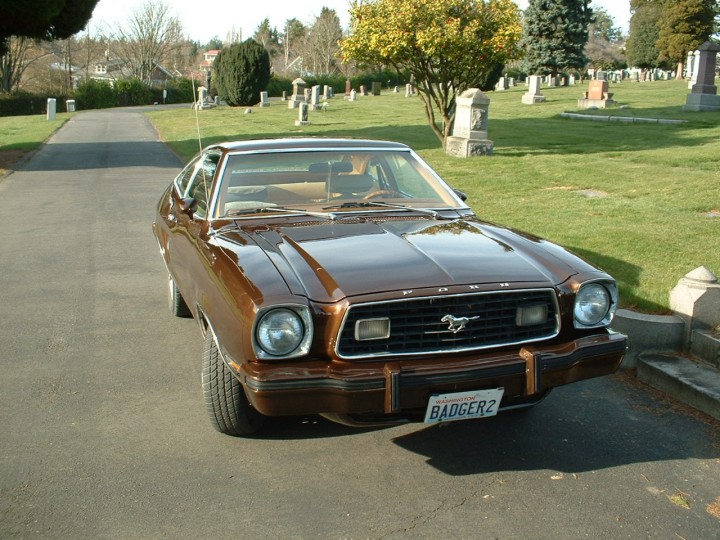
That's the original color, called dark metallic brown. Yeah, not a great color, but I wanted to keep it looking as stock as possible. Next came a new engine and exhaust. I went with a new one because it would be cleaner, more powerful, get better mileage, and just perform better than bolting stuff on the original. I put in a remanufactured 1989-93 5-liter fuel injected engine, the ones that came with Mustangs of those years. Here are two of the exhaust:
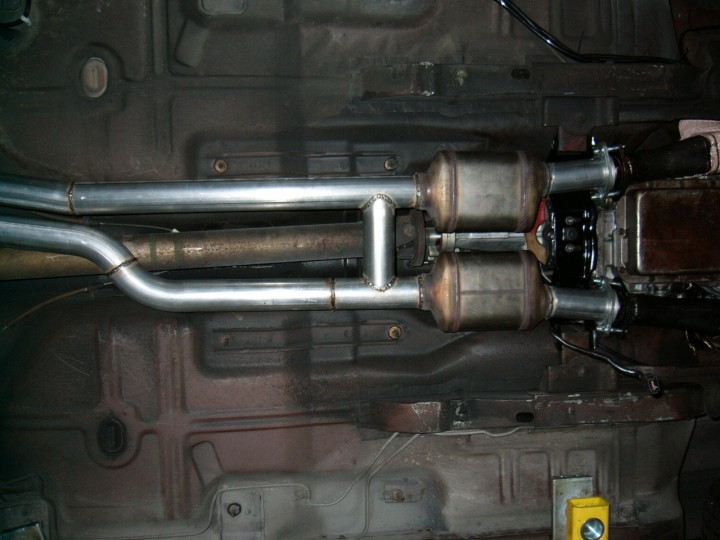
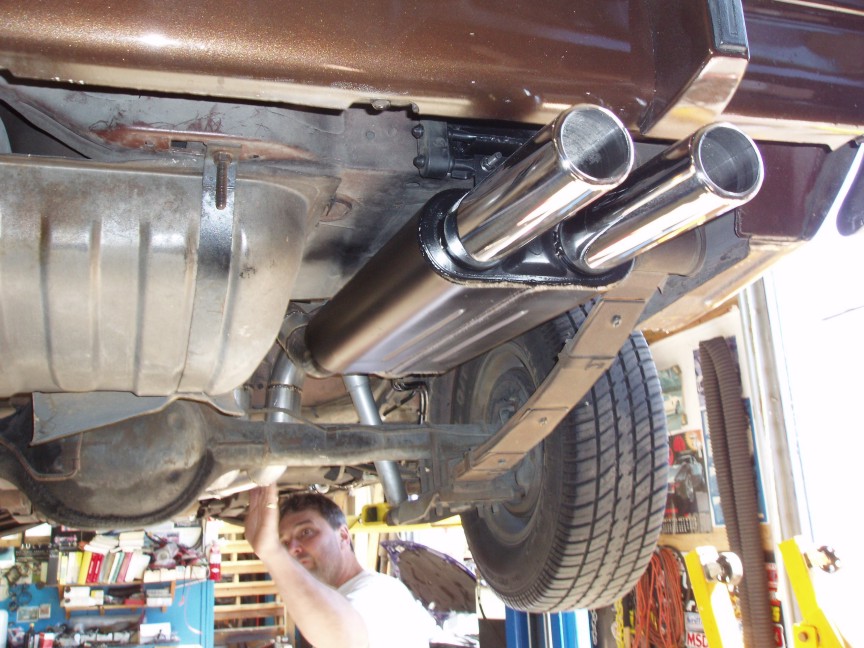
That's Brad of Brad's Custom Auto in the second one who did the work. They do lots of high performance stuff on mostly Mustangs and Corvette's. For the interested, those are 2.5" dual exhausts (with headers), catalytic converters pulled from a new Corvette, and a dual in/out muffler. Except for those two shiny things sticking out the back it looks like a basic stock Mustang II.
But.It.Hauls.
I don't think I've floored it yet. We estimate ca. 270hp. AND the mileage got better. Sady, I shall never know its top speed since the speedometer only goes to 85. . . . .
So there thank you for indulging me.
Okay, so this has nothing to do with archaeology, except that said automobile is rather old. But I'm throwing it out there anyway, since I'm rather pleased with the whole thing.
Actually, it does have some archy connection. In 1990 I had just bought a 1984 Bronco II because A) I hated with the white heat of a thousand suns the old 4-door 1975 Buick I had, and B) I was doing CRM work at the time and needed something that could go in the mud and junk. Talk about jinxed. Less than 24 hours after buying it I had my first accident. Then I got it back and drove down to California to do some fieldwork down there and the engine died in the middle of Oregon (Roseburg, OR: I hate you as well). Since I didn't have the money to rebuild the engine, I swapped 'em for a 1978 Mustang II off of their lot. It really was driven by a little old lady who drove it on Sunday and kept it garaged the rest of the time. It had 45k miles on it at the time. This is what it looked like when I got it:
It's kind of a weird car. It's essentially a special edition Cobra II like this one but without all the stickers, stripes, and spoilers. It wasn't bad for a mid-late 70s car, performance-wise, though obviously nothing like those from the early 70s and before (though it drives much better). It's got a 302 (5-liter) V8 but with a very modest 140 hp; still, not bad for a 2700 pound car. They never got much respect from the muscle car crowd, even though it sold far better than the early 70s models; it really had very little Pinto in it, but Ford very mistakenly made the sheet metal look much too Pinto-like and the reputation stuck. OTOH, while a lot of other pony cars were dropped, the Mustang line kept going with increased sales.
At any rate, a few years ago, the old boy started looking a little worse for wear. The paint on the entire front end was peeling and cracking, and I was getting tired of hearing the engine knock going uphill on the highway -- it was indeed a car of its time, made specifically for 55 mph and few freeways. If I were going to keep it, it would need new paint and either a modified or new engine, which I estimated would cost anywhere between $7-15,000. Yeesh. A lot of money for a non-collectible car. But then, to get what I really wanted in a new car would cost probably $30,000 and it would be sitting in the garage most of the time.
So after much internal debate, I decided to restore/modify it. So I got it painted:
That's the original color, called dark metallic brown. Yeah, not a great color, but I wanted to keep it looking as stock as possible. Next came a new engine and exhaust. I went with a new one because it would be cleaner, more powerful, get better mileage, and just perform better than bolting stuff on the original. I put in a remanufactured 1989-93 5-liter fuel injected engine, the ones that came with Mustangs of those years. Here are two of the exhaust:
That's Brad of Brad's Custom Auto in the second one who did the work. They do lots of high performance stuff on mostly Mustangs and Corvette's. For the interested, those are 2.5" dual exhausts (with headers), catalytic converters pulled from a new Corvette, and a dual in/out muffler. Except for those two shiny things sticking out the back it looks like a basic stock Mustang II.
But.It.Hauls.
I don't think I've floored it yet. We estimate ca. 270hp. AND the mileage got better. Sady, I shall never know its top speed since the speedometer only goes to 85. . . . .
So there thank you for indulging me.
Digging up archaeology interest
Well. Uhhh. . . .hmmmm.
As Danielle Kerr, 11, examined pieces of green glass from a broken bottle that was unearthed during an archaeological dig around the Morris Canal, she thought she might change her mind about becoming an actress.
"I wanted to be an actress, but now I'm thinking that I might want to be an archaeologist," she said, as her classmates dusted off other pieces of the bottle.
Well. Uhhh. . . .hmmmm.
Hmmmmm. . . Bulgarian Archaeologist Claims Ancient Man Performed Brain Surgery
That's the whole thing. Doesn't seem too terribly important since trephination has been known for a long time. I don't think this is any earlier than any oher examples. . . .
Archaeologists from Bulgaria are claiming to have found evidence that ancient men performed brain surgery.
Georgi Nehrizov, who led the team of researches say diggings near the city of Svilengrad in Bulgaria revealed a skull from the Thracian period or some 4,000 years ago, bearing a hole that had been carved out with surgical precision.
He said, "The skull dates back to 2500-1800 BC and the hole had clearly been made for medical reasons. It is the first such discovery from Thracian times."
Thracians were a nation comprised of different tribes that developed from a mix of invading Indo-European and indigenous settlers in the Balkans over the centuries, beginning from the Early Bronze Age.
The group was mentioned in Homer's the "Iliad" as allies of the Trojans, hailing from Thrace.
That's the whole thing. Doesn't seem too terribly important since trephination has been known for a long time. I don't think this is any earlier than any oher examples. . . .
Extinctions update This one has been making the rounds recently, but I kind of neglected linking to it because the first story I saw didn't have anything to do with archaeology per se:
Scientists find more bones of big camels
Hawks linked to it, but I haven't found anything in any of the reports suggesting that people hunted the damn things, just that some hominid bones and tools were found in the general vicinity. So, make of it what you will.
Scientists find more bones of big camels
Hunters stalked giant camels as tall as some modern-day elephants in the Syrian desert tens of thousands of years ago and archaeologists behind the find are wondering where the camels came from and what caused them to die off.
The enormous beasts existed about 100,000 years ago and more of the bones, first discovered last year, have been found this year in the sands about 150 miles north of the capital, Damascus.
The animal, branded the "Syrian Camel" by its Swiss and Syrian discoverers, stood between three and four yards high — about twice the size of latter-day camels and the height at the shoulder of many African elephants.
Hawks linked to it, but I haven't found anything in any of the reports suggesting that people hunted the damn things, just that some hominid bones and tools were found in the general vicinity. So, make of it what you will.
Tuesday, October 10, 2006
Silver-in-the-pottery update I took a (fairly quick) look at the original paper.
THE DISCOVERY OF ANOMALOUSLY HIGH SILVER ABUNDANCES IN POTTERY FROM EARLY ROMAN EXCAVATION CONTEXTS IN JERUSALEM D. ADAN-BAYEWITZ1, F. ASARO and R. D. GIAUQUE Archaeometry Volume 48 Page 377 - August 2006.
Abstract
This is the first study on the differential distribution and concentrations of silver in ceramics recovered from archaeological excavations. The chemical compositions of 1174 pottery vessels from 38 Roman-period sites in Israel have been determined. Unusually high and variable abundances of silver were discovered in pottery samples of all vessel types and chemical compositions from four distinct archaeological contexts dating to late first century bce to 70 ce Jerusalem. The large majority of the Jerusalem vessels could be distinguished by their silver abundances from all analysed pottery pieces recovered at rural sites outside Jerusalem, even when the pottery types and chemical compositions, except for silver, of pottery found within and outside Jerusalem were indistinguishable. The evidence is suggestive of a human origin for the high and variable silver abundances, and dispersion of the silver by aqueous transport. The differential silver concentrations found in excavated pottery from Jerusalem and other urban and rural sites suggest that attention to the distribution of silver in pottery from excavated contexts may be helpful for evaluating the nature and function of archaeological remains and patterns of urban contamination.
No page numbers for the quotes, as I lifted them from an HTML version.
Relating to the sample prep:
That occurred to me initially -- whether they were getting surficial contamination or if the silver was getting deep into the fabric. So it seems as they sampled deep into the wall, indicating whatever put the Ag there, it had to penetrate deep into the structure.
One other question was whether there was any evidence of silver nearby that could serve as a source for the aqueous transport:
There seems to be at least some silver material present in the surrounding sediments. It should also be noted that the samples came from a variety of types -- "bowls, cooking pots, storage jars, jugs, juglets, flasks and lamps" -- and one group came from a mikveh which is described as a "ritual immersion bath". According to Figure 6(c), there is no significant difference between the various types, suggesting that it probably wasn't a function of use.
They did deal somewhat with the possibility of vessels containing silver objects by testing a vessel that did contain a mass of silver:
Those are much higher concentrations than the ones they were getting from the other samples.
I'm tending to lean toward something other than the coins-in-the-vessel idea, mainly because the high concentrations are in a variety of vessel types in a variety of contexts. But I'm still not convinced that it was aqueous transport, since not a lot of information was provided on the likely sources of the silver in solution. This isn't really a criticism of the paper per se since that's a whole other can o' worms, and this largely dealt with the pottery itself. So, eh, interesting hypothesis.
THE DISCOVERY OF ANOMALOUSLY HIGH SILVER ABUNDANCES IN POTTERY FROM EARLY ROMAN EXCAVATION CONTEXTS IN JERUSALEM D. ADAN-BAYEWITZ1, F. ASARO and R. D. GIAUQUE Archaeometry Volume 48 Page 377 - August 2006.
Abstract
This is the first study on the differential distribution and concentrations of silver in ceramics recovered from archaeological excavations. The chemical compositions of 1174 pottery vessels from 38 Roman-period sites in Israel have been determined. Unusually high and variable abundances of silver were discovered in pottery samples of all vessel types and chemical compositions from four distinct archaeological contexts dating to late first century bce to 70 ce Jerusalem. The large majority of the Jerusalem vessels could be distinguished by their silver abundances from all analysed pottery pieces recovered at rural sites outside Jerusalem, even when the pottery types and chemical compositions, except for silver, of pottery found within and outside Jerusalem were indistinguishable. The evidence is suggestive of a human origin for the high and variable silver abundances, and dispersion of the silver by aqueous transport. The differential silver concentrations found in excavated pottery from Jerusalem and other urban and rural sites suggest that attention to the distribution of silver in pottery from excavated contexts may be helpful for evaluating the nature and function of archaeological remains and patterns of urban contamination.
No page numbers for the quotes, as I lifted them from an HTML version.
Relating to the sample prep:
The pottery pieces were carefully cleaned and the surface layer removed before grinding and preparation of samples for analysis. The detected major Ag anomalies, therefore, were in the fabric of the pottery, not just on the surface. The only feasible way for the Ag to enter the pottery fabric, therefore, would most likely have been by aqueous transport.
From the above arguments, it appears that a likely source of the Ag anomalies in the Jerusalem samples is in situ contamination by aqueous transport after deposition, although a use-related source for the Ag in some samples is also possible.
That occurred to me initially -- whether they were getting surficial contamination or if the silver was getting deep into the fabric. So it seems as they sampled deep into the wall, indicating whatever put the Ag there, it had to penetrate deep into the structure.
One other question was whether there was any evidence of silver nearby that could serve as a source for the aqueous transport:
After six years of excavation in the Jewish Quarter during which no silver coins were recovered, a hoard of 13 silver coins, of the first, second, third and fourth years of the First Jewish Revolt (see below), was found in an excavation area about 50 m south-east of Area E
. . .
Although only the above-mentioned hoard of 13 silver coins has been reported from the Jewish Quarter excavations, over the past century a relatively large number of silver coins has been recovered in the many excavations that have been conducted in Jerusalem and its vicinity, and in chance finds in the area.
There seems to be at least some silver material present in the surrounding sediments. It should also be noted that the samples came from a variety of types -- "bowls, cooking pots, storage jars, jugs, juglets, flasks and lamps" -- and one group came from a mikveh which is described as a "ritual immersion bath". According to Figure 6(c), there is no significant difference between the various types, suggesting that it probably wasn't a function of use.
They did deal somewhat with the possibility of vessels containing silver objects by testing a vessel that did contain a mass of silver:
In order to learn more about the possible patterns of Ag corrosion and dispersion, we measured by HPXRF the Ag concentrations within the ceramic of a large Iron Age jug (c. late 11th to early 10th centuries bce) from Dor (Fig. 1) that contained a hoard of about 8.5 kg of silver (disc-shaped tokens, small fragments, and scraps of jewellery). The jug, discovered intact, was found standing in an upright position, with its mouth covered by a bowl (Stern et al. 2000; Stern 2001). Two samples were taken from the jug, one from the upper shoulder, above the present level of the mass of metal, and one from the base. Routine procedures for sample preparation were followed, including removal prior to analysis of the surfaces from both sampled pottery fragments. The Ag concentrations in the shoulder and base were 29.8 ± 0.6 and 101 ± 1 ppm, respectively. These data indicate that Ag entered the ceramic fabric.
Those are much higher concentrations than the ones they were getting from the other samples.
I'm tending to lean toward something other than the coins-in-the-vessel idea, mainly because the high concentrations are in a variety of vessel types in a variety of contexts. But I'm still not convinced that it was aqueous transport, since not a lot of information was provided on the likely sources of the silver in solution. This isn't really a criticism of the paper per se since that's a whole other can o' worms, and this largely dealt with the pottery itself. So, eh, interesting hypothesis.
This just in . . . . Just got this email from Richard Pettigrew of ArchaeologyChannel.org:
Friends and colleagues: The threat of nuclear weapons literally exploded
onto the world scene during World War II when the United States tested
the first nuclear device. The irony of the test site location, in the
heartland of traditional Puebloan Culture, prompted the imaginative
production of Ground Zero/Sacred Ground, the latest video feature on our
nonprofit streaming-media Web site, The Archaeology Channel
(http://www.archaeologychannel.org).
In south-central New Mexico lies Three Rivers, where the Jornada Mogollon
created over 10,000 petroglyphs between AD 900 and 1400. At the nearby
Trinity Site, White Sands Missile Range, the world's first atomic bomb
detonated in 1945. Juxtaposing these two sites reveals a striking
contrast between two worlds: one which reveres and lives in harmony with
the natural world and one which manipulates the forces of nature,
creating the means for its destruction. This animated film explores
these opposing forces and their relationship to, and effect on, one
another.
This and other programs are available on TAC for your use and enjoyment.
We urge you to support this public service by participating in our
Membership (http://www.archaeologychannel.org/member.html) and
Underwriting (http://www.archaeologychannel.org/sponsor.shtml) programs.
Only with your help can we continue and enhance our nonprofit
public-education and visitor-supported programming. We also welcome new
content partners as we reach out to the world community.
Cracked pyramid forces ban on idling vehicles
Huh. They quit having tour busses get near the Valley of the Kings several years ago for fear the engine and rumbling of them would start to crack many of the tombs. They might have limited bus access to the Giza site too, if memory serves (I might be thinking of the tourist vendors though).
Egyptian authorities have put a ban on idling vehicle engines in Saqqara, south-west of Cairo, after cracks started to show on the country's oldest pyramid.
The head of Egypt's supreme council for antiquities, Zahi Hawass, had "decided to ban the running of engines of all cars and buses waiting for tourists in the archaeological area of Saqqara", a council statement said.
"The running of engines has caused the area to experience some shaking which has in turn caused cracks in the pyramid of Djoser," the statement said.
Huh. They quit having tour busses get near the Valley of the Kings several years ago for fear the engine and rumbling of them would start to crack many of the tombs. They might have limited bus access to the Giza site too, if memory serves (I might be thinking of the tourist vendors though).
Monday, October 09, 2006
Developer agrees to survey land for Indian artifacts
That's the whole thing.
Developers of property next to York County's planned life and environment museum say they will do a thorough archaeological survey on nearly 400 acres of former museum property.
The announcement came after a meeting between developers and staffers at the state Historic Preservation office.
University scholars and archaeologists had criticized the York County Culture and Heritage Museums for not thoroughly searching the 400-acre site during the seven years its nonprofit association owned the property.
Leaders of the joint venture company created to manage the development say they plan to leave a large portion of the site as open space, preserving the historical, cultural and environmental features located there.
That's the whole thing.
This seems to be making the rounds Archaeologists find 18th-century store
A five-year-long archaeological project has unearthed the 250-year-old site of a merchant's establishment that sold wine, rum, tobacco and other goods to the thousands of soldiers who passed through this region during the French and Indian War, when Fort Edward was the largest British military post in North America.
Sutler, derived from the Dutch word for someone who performs dirty work, was the name given to the merchants who arrived on the heels of the British army and sold what the redcoats wouldn't _ or couldn't _ provide at a frontier outpost. With the permission of military officials, sutlers set up shop near a fort's gates, taking advantage of the isolated location to do a brisk trade with off-duty soldiers and officers.
Ancients buried with their pets in two Narges-Tappeh graves
Kind of touching until you realize that the pups were probably killed before burial.
A team of archaeologists working at Narges-Tappeh recently unearthed two graves where animals were buried with their owners at the ancient site, the Persian service of CHN reported on Sunday.
The team discovered skeletons of a woman and her child, who were buried with a dog and its puppy. They have also found a skeleton of a man buried seated upon his horse at Narges-Tappeh, which is located in northern Iran near Gorgan, Golestan Province.
“We discovered the mother buried in a squatting position and her child, which date back to the early first millennium BC, and the dog and its puppy were buried a little above and to the left side (of her),” team director Qorban-Ali Abbasi said.
Kind of touching until you realize that the pups were probably killed before burial.
Homo hobbitus update Compelling evidence demonstrates that 'Hobbit' fossil does not represent a new species of hominid
No doubt Hawks will be looking into this paper soon.
The starting point for the new research in Anatomical Record was the realization that the brain of the Flores skull (at 400 cc, the size of a grapefruit and less than one-third of the normal size for a modern human) is simply too small to fit anything previously known about human brain evolution. In addition, the stone tools found at the same site include types of tools that have only been reported for our own species, Homo sapiens.
Brain size of the Flores hominid, originally called Homo floresiensis, is known only from the main specimen discovered there, the LB1 skeleton. Skeletal fragments have been attributed to eight other individuals, but nothing can be said about their brain sizes. (They are small-bodied, but that has never been at issue.)
The new exhaustive research shows that the LB1 brain is simply too small to have been derived from H. erectus by evolutionary dwarfing, as was claimed by those who discovered it. In fact, the size of the brain corresponds very closely to the average value for modern human microcephalics.
No doubt Hawks will be looking into this paper soon.
Vatican Necropolis Gives Up Secrets After Escaping Construction
``It's not easy to dig with all the wonderful things that are underground,'' said Cardinal Francesco Marchisano, head of the Pontifical Commission for Sacred Archaeology, in an interview.
The 500 square meters (5,380 square feet) of mostly pagan crypts will be opened to the public on Oct. 13 as part of the Vatican Museums' 500th anniversary. The necropolis is part of three other sections that in their entirety consist of about 1,000 square meters of graves.
It will be years before the conservation is completed, said Giandomenico Spinola, the archaeologist heading up the excavation. Until now, the work has cost about 400,000 euros ($508,000), financed by the Vatican Museums and Vatican City.
Mummy DNA Reveals Birth of Ancient Scourge
Neat part: "In this study, we haven't found evidence for Leishmania DNA in the samples from the New Kingdom to the Late Period, which are 500 to 1,000 years younger than those from the Middle Kingdom," Zink notes. "Therefore, we think that the presence of leishmaniasis is more due to the close cultural contacts of the Egyptians and the Nubians."
Albert Zink of Ludwig-Maximilians University in Munich and his colleagues tested the DNA of bone samples from 91 ancient Egyptian mummies and 70 from old Nubia--modern Sudan--to determine if they had suffered from leishmaniasis. In nine of the 70 Nubian mummies--taken from graves stretching as far back as A.D. 550--mitochondrial DNA of the parasite was discovered, proving the disease was endemic at least that far back. It likely has even more ancient roots; four of the Egyptian mummies carried the parasite's DNA, each dating from the Middle Kingdom period of 2050 to 1650 B.C. when trade ties with Nubia were strongest.
Neat part: "In this study, we haven't found evidence for Leishmania DNA in the samples from the New Kingdom to the Late Period, which are 500 to 1,000 years younger than those from the Middle Kingdom," Zink notes. "Therefore, we think that the presence of leishmaniasis is more due to the close cultural contacts of the Egyptians and the Nubians."
Archaeologists often find treasures in ashes left by wildfires
Forest Service archaeologists have found more than 318,000 historic sites in federal parkland. Thousands more have been unearthed by workers in state parks.
Still, the search goes on, with experts in fire-prone areas from California to Arkansas often relying on wildfires to clear dense underbrush and reveal the remnants of villages and campgrounds.
"Fires are a double-edged sword," said Richard Fitzgerald, an archaeologist for California state parks. "They can be very destructive, but after a big fire you can find new sites, even in areas that have been surveyed before."
TV update History Channel's Engineering an Empire on tonight (Monday, 9 Oct) at 9/8. Peter Weller (Robocop, etc.) is hosting. Blogged about his 2nd career here somewhere, but a search failed to find said post. He's apparently either getting or gotten (probably the former) doctorate at Syracuse.
Haven't seen the thing yet, but Tracy Spurrier has a review at Archaeology.org:
We'll have to see how to reenactments end up. They can be fairly good and provide some insight into how things were done, but most often it's a bunch of guys in loincloths milling about pretending to be actually working at something.
Haven't seen the thing yet, but Tracy Spurrier has a review at Archaeology.org:
Overall "Engineering an Empire: Egypt" is a fascinating look at how ancient people built extraordinary monuments. The techniques used to create, build, and decorate are unique methods which haven't been seen or implemented in quite a few millennia. The only inspiration for architecture the Egyptians had was what nature itself created. The show was entertaining and I plan to catch some of the episodes to follow which will feature the Aztecs, Greeks, Maya, Chinese, and Russians, to name a few. If you have ever wondered how the pyramids and other ancient wonders were built, then tune in to the History Channel on Monday nights.
We'll have to see how to reenactments end up. They can be fairly good and provide some insight into how things were done, but most often it's a bunch of guys in loincloths milling about pretending to be actually working at something.
Sunday, October 08, 2006
Unearthing 200-year-old village pottery
Just don't read the caption on the photograph. . . .
A WEST Cumbrian village has been awarded £10,000 to uncover the secrets of a 200-year-old pottery buried beneath its playing fields.
Dearham Parish Council wanted to develop an overgrown part of Pottery Park for use as a recreation facility, but an evaluation of the site revealed that there was an eighteenth century pottery buried beneath the site – which explained the name of the area.
Archaeologists made the discovery while studying old Tithe maps, which contain details of the ‘Newlands Bank Pottery’.
Just don't read the caption on the photograph. . . .
Saturday, October 07, 2006
Silver Anomalies Found in Jerusalem Pottery Hint at Wealth During Second Temple Period
Hmmmm. They seem to be saying that the silver was post-depositionally inserted into the ceramics through groundwater, and that the silver came from objects stored underground by the wealthy inhabitants. Not sure how likely that is. Seems there'd have to be an wfully lot of silver exposed to groundwater for that to happen. Maybe the source clay or temper had silver in it? (but they say the samples with silver were only found in cities) So, eh.
Scientists with the U.S. Department of Energy’s Lawrence Berkeley National Laboratory (Berkeley Lab) and Bar-Ilan University have discovered unusually high concentrations of silver in samples of many different types of pottery from excavations in Jerusalem of the late Second Temple period, the first century BCE (Before the Common Era) through 70 CE (Common Era). This is the first study ever conducted on silver in archaeological ceramics.
David Adan-Bayewitz, Associate Professor at Bar-Ilan in Ramat-Gan, Israel, and a guest at Berkeley Lab, and Frank Asaro and Robert D. Giauque of Berkeley Lab’s Environmental Energy Technologies Division made their discovery of performing measurements on 1,200 pottery vessels from 38 sites in Roman Judea (present-day Israel). They used high-precision X-ray fluorescence (HPXRF) and instrumental neutron activation analysis (INAA). The Berkeley Lab team developed a variation of INAA, the INAA coincidence technique, specifically for measuring silver concentrations in archaeological samples, as a more accurate means of checking the results of HPXRF and conventional INAA.
Hmmmm. They seem to be saying that the silver was post-depositionally inserted into the ceramics through groundwater, and that the silver came from objects stored underground by the wealthy inhabitants. Not sure how likely that is. Seems there'd have to be an wfully lot of silver exposed to groundwater for that to happen. Maybe the source clay or temper had silver in it? (but they say the samples with silver were only found in cities) So, eh.
Neanderthal update Neanderthal Man
It's more centered around Paabo, but it gives a good summary of the various Neanderthal DNA stuff that's been going on. Long article al free from Smithsonian.
Another Neanderthal story here.
As a boy in Sweden, Svante Paabo read everything he could about ancient civilizations. After powerful North Sea storms uprooted trees, he begged his parents to take him to archaeological sites to look for potsherds and other artifacts. When he was 13, his mother, a food chemist in Stockholm, yielded to her son's most frequent request: to visit Egypt. "It was absolutely fascinating," he recalls. "We went to the pyramids, to Karnak and the Valley of the Kings. The soil was full of artifacts."
Paabo, 51, is still looking for artifacts, but in a very different place. He's a leader of the worldwide quest to explore the past by analyzing human DNA. He has helped show that human groups—southern Africans, Western Europeans, Native Americans—are closely related, despite superficial distinctions. He has been uncovering key genetic changes that helped transform our shambling, hirsute ancestors into the brainy bipeds we are today. This past summer, Paabo announced that he and his co-workers were going to take the next—and biggest—step, in their effort to resurrect the genome of the Neanderthal, our distant evolutionary cousin, who went extinct 30,000 years ago.
It's more centered around Paabo, but it gives a good summary of the various Neanderthal DNA stuff that's been going on. Long article al free from Smithsonian.
Another Neanderthal story here.
Roman mosaics found on Quantocks
Archaeologists working on the Quantock Hills in Somerset have uncovered evidence of a substantial Roman villa with a mosaic floor in the main room.
The findings are part of a six-year study carried out on six separate sites around the area.
The dig team said the villa at Yarford is one of the most westerly villas with mosaic floors found in Roman Britain.

Aztec temple update Mexican archaeologists find important Aztec ruins
Mexican archaeologists have found what may be the most significant Aztec ruin in decades, with the unearthing of an altar and a monolith in the busy heart of Mexico City, Mayor Alejandro Encinas said on Wednesday.
The 15th century altar, part of the Aztec empire's main temple, was uncovered last weekend near the city's main Zocalo square along with the 11-foot (3.5-m) stone slab, most of which is still buried under earth.
Click to learn more...
"It is a very important discovery, the biggest we have made in 28 years. It will allow us to find out a lot more," Encinas told reporters.
Archaeologists uncover ancient burial cave of warrior tribe in Peru
No indication why the preservation is so good, though they seem to have been high-altitude dwellers so it's presumably a high-altitude cave site.
Archaeologists have uncovered a 600-year-old, large underground cemetery belonging to a Peruvian warrior culture.
It is thought to be the first discovery of its kind.
After a tip-off from a farmer in Peru's northern Amazon jungle, archaeologists from Peru's National Culture Institute last week found the 250-metre deep cave that was used for burial and worship by the Chachapoyas tribe.
Herman Corbera, the expedition's leader and regional cultural director, says so far archaeologists have found five mummies, two of which are intact with skin and hair, as well as ceramics, textiles and wall paintings.
No indication why the preservation is so good, though they seem to have been high-altitude dwellers so it's presumably a high-altitude cave site.
Early humans followed the coast
There's not much really new on the marine-migration angle, but some interesting stuff that's been found on the Channel islands, though really nothing that supports the marine hypothesis.
Professor Jon Erlandson says the maritime capabilities of ancient humans have been greatly underestimated.
He has found evidence that early peoples in California pursued a sophisticated seafaring lifestyle 10,000 years ago.
Anthropologists have long regarded the exploitation of marine resources as a recent development in human history, and as peripheral to the development of civilisation.
This view has been reinforced by a relative lack of evidence of ancient occupation in coastal areas.
But that view is gradually changing; genetic studies, for example, suggest a major early human expansion out of Africa occurred along the southern coastline of Asia, leading to the colonisation of Australia 50,000 years ago.
There's not much really new on the marine-migration angle, but some interesting stuff that's been found on the Channel islands, though really nothing that supports the marine hypothesis.
Friday, October 06, 2006
And now. . . .news from the EEF
Press report: “An Oasis of Art in the Egyptian Desert”
http://www.las.uiuc.edu/news/2006fall/06oct_rockart.html
“When Douglas Brewer ventured deep into the Egyptian desert this year,
he (...) actually found were well over 1,000 examples (...) of "rock art."
(..) Perhaps strangest of all was the abundance of boats depicted in
the art. (..) It is hard to tell whether it is the work of an independent
desert culture. (..) it is possible that the art was the work of Nile
Valley pastoralists who took their cattle out in search of grazing land. "
Online doctoral thesis: F.C. Woudhuizen, The Ethnicity of
the Sea Peoples, April 2006. In PDF, 4.1 MB.
https://ep.eur.nl/handle/1765/7686
The author seeks "to determine whether the enigmatic
Sea Peoples were merely a bunch of pirates or whether
they constituted a set of coherent ethnic entities,
temporarily making common cause in pursuit of the
richnesses of, and hence a better life in, the Near East.
Of vital importance to this endeavour is the question
of the homelands of the various groups which make up the
Sea Peoples. In order to tackle this problem, an
interdisciplinary proto-historical method has been applied,
which makes full use of the available archaeological,
historical,and linguistic data as provided by Egyptian,
Levantine, Anatolian, Aegean, and central Mediterranean
sources."
[Submitted by Brian Yare (brian@freeola.org)]
* Yare Egyptology ( http://www.yare.org/egypt ) are
pleased to announce the availability, as pdf images on CD:
Mace, A. C. and Winlock, H. E. (1916) The Tomb of Senebtisi at Lisht.
Schmidt, Valdemar (1910) Museum Muenterianum (a collection of stelae
transferred to the Glyphtoteque Ny Carlsberg)
Petrie, W. M. Flinders (1938) Egyptian Architecture
Petrie, W. M. Flinders (1939) The Making of Egypt
Petrie, W. M. Flinders (1940) The Wisdom of the Egyptians
Please check out our website for more than 250 historical works. We
apologise for the short outage of our web-site last Thursday night, just
after EEF NEWS came out.
Myron Marx and Sue H. D'Auria, "CT Examination of
Eleven Egyptian Mummies", in: RadioGraphics Vol. 6, no.2,
March 1886, pp. 321-330, In PDF (1.57MB).
http://radiographics.rsnajnls.org/cgi/reprint/6/2/321.pdf
Results of the CT-scanning of eleven mummies from the
MFA Boston collection. With an overview of mummification
techniques during the pharaonic era.
Myron Marx and Sue H. D'Auria, "Paleoradiology
Three-Dimensional CT Reconstructions of an Ancient
Human Egyptian Mummy", in: American Journal of
Roentgenology,150 (January 1988), pp. 147-149. In
PDF (400kB).
http://www.ajronline.org/cgi/reprint/150/1/147.pdf
Digitized CT data of the mummy of Tabes, Songstress of
Amun, from the MFA Boston, are recreated into 3D images.
On USA TV:
-- History Channel USA, October 9, 2006, 9:00 pm
"Egypt: Engineering an Empire"
http://www.history.com/marquee.do?marquee_id=51188
"This two-hour special uses cinematic recreations and
cutting-edge CGI to profile the greatest engineering
achievements of ancient Egypt, and the pharaohs and
architects who were behind them. Includes Djoser's Step
Pyramid at Saqqara, Senusret's Nubian Superfortresses,
Hatshepsut's Mortuary Temple at Deir el-Bahari,
Akhenaten's city at Amarna, and the temples of
Ramesses the Great at Abu Simbel.”
[For a review, see:
http://www.archaeology.org/online/reviews/engineering.html]]
[NOTE:that link doesn't work. Will try to find it.]
End of EEF news
Press report: “An Oasis of Art in the Egyptian Desert”
http://www.las.uiuc.edu/news/2006fall/06oct_rockart.html
“When Douglas Brewer ventured deep into the Egyptian desert this year,
he (...) actually found were well over 1,000 examples (...) of "rock art."
(..) Perhaps strangest of all was the abundance of boats depicted in
the art. (..) It is hard to tell whether it is the work of an independent
desert culture. (..) it is possible that the art was the work of Nile
Valley pastoralists who took their cattle out in search of grazing land. "
Online doctoral thesis: F.C. Woudhuizen, The Ethnicity of
the Sea Peoples, April 2006. In PDF, 4.1 MB.
https://ep.eur.nl/handle/1765/7686
The author seeks "to determine whether the enigmatic
Sea Peoples were merely a bunch of pirates or whether
they constituted a set of coherent ethnic entities,
temporarily making common cause in pursuit of the
richnesses of, and hence a better life in, the Near East.
Of vital importance to this endeavour is the question
of the homelands of the various groups which make up the
Sea Peoples. In order to tackle this problem, an
interdisciplinary proto-historical method has been applied,
which makes full use of the available archaeological,
historical,and linguistic data as provided by Egyptian,
Levantine, Anatolian, Aegean, and central Mediterranean
sources."
[Submitted by Brian Yare (brian@freeola.org)]
* Yare Egyptology ( http://www.yare.org/egypt ) are
pleased to announce the availability, as pdf images on CD:
Mace, A. C. and Winlock, H. E. (1916) The Tomb of Senebtisi at Lisht.
Schmidt, Valdemar (1910) Museum Muenterianum (a collection of stelae
transferred to the Glyphtoteque Ny Carlsberg)
Petrie, W. M. Flinders (1938) Egyptian Architecture
Petrie, W. M. Flinders (1939) The Making of Egypt
Petrie, W. M. Flinders (1940) The Wisdom of the Egyptians
Please check out our website for more than 250 historical works. We
apologise for the short outage of our web-site last Thursday night, just
after EEF NEWS came out.
Myron Marx and Sue H. D'Auria, "CT Examination of
Eleven Egyptian Mummies", in: RadioGraphics Vol. 6, no.2,
March 1886, pp. 321-330, In PDF (1.57MB).
http://radiographics.rsnajnls.org/cgi/reprint/6/2/321.pdf
Results of the CT-scanning of eleven mummies from the
MFA Boston collection. With an overview of mummification
techniques during the pharaonic era.
Myron Marx and Sue H. D'Auria, "Paleoradiology
Three-Dimensional CT Reconstructions of an Ancient
Human Egyptian Mummy", in: American Journal of
Roentgenology,150 (January 1988), pp. 147-149. In
PDF (400kB).
http://www.ajronline.org/cgi/reprint/150/1/147.pdf
Digitized CT data of the mummy of Tabes, Songstress of
Amun, from the MFA Boston, are recreated into 3D images.
On USA TV:
-- History Channel USA, October 9, 2006, 9:00 pm
"Egypt: Engineering an Empire"
http://www.history.com/marquee.do?marquee_id=51188
"This two-hour special uses cinematic recreations and
cutting-edge CGI to profile the greatest engineering
achievements of ancient Egypt, and the pharaohs and
architects who were behind them. Includes Djoser's Step
Pyramid at Saqqara, Senusret's Nubian Superfortresses,
Hatshepsut's Mortuary Temple at Deir el-Bahari,
Akhenaten's city at Amarna, and the temples of
Ramesses the Great at Abu Simbel.”
[For a review, see:
http://www.archaeology.org/online/reviews/engineering.html]]
[NOTE:that link doesn't work. Will try to find it.]
End of EEF news
Back to the Bosnia "pyramids" Tourists flock to Bosnian hills but experts mock amateur archaeologist's pyramid claims
Sure, don't even mention ArchaeoBlog. . . . .
The experts strongly dispute his claims. Mr Osmanagic, 46, says they are jealous. And at Visoko, an army of amateurs is busy digging up the hillsides to uncover traces of man-made structures that the Houston Bosnian insists date from a prehistoric cycle of civilisation rich in its sophistication and washed away "in the flood".
The locals love it. Farmers are turning fields into car parks. Coach tours are arriving from all over Bosnia and beyond. Cafes, bars, and hotels are doing booming business in what was a severely depressed Muslim town on the frontline of a war that ended 11 years ago.
"It's amazing, we've got 300 people here today. We've had more than 200,000 visiting in the last few months," said Haris Delibasic, a Visoko accountant who now spends most of his time at the "pyramids" site. "We thought these were just hills. Now we know they aren't."
Sure, don't even mention ArchaeoBlog. . . . .
Fight! Fight! Archaeologist defends Woodside's art scholarship
The archaeologist co-ordinating a project to profile rock art on the Burrup Peninsula in north-west Western Australia has defended a scholarship offered by oil giant Woodside.
The peninsula is home to Australia's largest collection of rock art, which dates back at least 7,000 years and possibly 20,000 years.
Woodside, which is planning to build a $5 billion gas plant in the region, has announced that it will fund a three-year study into the art.
Critics say the funding is a public relations stunt to bolster the chances of Woodside's development being approved.
New giant monolith discovered in Mexico
Much more from National Geographic.
And the IHT has something on another monolith, which seems more interesting.
A group of archaeologists have found a series of monoliths at one of Mexico City's main Aztec ruins, one of which may be a depiction of Tlaloc, the Aztec god of rain.
The Great Temple is part of the pre-Hispanic city called Tenochtitlan, which archaeologists established dates back to the mid 1400's.
Archaeologist Gabino Lopez Arenas said on Tuesday that a team of researchers was working in the area when they discovered the carved figures.
Much more from National Geographic.
And the IHT has something on another monolith, which seems more interesting.
Canoe makes first journey in 3,400 yrs
A priceless Bronze Age canoe discovered during work on a gas pipeline sped down a busy motorway today into the 21st century.
Up to 3,400 years since its last journey the ancient artefact, unearthed this summer, was lifted into the modern world.
Stonehenge was in its infancy when the one tonne dug-out canoe, or cooking trough, hewn from a single trunk of oak, last saw light of day.
Today, it was gently lifted from the site where it was discovered, near Milford Haven, west Wales, and put onto a lorry.
What lies beneath superstore car park?
THE history of a market town will be uncovered at a special event.
Following a dig at Loves Farm in St Neots, historians are trying to find out more about St Neots Priory, which gave its name to the town.
The ruins are under the area of Waitrose car park, but many years historians have tried to work out its exact location and structure.
TIME TEAM ARCHAEOLOGISTS FIND RARE INSCRIBED STONE ON ISLE OF MAN

Several exciting finds were made at the filmed excavation at the Mount Murray Country Club, but the most unusual was a small stone slab bearing an incised inscription written in a script no longer in use.
The letters are from an alphabet known as Ogham, which has its origins in Ireland and was common around 1600 years ago. The tablet is also unique in that the few Ogham inscriptions previously discovered on the island have tended to be memorials to individuals or inscriptions with the Ogham alphabet spelt out.
Wednesday, October 04, 2006
Vacation pictures II
UPDATE: Last picture link fixed.
The second part of the trip went from a place called Ruby Beach, which I blogged about somewhere else at one time. There are far better photos here, but I have one geological photo:

Not about 2/3 of the way up that formation there is a line where the overlying glacial till contacts the underlying bedrock. These are very common deposits around western Washington, though I have only seen the upper portions of them; never where they come in contact with the basement rocks. More on this later.
Next was Sequim.
Sequim has a small museum with an exhibit devoted to the Manis Mastodon site. This is a fairly famous site for early North Americanists because it is one of the earliest associations of extinct Pleistocene megafauna with undoubted human artifacts (ca. 12,000 BP). The Museum and Art Center in Sequim has a few pictures of the exhibit here; I went to have a look but forgot my camera. There are also a few photos here.
The exhibit itself is not bad. On thing I did notice was in one explanatory card they stated unequivocally that the mastodonts were killed off by climate change. Obviously done up before Paul Martin started publishing! Or maybe after and whoever did it just didn't buy into Overkill.
The beach by Dungeness Spit contains some more of the till deposits noted above:
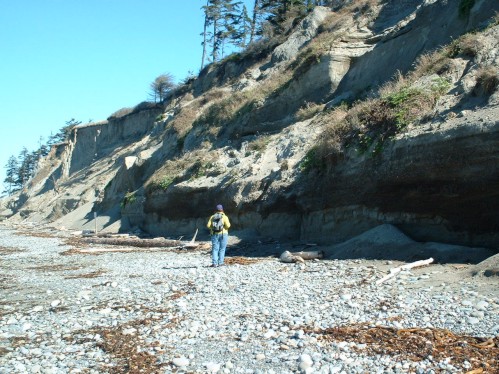
This shows some of the strata apparent within the till. The dark layer seen in that photo looks like this close up:
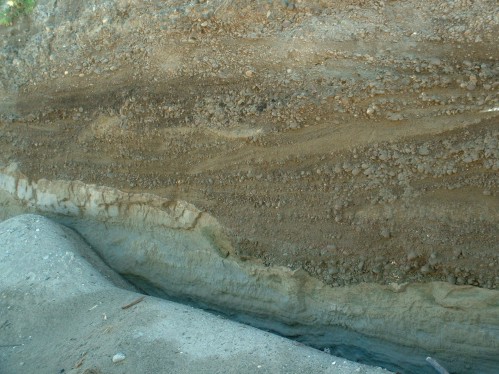
You can see it's got its own internal stratification, but overall is much coarser than the underlying deposits. The dark color is probably because it contains more water; the stuff underneath is much finer. That underlying junk is mostly compact silt, but I found some portions that ere a very hard, fine clay. I have been told that much of this clay, at least that found within the Puget Sound proper, was used extensively for pottery manufacture in the area.
Finally,

this shows some of the beach gravel, most of which presumably derives from the till. Note the wide variety of sizes and different materials present, all part of the junk the glaciers carried down from Canada and Alaska.
UPDATE: Last picture link fixed.
The second part of the trip went from a place called Ruby Beach, which I blogged about somewhere else at one time. There are far better photos here, but I have one geological photo:
Not about 2/3 of the way up that formation there is a line where the overlying glacial till contacts the underlying bedrock. These are very common deposits around western Washington, though I have only seen the upper portions of them; never where they come in contact with the basement rocks. More on this later.
Next was Sequim.
Sequim has a small museum with an exhibit devoted to the Manis Mastodon site. This is a fairly famous site for early North Americanists because it is one of the earliest associations of extinct Pleistocene megafauna with undoubted human artifacts (ca. 12,000 BP). The Museum and Art Center in Sequim has a few pictures of the exhibit here; I went to have a look but forgot my camera. There are also a few photos here.
The exhibit itself is not bad. On thing I did notice was in one explanatory card they stated unequivocally that the mastodonts were killed off by climate change. Obviously done up before Paul Martin started publishing! Or maybe after and whoever did it just didn't buy into Overkill.
The beach by Dungeness Spit contains some more of the till deposits noted above:
This shows some of the strata apparent within the till. The dark layer seen in that photo looks like this close up:
You can see it's got its own internal stratification, but overall is much coarser than the underlying deposits. The dark color is probably because it contains more water; the stuff underneath is much finer. That underlying junk is mostly compact silt, but I found some portions that ere a very hard, fine clay. I have been told that much of this clay, at least that found within the Puget Sound proper, was used extensively for pottery manufacture in the area.
Finally,
this shows some of the beach gravel, most of which presumably derives from the till. Note the wide variety of sizes and different materials present, all part of the junk the glaciers carried down from Canada and Alaska.
Atlantis found! Again. . . . Atlantis Rises Again
Eh. Whatever. Assuming someone was around that even knew of this island's existence 12,000 years ago, and assuming that the story was passed down for another 10,000 years, and assuming that the story changed very little in 10,000 years of retelling, and assuming that people kept track of how many years it had been for 10,000 years, and assuming that the story somehow ended up being passed over to the Mediterranean, well, I suppose. . . .
Like a very long game of telephone, the Atlantis story was orally passed down for 9000 years before Plato immortalized it in writing. "There occurred violent earthquakes and floods," he wrote. "And in a single day ... the island ... disappeared in the depths of the sea." Plato reports Atlantis sat off the coast of North Western Africa, sank 12,000 years ago, and was inhabited by an advanced civilization. Since Plato's time, scholars and nonscholars alike have claimed to have deciphered the location of the lost continent. One popular theory suggests that Atlantis was in Greece and perished by volcanic eruption 3500 years ago. Yet, Plato never reported volcanic ash; plus, the location and timing are off.
A sunken land mass suggested to be Atlantis in 2001 by geologist Jacques Collina-Girard of University of Aix en Provence in France also seemed a promising candidate because of its location off the northwest coast of Africa. His work indicated that the island, known as Spartel, sunk slowly under the rising sea levels of a melting ice age starting 20,000 years ago and that by 12,000 years ago it was less than 500 meters across. But this timing and gradual sinking also does not resemble Plato's account.
Eh. Whatever. Assuming someone was around that even knew of this island's existence 12,000 years ago, and assuming that the story was passed down for another 10,000 years, and assuming that the story changed very little in 10,000 years of retelling, and assuming that people kept track of how many years it had been for 10,000 years, and assuming that the story somehow ended up being passed over to the Mediterranean, well, I suppose. . . .
Tuesday, October 03, 2006
Vacation pictures, Part I
I spent a week around the Olympic Peninsula of Washington state, staying in two locations, the Lake Quinault rain forest and Sequim. Not to worry, gentle reader, I shall not bore you with dozens of images of "Marge and me loading up the car. . . .Marge and me waving goodbye. . . .Marge and me stopped at a gas station. . ." etc. I will provide only a few with some vague archaeological-ish connection.
The lake itself. . .
is glacial in origin, dating from the Wisconsin, created after glacial meltwater left a sediment dam (till) at the mouth of a valley. I couldn't find any depth measurements, but like most glacial lakes, it's probably pretty deep. The lake proper is also tribal-owned and the land surrounding it is Federal, so development is very limited. Consequently, not far off the roads is true wilderness. The area is well-watered (it is a rain forest after all) so the trees tend to grow quite large.
It's also prime Bigfoot hunting area. National Geographic did a program on Bigfoot and some guy was out there with loudspeakers broadcasting gorilla noises in hopes of attracting one.
I didn't see any.
Bigfoots, that is. Or Bigfeet?
There is other wildlife, however:
And by gummy, look what was on the trail first thing one morning:
Look closely and you can just make out the pad impressions (he slipped) with two claw depressions at the end of the two middle ones. Happily, I never saw the owner.
This is one of the more moderately-sized trees (with yours truly providing scale):

Many, if not most of these things, grow on old fallen trees, since the undergrowth is so thick it prevents most seedlings from getting a start. So often you'll see them growing out of what are called nursery logs:
Kinda hard to make out, but you can see the roots start well above the actual ground surface. Also interesting, you will often see several trees of similar age in a straight line resulting from them all starting on a single nursery log.
One of the more fierce denizens of the forest:

Stopped here for lunch one day. Not a bad spot, eh? It's the Quinault river about 7 miles upstream from the lake. The riverbed is so wide because of the copious amounts of rain, althugh it's been dry in these parts. It's a fairly competant river at times; the tree in the bed is one of the smaller ones in that area.
Finally, just a nice shot of a sunset:
I spent a week around the Olympic Peninsula of Washington state, staying in two locations, the Lake Quinault rain forest and Sequim. Not to worry, gentle reader, I shall not bore you with dozens of images of "Marge and me loading up the car. . . .Marge and me waving goodbye. . . .Marge and me stopped at a gas station. . ." etc. I will provide only a few with some vague archaeological-ish connection.
The lake itself. . .
is glacial in origin, dating from the Wisconsin, created after glacial meltwater left a sediment dam (till) at the mouth of a valley. I couldn't find any depth measurements, but like most glacial lakes, it's probably pretty deep. The lake proper is also tribal-owned and the land surrounding it is Federal, so development is very limited. Consequently, not far off the roads is true wilderness. The area is well-watered (it is a rain forest after all) so the trees tend to grow quite large.
It's also prime Bigfoot hunting area. National Geographic did a program on Bigfoot and some guy was out there with loudspeakers broadcasting gorilla noises in hopes of attracting one.
I didn't see any.
Bigfoots, that is. Or Bigfeet?
There is other wildlife, however:
And by gummy, look what was on the trail first thing one morning:
Look closely and you can just make out the pad impressions (he slipped) with two claw depressions at the end of the two middle ones. Happily, I never saw the owner.
This is one of the more moderately-sized trees (with yours truly providing scale):
Many, if not most of these things, grow on old fallen trees, since the undergrowth is so thick it prevents most seedlings from getting a start. So often you'll see them growing out of what are called nursery logs:
Kinda hard to make out, but you can see the roots start well above the actual ground surface. Also interesting, you will often see several trees of similar age in a straight line resulting from them all starting on a single nursery log.
One of the more fierce denizens of the forest:
Stopped here for lunch one day. Not a bad spot, eh? It's the Quinault river about 7 miles upstream from the lake. The riverbed is so wide because of the copious amounts of rain, althugh it's been dry in these parts. It's a fairly competant river at times; the tree in the bed is one of the smaller ones in that area.
Finally, just a nice shot of a sunset:
Archaeologists find 8800BC building
ARCHAEOLOGISTS said they have discovered an 11-millennium-old building with on the banks of the Euphrates River in northern Syria.
“A remarkable discovery has just been uncovered of a large circular building dating back to 8800BC near (the locality of) Ja'de,” said the head of the French archaeological team that made the find.
The building, much larger than normal houses, “had a collective use, probably for all of the village or a group,” Eric Coqueugniot said.
Archaeologists plan dig at former village near Aurora
Archaeologists want to learn more about a former village in eastern Iowa.
To do that, a dig will begin this month at a log cabin built in 1851 near Aurora.
That's according to Dan Cohen, director of the Buchanan County Conservation Department.
He says the cabin currently serves as the centerpiece of Buchanan County's Jakway Park. In the past, it has been a stage coach stop, an inn, a post office and polling place.
Trephination update Bulgarian Archaeologists: Ancient Thracians Made Brain Surgeries
Bulgarian archaeological expedition discovered an ancient Thracian man's skull, which had undergone cranium surgery.
The skull was found near the Southeast Bulgarian city of Svilengrad, where archaeologists make rescue excavations.
The trepanation was done for medical reasons and it is the first one believed to be from Thracian times, chief archaeologist Georgi Nehrizov commented. The find is dated year 2500-1800 BC.
Genome archaeology illuminates the genetic engineering debate
Interesting, but I don't know what to make of it in any serious way.
Genome Research's cover story for Oct. 2 tells a tale of "genome archaeology" by genetic researchers who dug deeply into the long history of maize and rice. Their resulting insights into plant genomic evolution may well fuel the fires of the genetically modified organism (GMO) controversy.
"Our findings elucidate an active evolutionary process in which nature inserts genes much like modern biotechnologists do. Now we must reassess the allegations that biotechnologists perform 'unnatural acts,' thereby creating 'Frankenfoods,'" said Professor Joachim Messing, project leader and director of the Waksman Institute of Microbiology at Rutgers, The State University of New Jersey.
By comparing corresponding segments of two maize (corn) chromosomes with each other, and then to a corresponding segment of rice, project scientists reconstructed a genetic history replete with "reconfiguration and reshuffling, reminiscent of working with Lego blocks," Messing said.
Interesting, but I don't know what to make of it in any serious way.
Okay then Study finds shoelace tags better than gold
A British study finds the device that prevents shoelaces from fraying was more valuable than gold to indigenous Cubans who traded with Columbus's fleet.
Archaeologists at University College London analyzed material from one of the largest burial sites in northeast Cuba. To their surprise very little gold was discovered, despite its relative abundance in the region. Instead, the most common artifacts were small metal tubes made of brass that were often threaded onto necklaces.
Well, that about wraps it up for out of body experiences Via Althouse:
Out-of-Body Experience? Your Brain Is to Blame
Technically, of course, they're not really proving that being able to reproduce an OOBE by stimulating this part of the brain is entirely equivalent to a "real" one, but it sure does go a long way towards explaining why people experience such things. There's always the small sample size and lack of controls inherent in this sort of thing -- you can't go around opening up the heads of a random sample of people and try reproducing it in all of them after all -- but it seems a rather intuitively satisfying start to a coherent explanation.
Out-of-Body Experience? Your Brain Is to Blame
They are eerie sensations, more common than one might think: A man describes feeling a shadowy figure standing behind him, then turning around to find no one there. A woman feels herself leaving her body and floating in space, looking down on her corporeal self.
Such experiences are often attributed by those who have them to paranormal forces.
But according to recent work by neuroscientists, they can be induced by delivering mild electric current to specific spots in the brain. In one woman, for example, a zap to a brain region called the angular gyrus resulted in a sensation that she was hanging from the ceiling, looking down at her body. In another woman, electrical current delivered to the angular gyrus produced an uncanny feeling that someone was behind her, intent on interfering with her actions.
Technically, of course, they're not really proving that being able to reproduce an OOBE by stimulating this part of the brain is entirely equivalent to a "real" one, but it sure does go a long way towards explaining why people experience such things. There's always the small sample size and lack of controls inherent in this sort of thing -- you can't go around opening up the heads of a random sample of people and try reproducing it in all of them after all -- but it seems a rather intuitively satisfying start to a coherent explanation.
Monday, October 02, 2006
More to learn from Indian Point
Over the past century, archaeologists have scratched the surface at Indian Point
William H. Holmes, an archaeologist with the Smithsonian Institution, first visited the Stafford peninsula between 1888 and 1910.
In 1934, Hugh Stabler and Richard Slattery, two amateur archaeologists from Washington, visited.
Cemetery archaeology Archaeologists Dig Outside Cemetery
A team of archaeologists is digging for answers about the past outside a cemetery where the future includes road construction.
. . .
Wendy Morrow with the JTA says, "There's been extensive historical studies done in the area and there are some people who recall some burials outside the walls of the cemetery."
News from. . . .Mehr! 3000-year-old skeleton, artifacts found at Narges Tappeh
Archaeologists have discovered a goat statuette and a bas-relief of a lizard buried with the skeleton of a woman in the cemetery of the Narges Tappeh ancient site near Gorgan, Golestan Province, the Persian service of CHN reported on Sunday.
“The goat statuette was located under the left arm of the woman, who was buried in a squatting position. The bas-relief of the lizard has been carved on the handle of a stick-like artifact, the likes of which have never been seen at any ancient Iranian site. The skeleton dates back to the first millennium BC,” archaeological team director Qorban-Ali Abbasi explained.
2,500 year-old jars unearthed
Not much else there.
Archaeologists have just finished their three-week excavation to unearth 30 jar tombs from a resident’s garden in Hue City.
The ground is owned by Nguyen Cong Man, who discovered the objects while digging up dirt to plant trees one month ago. He informed city authorities who permitted the excavation project in Phu O Village, Huong Chu Commune of the city’s Huong Tra District.
Not much else there.
Peer-review update This came across the EEF list:
Web journals threaten peer-review system
It's part of the Public Library of Science project. Called PLoS ONE, articles will be reviewed by an editor, but no peer review; instead, comments will be accepted, but no anonymous ones, and the article (apparently in the form it was originally posted) will then be archived. I.e., the author can provide additional commentary (and comments on the comments), but can't revise the paper further. The two main pros and cons:
That first point may be moot because there is still a gatekeeper in the editor(s) who, presumably, will maintain some standards and (should) have at least some expertise in the field (though from the article, it appears it's going to be a mishmash of biomedical stuff). I don't see the second part (rogue researchers trashing others' work) as a major problem, because they will be ratted out as quickly as the bad science will be; that's more or less the modus operandi of the blogosphere. OTOH, that might end up confusing the heck out of non-specialists who may not have the time or expertise to go fully into the comments.
One great thing this might do is encourage the publication of negative results. This isn't so much of an issue in archaeology, but elsewhere it can be a serious problem (known as publication bias). It might also encourage the publication of smaller studies that may not be definitive in and of themselves but possibly point to areas where more research is needed.
Web journals threaten peer-review system
Scientists frustrated by the iron grip that academic journals hold over their research can now pursue another path to fame by taking their research straight to the public online.
Instead of having a group of hand-picked scholars review research in secret before publication, a growing number of Internet-based journals are publishing studies with little or no scrutiny by the authors’ peers. It’s then up to rank-and-file researchers to debate the value of the work in cyberspace.
It's part of the Public Library of Science project. Called PLoS ONE, articles will be reviewed by an editor, but no peer review; instead, comments will be accepted, but no anonymous ones, and the article (apparently in the form it was originally posted) will then be archived. I.e., the author can provide additional commentary (and comments on the comments), but can't revise the paper further. The two main pros and cons:
Not all studies are useful and flooding the Web with essentially unfiltered research could create a deluge of junk science. There’s also the potential for online abuse as rogue researchers could unfairly ridicule a rival’s work.
Supporters point out that rushing research to the public could accelerate scientific discovery, while online critiques may help detect mistakes or fraud more quickly.
That first point may be moot because there is still a gatekeeper in the editor(s) who, presumably, will maintain some standards and (should) have at least some expertise in the field (though from the article, it appears it's going to be a mishmash of biomedical stuff). I don't see the second part (rogue researchers trashing others' work) as a major problem, because they will be ratted out as quickly as the bad science will be; that's more or less the modus operandi of the blogosphere. OTOH, that might end up confusing the heck out of non-specialists who may not have the time or expertise to go fully into the comments.
One great thing this might do is encourage the publication of negative results. This isn't so much of an issue in archaeology, but elsewhere it can be a serious problem (known as publication bias). It might also encourage the publication of smaller studies that may not be definitive in and of themselves but possibly point to areas where more research is needed.
Subscribe to:
Posts (Atom)