A discovery near Rehoboth Bay has archaeologists across the state buzzing with excitement.
At first glance, what might look like an unimpressive bit of black and wet kindling is a "rare and wonderful" find, said archaeologist Dan Griffith. What he and others recently found below the surface is the remains of a well casement dating to about 1675.
Roughly two and a half feet square and almost three feet tall, the water-logged wooden frame was found so beautifully preserved that workers were able to knock out trunnel pins or "pegs" in the mortise and tenon joints that held the oak structure together so that it could be easily moved to a conservation lab.
Monday, September 24, 2007
It makes the past come alive' Archaeologists discover preserved well casement dating to the 1600s
The first Helenans
It's not a bad article. Much of it is summarizing Clovis, but the last bit is on the post-contact Kootenai, which I really don't know much about, I'm afraid.
[S]ome histories are written on paper. Others are revealed by landscapes, rocks, bones and human memory.
Now new computer technologies and archaeological investigations in the past decade are revealing data and discoveries that have historians rethinking the early history of the Americas, including that of the Helena Valley.
“The canon (of history) is being rewritten,” said historian Nicholas Vrooman, who is also interim director of the Helena Indian Alliance.
“Much of American history can be found by looking at one place on the face of the Earth and watching it transform over time. The Helena Valley is such a place,” he said.
It's not a bad article. Much of it is summarizing Clovis, but the last bit is on the post-contact Kootenai, which I really don't know much about, I'm afraid.
The Simpsons' homage to Raiders of the Lost Ark
I've never actually seen the clip that this is based on. Had a friend of mine rolling on the floor, but I've never managed to actually see it.
There's also one for 2001 but he/they neglected one episode where Homer went into space and there was a section from 2001 in that one, too.
UPDATE: Well, okay, here's the video. Is there anything you can't find on the Internets?
Update II: And I just went on iTunes and bought the Indy soundtrack. Actually, it's this one if that link works. Oddly, I'd never gotten any of the Indy soundtracks before. Always liked the music though.
And the only time I've ever let the theme flit through my mind was on a few occasions while studying for my comps when I'd be heading over to the library to read a bunch of references on some arcane archaeological subject and the absurdity of it all would strike my fancy.
I've never actually seen the clip that this is based on. Had a friend of mine rolling on the floor, but I've never managed to actually see it.
There's also one for 2001 but he/they neglected one episode where Homer went into space and there was a section from 2001 in that one, too.
UPDATE: Well, okay, here's the video. Is there anything you can't find on the Internets?
Update II: And I just went on iTunes and bought the Indy soundtrack. Actually, it's this one if that link works. Oddly, I'd never gotten any of the Indy soundtracks before. Always liked the music though.
And the only time I've ever let the theme flit through my mind was on a few occasions while studying for my comps when I'd be heading over to the library to read a bunch of references on some arcane archaeological subject and the absurdity of it all would strike my fancy.
Breaking news Report: Herod's Temple quarry found
Which is neat. I found this of interest as well:
Often, the screw-ups are some of the more interesting items found. In our 1996 season at Memphis (ARCE Field School) the only intact ceramic vessel we found was a nifty little bowl that had misfired and was misshappen. That area was probably a dumping ground for various ceramics manufacturing activities, so I'm always tickled that that reject came down as the only intact survivor.
Also, there is a particular type of Predynastic pottery called black-topped brown/red war. The way they made it was (probably) by taking the vessel out of the kiln and inverting it into some organic debris (sawdust maybe) and letting the top get blackened. Anyway, I was in the Petrie Museum and saw one jar that had no black on the top, but had a big spot of it on its side. Apparently, someone had dropped it before they could get it into the proper upside down position. I still wonder what word Egyptians used when they botched something up.
Israeli archaeologists said they have discovered a quarry that provided King Herod with the stones he used to renovate the biblical Second Temple compound — offering rare insight into construction of the holiest site in Judaism.
The source of the huge stones used 2,000 years ago to reconstruct the compound in Jerusalem's Old City was discovered on the site of a proposed school in a Jerusalem suburb.
. . .
"This is the first time stones which were used to build the Temple Mount walls were found," said Yuval Baruch, an archaeologist with the Israeli Antiquities Authority involved in the dig.
Which is neat. I found this of interest as well:
But researchers said the strongest piece of evidence was found wedged into one of the massive cuts in the white limestone — an iron stake used to split the stone. The tool was apparently improperly used, accidentally lodged in the stone and forgotten.
"It stayed here for 2,000 years for us to find because a worker didn't know what to do with it," said archaeologist Ehud Nesher, also of the Antiquities Authority.
Often, the screw-ups are some of the more interesting items found. In our 1996 season at Memphis (ARCE Field School) the only intact ceramic vessel we found was a nifty little bowl that had misfired and was misshappen. That area was probably a dumping ground for various ceramics manufacturing activities, so I'm always tickled that that reject came down as the only intact survivor.
Also, there is a particular type of Predynastic pottery called black-topped brown/red war. The way they made it was (probably) by taking the vessel out of the kiln and inverting it into some organic debris (sawdust maybe) and letting the top get blackened. Anyway, I was in the Petrie Museum and saw one jar that had no black on the top, but had a big spot of it on its side. Apparently, someone had dropped it before they could get it into the proper upside down position. I still wonder what word Egyptians used when they botched something up.
Sunday, September 23, 2007
Jerusalem tunnel update See the comment by David Sanders in this post for a link to an article by Norman Golb of U Chicago.
Honoring the Bones
Cracked and yellow with age, sealed in zippered plastic bags and large cardboard boxes, the bones are believed to be the remains of more than 50 19th-century European immigrants, among them victims of the Irish potato famine. There are about 10 intact adult skeletons, most of them men in their 20s and 30s. There are smaller skeletons too, but none complete; children’s bones tend to disintegrate in acidic soil.
Dr. Amorosi is a physical anthropologist. On an overcast August day last year, he and a team of archaeologists dug up the bones from beneath the fractured asphalt of a municipal parking lot in St. George, Staten Island. The bones had been found during excavation for a $109 million courthouse complex.
NEW THRACIAN TOMB FOUND IN BULGARIA
Not much on what was actually in it, I'm afraid.
Archaeologists found a Thracian tomb near the town of Ivailovgrad, at the Bulgarian-Greek border.
The tomb was discovered during excavations, led by the Thracian archaeology expert Georgi Nehrizov, Bulgarian Academy of Science’s National Institute of Archaeology and Museum said.
Treasure-hunters destroyed the antechamber of the tomb with a digger in the autumn of 2006, but the burial chamber is completely preserved, two m high and two to 1.8 m wide.
Not much on what was actually in it, I'm afraid.
Archaeologists unearth ancient city in Turkey's south-west Aegean province
Ankara, Sept 19: Archaeologists are unearthing the ancient city of Tabea in the Aegean province of Denizli in south-west Turkey.
Governor Hasan Canpolat said excavations have started at three parts of the ancient city in Denizli's Kale district.
Canpolat visited the excavation area with Kale provincial administrator, Ömer Dagdeviren, Kale mayor, Abdullah Karaayvaz, and Denizlli Culture and Tourism provincial director, Mehmet Korkmaz.
Archaeology experts 'thrilled' by discoveries
MORE fascinating finds have been unearthed in the second week of a major archaeological project in Fort William.
Experts are "thrilled" by discoveries made in the town's Parade area, while fresh digs at the Old Fort have also uncovered more exciting links to Fort William's military history.
Mystery boy in iron coffin identified
That's actually a pretty neat bit of detective work. There's a photo there and it shows how tightly the body was packed into the coffin.
Researchers have solved the mystery of the boy in the iron coffin. The cast-iron coffin was discovered by utility workers in Washington two years ago. Smithsonian scientists led by forensic anthropologist Doug Owsley set about trying to determine who was buried in it, so the body could be placed in a new, properly marked grave.
The body was that of 15-year-old William Taylor White, who died in 1852 and was buried in the Columbia College cemetery, they announced Thursday.
"The mystery of this young boy's life and a strong sense of responsibility to properly identify him kept me and the entire team focused and determined. This was not a one-person project. It took more than three dozen people nearly two years to make the ID," Deborah Hull-Walski, an anthropologist at the Smithsonian's National Museum of Natural History, said in a statement.
That's actually a pretty neat bit of detective work. There's a photo there and it shows how tightly the body was packed into the coffin.

Saturday, September 22, 2007
Homo hobbitus update Hobbits of Indonesia were different human species
No comments on it yet.
Ever since there has been debate whether or not the bones were actually from pygmies - even today there are pygmies on the island - and not a new species of human that lived between 120,000 and 10,000 years ago. One idea is that they suffered from microcephaly, a disorder that limits brain growth.
Today in the journal Science an analysis of three wrist bones of one of the fossil specimens (called LB1) led by Matthew Tocheri of the Smithsonian Institution, Washington, and including Prof Morwood and colleagues in Indonesia and America shows that the bones are primitive and shaped differently compared to both the wrist bones of both humans and of Neanderthals, suggesting they do represent a different kind of human.
No comments on it yet.
Friday, September 21, 2007
Dept. of unfortunate acronyms SLUT -- Streetcar's unfortunate acronym seems here to stay
This quote seems fairly typical for around here: "There was a meeting with representatives from the city several years ago," Johnson recalled. "They asked us what we could do for you. Most people raised their hands and said 'affordable housing,' " he said. "Then the people from the city huddled together -- 'whisper, whisper, whisper,' -- and they said, 'How about a trolley?' "
Sad to say, I probably won't ever ride the SLUT. I mean, this SLUT will be like the village bicycle, everybody will have a ride. But then, you don't ride a SLUT just because it would be fun. I don't have much cause to go through that part of town, and so if I did at some point, everyone would know it was only to ride the SLUT. Besides, I'm a pretty experienced rider of these sorts of SLUTs, having ridden some in London and Cairo and Paris often. I'm afraid this SLUT probably won't compare very favorably with those more established ones. Still, a brand new, young SLUT does have a certain allure. Everything's still all nice and clean, the hardware all works, and everyone will be enthusiastic. But youthful enthusiasm only goes so far; sometimes having had a lot of riders makes a SLUT just plain more experienced. You know, one that's been around the block a few times will probably get you going faster and more efficiently. But who knows, I'll find out from other people of this SLUT is worth a ride and maybe I'll end up trying it.
Okay, stopping now.
There's a story going around South Lake Union, but a spokeswoman for Vulcan, Paul Allen's development company, says it's just an urban legend.
That aside, the story that the neighborhood's streetcar line now under construction was called the South Lake Union Trolley until the powers that be realized the unfortunate acronym -- SLUT -- seems here to stay.
Officially, it's now the South Lake Union Streetcar. But the trolley name already has caught on, and in the old Cascade neighborhood in South Lake Union, they're waiting for the SLUT.
At the Kapow! Coffee house on Harrison Street, they're selling T-shirts that read "Ride the SLUT."
This quote seems fairly typical for around here: "There was a meeting with representatives from the city several years ago," Johnson recalled. "They asked us what we could do for you. Most people raised their hands and said 'affordable housing,' " he said. "Then the people from the city huddled together -- 'whisper, whisper, whisper,' -- and they said, 'How about a trolley?' "
Sad to say, I probably won't ever ride the SLUT. I mean, this SLUT will be like the village bicycle, everybody will have a ride. But then, you don't ride a SLUT just because it would be fun. I don't have much cause to go through that part of town, and so if I did at some point, everyone would know it was only to ride the SLUT. Besides, I'm a pretty experienced rider of these sorts of SLUTs, having ridden some in London and Cairo and Paris often. I'm afraid this SLUT probably won't compare very favorably with those more established ones. Still, a brand new, young SLUT does have a certain allure. Everything's still all nice and clean, the hardware all works, and everyone will be enthusiastic. But youthful enthusiasm only goes so far; sometimes having had a lot of riders makes a SLUT just plain more experienced. You know, one that's been around the block a few times will probably get you going faster and more efficiently. But who knows, I'll find out from other people of this SLUT is worth a ride and maybe I'll end up trying it.
Okay, stopping now.
Thursday, September 20, 2007
Philistines! Archeology: Serendipity in the Negev
In late July, archaeologists and students from four universities in three countries - Israel, Germany and Canada - converged on a remote, blisteringly hot hilltop in the northern Negev. Their goal was to perform the first ever archaeological excavation of a Philistine agricultural village, as compared to an urban area or a tel.
"We had a surprise," says co-director Prof. Steve Rosen of Ben-Gurion University of the Negev (BGU). "Based on prior surveys and test excavations of the site, Qubur al-Walaydah, we believed we'd find a Philistine farming village - an early Iron Age, transitional Bronze Age, farming community. Well, it was there and we found it - with evidence of lots of Philistines. Unfortunately, not much of it was left. It was situated very high up and most of it had been destroyed long ago by plowing."
History Rewritten on Cherokee Collapse
He's arguing that it was a series of events including an inability to produce enough through farming because of warfare.
The date of the Cherokee society's collapse is often cited as 1785, when several tribes signed the Treaty of Hopewell and came under the jurisdiction of the new United States of America. Resource scarcity was the major factor in the dissolution, many historians have thought, based on an eyewitness narrative of sparse settlement patterns.
But the Cherokee of the Southeastern United States actually had plenty of land, crops and animals to go around, the new land-usage research indicates. The collapse was more likely instigated by a series of events that occurred over a period of a few decades, said University of Georgia anthropologist Ted Gragson.
He's arguing that it was a series of events including an inability to produce enough through farming because of warfare.
More paleoanth Lost in a Million-Year Gap, Solid Clues to Human Origins
Good long article.
UPDATE: Related.
Sometimes the maturity of a field of science can be measured by the heft of its ambition in the face of the next daunting unknown, the mystery yet to be cracked.
Neurobiology probes the circuitry of the brain for the secrets of behaviors and thoughts that make humans human. High-energy physics seeks and may be on the verge of finding the so-called God particle, the Higgs boson thought to endow elementary particles with their mass. Cosmology is confounded by dark matter and dark energy, the pervasive but unidentified stuff that shapes the universe and accelerates its expansion.
In the study of human origins, paleoanthropology stares in frustration back to a dark age from three million to less than two million years ago. The missing mass in this case is the unfound fossils to document just when and under what circumstances our own genus Homo emerged.
Good long article.
UPDATE: Related.
Local historians locate Lake Michigan shipwreck
An Illinois-based group named for a local historian thinks it has found the remains of a ship that once carried escaping slaves to freedom before it was destroyed by slave hunters on the shore of Lake Michigan in Ogden Dunes.
Roger Barski, an underwater photographer and ex-Hollywood lighting technician, presented the findings of the Briggs Project to a spellbound audience of two dozen history buffs at a meeting of the Portage Community Historical Society on Tuesday night.
Barski is a Project leader and a member of the underwater Archaeological Society of Chicago. He served as official photographer for the Kankakee Valley Historical Association's 2005 excavation at the Collier Lodge near Kouts.
New monuments discovered near Luxor temple
A collection of new kingdom pillars, lintels and reliefs were accidentally found by Egyptian restorers from the Supreme Council of Antiquities (SCA), Egyptian Minister of Culture Farouk Hosny said Thursday.
The monuments were discovered within the internal walls of Abul Haggag El Loxory mosque, built on top of the open court of Luxor temple during restoration operations, Farouk added.
Hmmmmmmm. . . . Japan's Ancient Underwater "Pyramid" Mystifies Scholars
There's a few photos of the underwater site and a couple comparative ones of terrestrial features. One can certainly see how they could appear man-made, but it will take far more conclusive evidence than this.
Submerged stone structures lying just below the waters off Yonaguni Jima are actually the ruins of a Japanese Atlantis—an ancient city sunk by an earthquake about 2,000 years ago.
That's the belief of Masaaki Kimura, a marine geologist at the University of the Ryukyus in Japan who has been diving at the site to measure and map its formations for more than 15 years.
. . .
"The largest structure looks like a complicated, monolithic, stepped pyramid that rises from a depth of 25 meters [82 feet]," said Kimura, who presented his latest theories about the site at a scientific conference in June.
There's a few photos of the underwater site and a couple comparative ones of terrestrial features. One can certainly see how they could appear man-made, but it will take far more conclusive evidence than this.
Treasure trove of Homo erectus found
A trove of the oldest human skeletal bones outside Africa is reported in Nature this week — a find that will help researchers to improve their understanding of the biology of the 1.8-million-year-old hominins.
The work, led by researchers from the Georgian National Museum in Tbilisi, describes three-dozen fossils from the skeletons of four primitive Homo erectus individuals found in recent years at Dmanisi in Georgia, central Asia.
H. erectus is thought to have migrated across Asia after coming out of Africa, where the oldest relative of man is traced to nearly 7 million years ago. H. erectus fossils have been found from Africa across Asia as far as Indonesia. Typically there are only a few scattered fossils at one location. A single site with so many bones from so many individuals is rare. And they date back to very soon after H. erectus's exodus from Africa.
Tuesday, September 18, 2007
Field photos du jour This is actually sort of an update to this post on the Fayum. I have a couple more photos of the northern escarpment. This first one was taken in 1994 from the first escarpment near the western edge of Birket Qarun (the lake) near Qasr Qarun (map here). I went up here because the 1905 maps indicated that there were chert/flint deposits on top of that first bench. This is a view facing back eastwards:
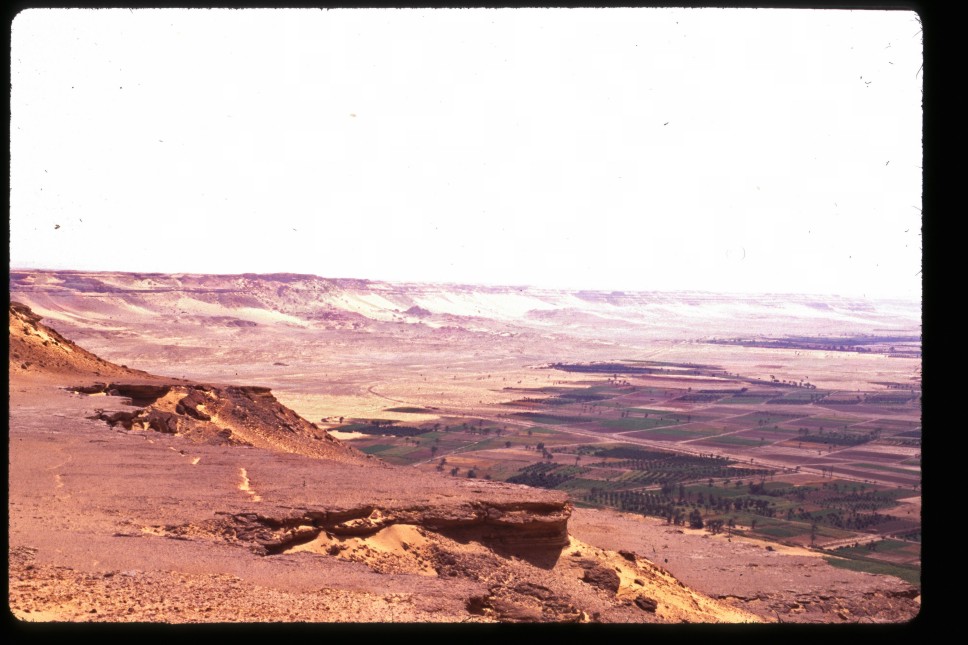
Full image here.
And another from the same spot looking east but a little further south as well:
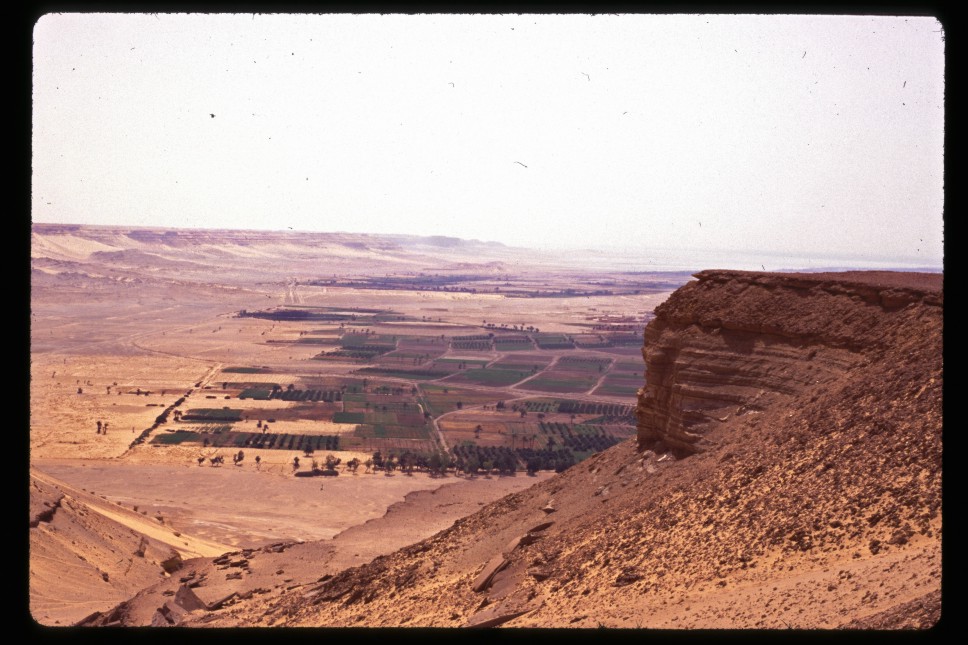
Full image here.
We came up from the bottom along that wadi going down. Most of it was filled with sand, and about halfway up we spied this little critter:
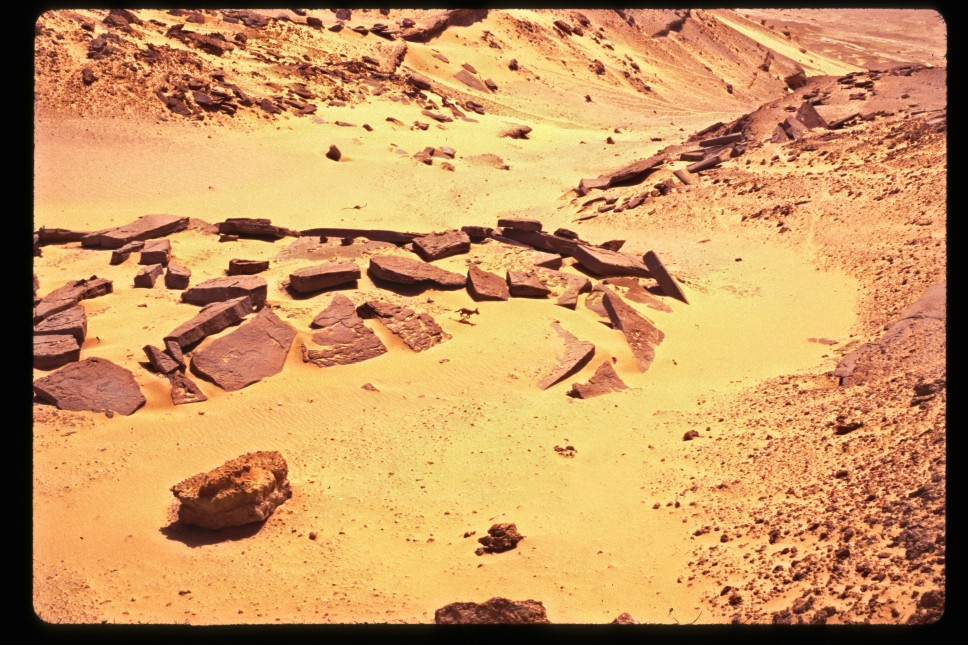
Full image here.
A desert fox! He's dead center running across.
Lastly, we come to something that illustrates one of the great dangers of archaeology. . .not to life and limb, but. . . .wait, it is to life and limb:
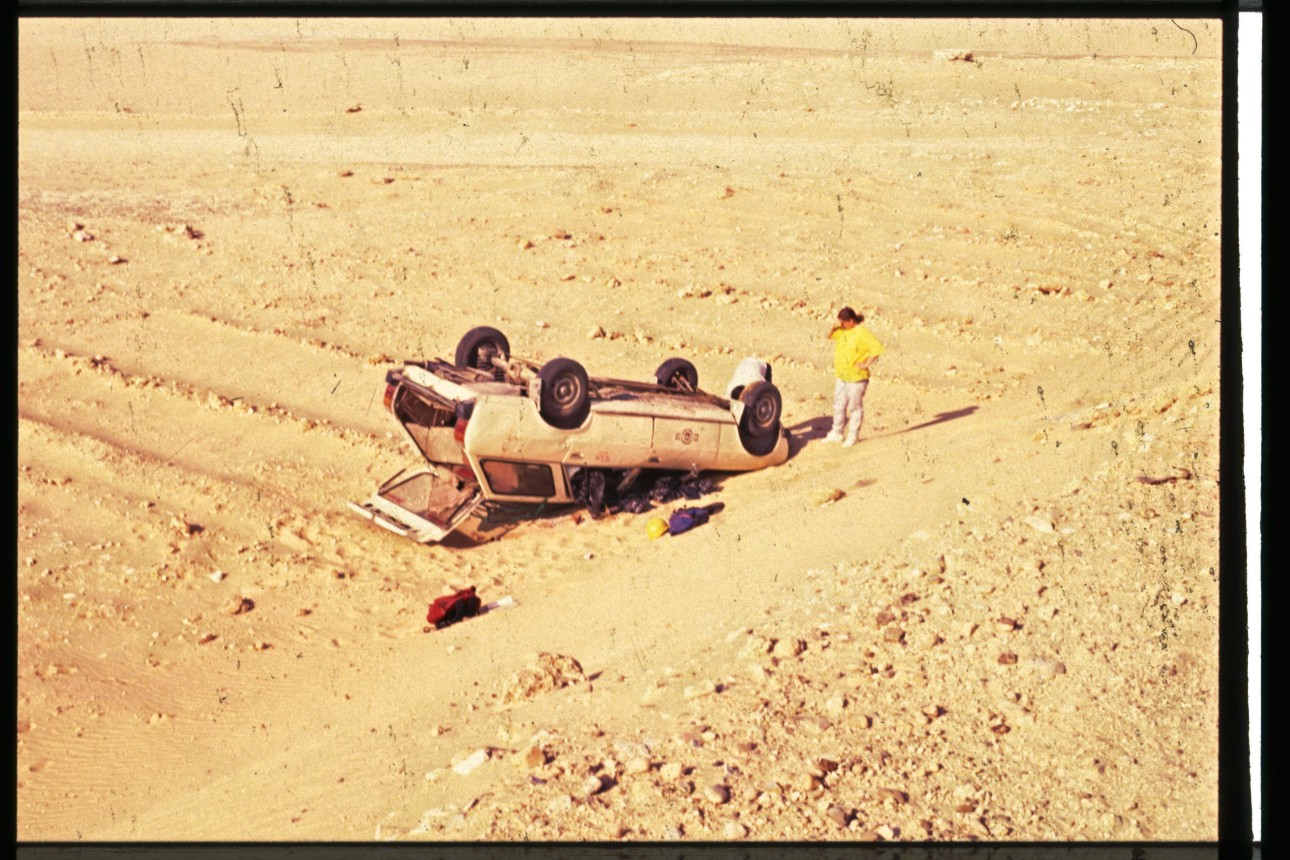
Full image here.
We were driving out to Wadi Rayan which is southwest of the Fayum. It was a nice new road so we were bombing along at like 60 wen we rounded a curve and found that a sand dune had covered most of the road. So the driver swerved and over the embankment we went, rolling over about 3.5 times and ending up as you see there. The only thing I was thinking as we were rolling was "So this is what a real rollover accident looks like. . ."
Nobody was really hurt (odd since seat belts are virtually unused). The horn still worked!
Full image here.
And another from the same spot looking east but a little further south as well:
Full image here.
We came up from the bottom along that wadi going down. Most of it was filled with sand, and about halfway up we spied this little critter:
Full image here.
A desert fox! He's dead center running across.
Lastly, we come to something that illustrates one of the great dangers of archaeology. . .not to life and limb, but. . . .wait, it is to life and limb:
Full image here.
We were driving out to Wadi Rayan which is southwest of the Fayum. It was a nice new road so we were bombing along at like 60 wen we rounded a curve and found that a sand dune had covered most of the road. So the driver swerved and over the embankment we went, rolling over about 3.5 times and ending up as you see there. The only thing I was thinking as we were rolling was "So this is what a real rollover accident looks like. . ."
Nobody was really hurt (odd since seat belts are virtually unused). The horn still worked!
Bronze Age burial site unearthed
A Bronze Age burial site has been unearthed by archaeologists working at a quarry in Cambridgeshire.
The find was made at Pode Hole Quarry, in Thorney, near Peterborough, where a child's skeleton has been uncovered.
Teams had already discovered the 3,500-year-old remains of a man at the quarry, in July.
Archaeologist Andy Richmond said the find was significant as it helped to piece together the history of life on the edge of the Fens.
Ethics and archaeology Tricky Ethics
Doubtful they'll ever be returned because they'd be looted within a week, probably. Unfortunately, part of archaeology these days is getting the goods out before the looters do. Whether to display them is another issue. Whether to even look for them in the first place -- thus letting potential looters know where the stuff is -- might also be an issue.
Archaeologists have a dark history. Dogged by their 19th century predecessors who thought nothing of essentially looting artifacts, exploiting First Nations people, ignoring laws regarding access to sites and grave robbing, today's archaeologists and anthropologists are still trying to repair their tarnished reputation.
So what to make of the story, recently published in the New York Times, of the "maiden, the boy, [and] the girl of lightning?" These children, ritually sacrificed 500 years ago on a volcano near the border of Chile and Argentina, were removed in 1999 by archaeologists. The cold, dry air in their burial chamber preserved them remarkably well; their features are as recognizable as the last open casket funeral you attended. After several years of extensive study and testing, a decision was made to display "La Doncella," the oldest of the children, at the Museum of High Altitude Archaeology in Salta, Argentina.
Doubtful they'll ever be returned because they'd be looted within a week, probably. Unfortunately, part of archaeology these days is getting the goods out before the looters do. Whether to display them is another issue. Whether to even look for them in the first place -- thus letting potential looters know where the stuff is -- might also be an issue.
Just when you thought personal care had gone everywhere Now comes. . . .Anal bleaching!:
So there you have it. And y'all thought just brushing your teeth was enough. . . .
Regular archaeological programming will resume shortly.
The first thing you need to know about Anal Bleaching is that it is REAL! Anal Bleaching is a growing trend started as a response to waxing salon customers who were concerned that their anal and vaginal areas were dark.
Featured on E! Network's program Dr. 90210 which highlights interesting and unusual cosmetic procedures, a recent episode showcased customer and porn star Tabitha Stevens having the treatment done.
Originally, anal and vaginal lightening was discovered by adult film stars, dancers, models, beauty-concious celebrities and others on the forefront of the waxing trend who were "exposed" and wanted to enhance the appearance of the anal, vaginal and other areas. However, they had to go to special salons and use harsh chemicals that could have potentially harmful side effects. As the popularity of bikini waxing grew, more waxing customers began noticing that their genital areas were darker than normal. It became a genuine concern from regular housewives and people in general. And the requests were coming in more and more.
So there you have it. And y'all thought just brushing your teeth was enough. . . .
Regular archaeological programming will resume shortly.
Monday, September 17, 2007
"Cairo. . . .city of the living. . .a paradise on earth" Andie has a post up on houseboats of the Nile. They're apparently becoming a dying breed. Which is kind of a shame because they're probably the most pleasant manner of habitation in Cairo. ARCE maintained a houseboat for visiting guests and the Cairo director for many years, finally abandoning it in the early 1990s. It was a classic 1930s-style thing, just like you see in the movies. You reached it by going down a walkway bounded by a lot of plant life to the boat and then crossed a short gangplank onto the boat. It had bedrooms, an office, kitchen, bathrooms, the whole shebang. It was very quiet, on the west shore just south of the University bridge. I think they called it the Fustat.
I first stayed on it in 1988. The next time I went back, in 1991, it was in a sad state of disrepair. I imagine it must have been expensive to maintain, and it was quite a distance from the main ARCE offices downtown by the Museum. They eventually decided to buy more space in their existing building, refurbish everything with some guestrooms for visitors, and just sell the old houseboat. It's too bad they couldn't have kept it for some purpose because it really was a treat to stay on it. I'll have to dig up some pictures of it if I have any.
I first stayed on it in 1988. The next time I went back, in 1991, it was in a sad state of disrepair. I imagine it must have been expensive to maintain, and it was quite a distance from the main ARCE offices downtown by the Museum. They eventually decided to buy more space in their existing building, refurbish everything with some guestrooms for visitors, and just sell the old houseboat. It's too bad they couldn't have kept it for some purpose because it really was a treat to stay on it. I'll have to dig up some pictures of it if I have any.
Do We Really Know What Makes Us Healthy?
I post this in part because it's a good article and explains in good laymen's terms many of the problems with epi research, and because it goes into why most research is probably wrong (though see a counter argument here). Gold standards are tough to come by, even case-controlled double-blind placebo-controlled clinical trials. Definitely read the whole thing closely, even when it gets a bit techy.
Ought to provide a corrective to much thinking in archaeology when what is itself a "gold standard" research methodology is called into broad question; and archaeologists usually have more problems with sample size and representativeness, and far less control over measurement adequacy.
I like to think we're somewhat more immune to "consensus" thinking, given that finding consensus on nearly anything is virtually impossible anyway, given the rebelliousness of anthropologists in general. Even when "Clovis First" was something one might be considered "consensus", by far the majority of archaeologists would readily concede that it was only so because evidence of previous habitations weren't there (of course, there were rebels on both sides, some arguing that the standards of evidence were too high, others that they were too low). But still, I would argue that what consensus there was had more to do with data absence than presence. The same strictures would apply to Overkill, though outside of archaeology proper, it's probably "consensus" that humans killed off the megafauna.
Some of this isn't strictly applicable to the archaeological question, obviously; you wouldn't need a large sample of pre-Clovis sites to demonstrate pre-Clovis occupation, just one that was securely dated. On the converse, a hundred poorly dated sites don't add up to one good one. But the correlation <> causation warning should probably be given far more credence that it usually is.
Eh, that's going a bit far afield. It's a good article.
Once upon a time, women took estrogen only to relieve the hot flashes, sweating, vaginal dryness and the other discomforting symptoms of menopause. In the late 1960s, thanks in part to the efforts of Robert Wilson, a Brooklyn gynecologist, and his 1966 best seller, “Feminine Forever,” this began to change, and estrogen therapy evolved into a long-term remedy for the chronic ills of aging. Menopause, Wilson argued, was not a natural age-related condition; it was an illness, akin to diabetes or kidney failure, and one that could be treated by taking estrogen to replace the hormones that a woman’s ovaries secreted in ever diminishing amounts. With this argument estrogen evolved into hormone-replacement therapy, or H.R.T., as it came to be called, and became one of the most popular prescription drug treatments in America.
By the mid-1990s, the American Heart Association, the American College of Physicians and the American College of Obstetricians and Gynecologists had all concluded that the beneficial effects of H.R.T. were sufficiently well established that it could be recommended to older women as a means of warding off heart disease and osteoporosis. By 2001, 15 million women were filling H.R.T. prescriptions annually; perhaps 5 million were older women, taking the drug solely with the expectation that it would allow them to lead a longer and healthier life. A year later, the tide would turn. In the summer of 2002, estrogen therapy was exposed as a hazard to health rather than a benefit, and its story became what Jerry Avorn, a Harvard epidemiologist, has called the “estrogen debacle” and a “case study waiting to be written” on the elusive search for truth in medicine.
Many explanations have been offered to make sense of the here-today-gone-tomorrow nature of medical wisdom — what we are advised with confidence one year is reversed the next — but the simplest one is that it is the natural rhythm of science. An observation leads to a hypothesis. The hypothesis (last year’s advice) is tested, and it fails this year’s test, which is always the most likely outcome in any scientific endeavor. There are, after all, an infinite number of wrong hypotheses for every right one, and so the odds are always against any particular hypothesis being true, no matter how obvious or vitally important it might seem.
I post this in part because it's a good article and explains in good laymen's terms many of the problems with epi research, and because it goes into why most research is probably wrong (though see a counter argument here). Gold standards are tough to come by, even case-controlled double-blind placebo-controlled clinical trials. Definitely read the whole thing closely, even when it gets a bit techy.
Ought to provide a corrective to much thinking in archaeology when what is itself a "gold standard" research methodology is called into broad question; and archaeologists usually have more problems with sample size and representativeness, and far less control over measurement adequacy.
I like to think we're somewhat more immune to "consensus" thinking, given that finding consensus on nearly anything is virtually impossible anyway, given the rebelliousness of anthropologists in general. Even when "Clovis First" was something one might be considered "consensus", by far the majority of archaeologists would readily concede that it was only so because evidence of previous habitations weren't there (of course, there were rebels on both sides, some arguing that the standards of evidence were too high, others that they were too low). But still, I would argue that what consensus there was had more to do with data absence than presence. The same strictures would apply to Overkill, though outside of archaeology proper, it's probably "consensus" that humans killed off the megafauna.
Some of this isn't strictly applicable to the archaeological question, obviously; you wouldn't need a large sample of pre-Clovis sites to demonstrate pre-Clovis occupation, just one that was securely dated. On the converse, a hundred poorly dated sites don't add up to one good one. But the correlation <> causation warning should probably be given far more credence that it usually is.
Eh, that's going a bit far afield. It's a good article.
Sunday, September 16, 2007
Field photos du jour These are from a little side trip I took to the Fayum in 1991 while doing other work in the valley of the Kings. The area is the northern part of the depression near the Qasr el-Sagha temple. This s a photo of the temple:
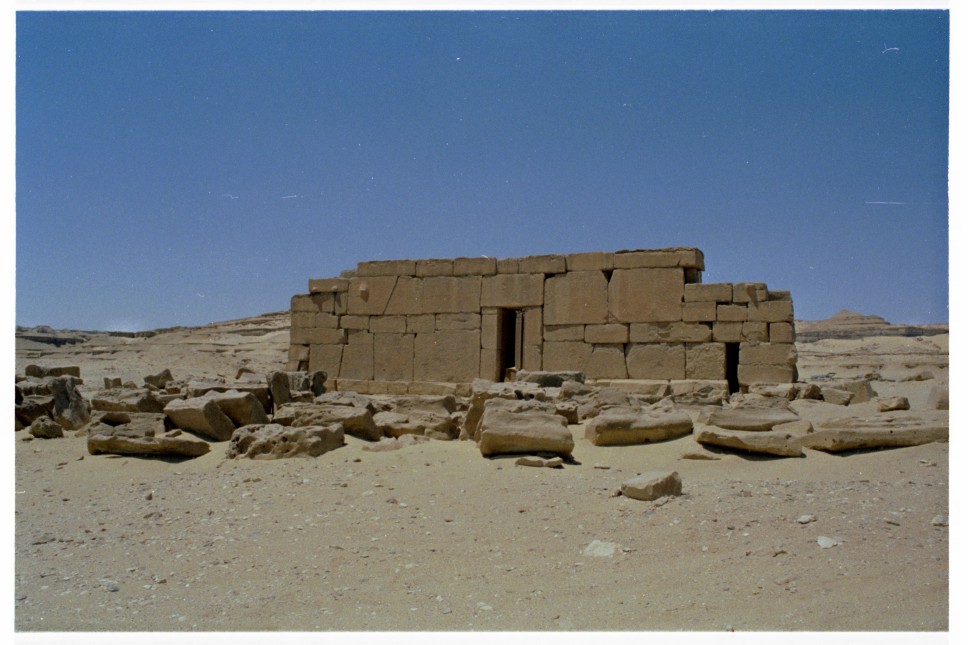
Full photo here.
It's kind of a funny little temple. Its construction has been variously described as Old or Middle Kingdom and most often thought to be dedicated to Sobek. The blocks making up the structure are of various sizes and shapes and fit together without mortar.
But that's not what this post is about. The temple sits at the base of a spectacular series of cliffs known as the Qasr el-Sagha escarpment. The northern rim of the depression is lined with escarpments of late Eocene (ca. 33.7-40 mya) and Oligocene (33.7 to 23.8 mya) age. The Qasr el-Sagha Formation is probably one of the most extensively studied of the Tertiary sequences in the Fayum, partly because of the escarpment (QeS is the formation's type site) and also because it is the equivalent of the Upper Mokattam (Ma’adi Formation) beds of the Gebel Mokattam near Cairo which also forms spectacular cliffs there.

Full photo here.
The formation itself is around 200m thick and is made up of a series of alternating crossbedded sand, sandstones, clays, marls, and limestones with abundant Ostrea, Carolia, and Turritella, along with numerous vertebrate species (Beadnell 1905:50-51). The environment throughout most of the sequence was a nearshore and estuarine or delta environment or as Bown and Kraus put it, a "retreat of shallow seas coupled with a concomitant advance of lagoonal and lowland coastal alluvial plain envronments" (Bown and Krauss 1988:48). The specific section here was probably a marine bar or estuary, perhaps lagoonal or the lee side of barrier islands. The temple member, shown above is one of the shallow (<20m) nearshore environments. A closeup of part of the formation:

Full photo here.
reveals the base of one stratum containing numerous burrow casts. Traversing up the various escarpments is geology at its finest, where one is able to note the changing environments and fossil contents with almost every step.
References:
Beadnell, H. J. L. (1905). The topography and geology of the Fayum Province of Egypt. Cairo., National Printing Department.
Bown, T. M. and M. J. Kraus (1988). Geology and paleoenvironment of the Oligocene Gebel Qatrani Formation and adjacent rocks, Fayum Depression, Egypt. Washington, United States Government Printing Office.
Full photo here.
It's kind of a funny little temple. Its construction has been variously described as Old or Middle Kingdom and most often thought to be dedicated to Sobek. The blocks making up the structure are of various sizes and shapes and fit together without mortar.
But that's not what this post is about. The temple sits at the base of a spectacular series of cliffs known as the Qasr el-Sagha escarpment. The northern rim of the depression is lined with escarpments of late Eocene (ca. 33.7-40 mya) and Oligocene (33.7 to 23.8 mya) age. The Qasr el-Sagha Formation is probably one of the most extensively studied of the Tertiary sequences in the Fayum, partly because of the escarpment (QeS is the formation's type site) and also because it is the equivalent of the Upper Mokattam (Ma’adi Formation) beds of the Gebel Mokattam near Cairo which also forms spectacular cliffs there.
Full photo here.
The formation itself is around 200m thick and is made up of a series of alternating crossbedded sand, sandstones, clays, marls, and limestones with abundant Ostrea, Carolia, and Turritella, along with numerous vertebrate species (Beadnell 1905:50-51). The environment throughout most of the sequence was a nearshore and estuarine or delta environment or as Bown and Kraus put it, a "retreat of shallow seas coupled with a concomitant advance of lagoonal and lowland coastal alluvial plain envronments" (Bown and Krauss 1988:48). The specific section here was probably a marine bar or estuary, perhaps lagoonal or the lee side of barrier islands. The temple member, shown above is one of the shallow (<20m) nearshore environments. A closeup of part of the formation:
Full photo here.
reveals the base of one stratum containing numerous burrow casts. Traversing up the various escarpments is geology at its finest, where one is able to note the changing environments and fossil contents with almost every step.
References:
Beadnell, H. J. L. (1905). The topography and geology of the Fayum Province of Egypt. Cairo., National Printing Department.
Bown, T. M. and M. J. Kraus (1988). Geology and paleoenvironment of the Oligocene Gebel Qatrani Formation and adjacent rocks, Fayum Depression, Egypt. Washington, United States Government Printing Office.
Caves reveal thousands of years of history
While scrambling around on Huxley Island doing an archeological survey in August, grad student Jenny Storey made an exciting discovery - a new cave under the roots of a blown down tree. Upon entering the cave she found an ancient stone knife blade lying on top of bare rock. "A drip of water coming down from the cave roof had washed away the dirt and exposed the knife blade," said Daryl Fedje, Parks Canada coastal archeologist and leader of a team working on a project to uncover evidence that people inhabited Haida Gwaii more than 14,000 years ago. "It is in an area that was surveyed before but a tree blew down and under the roots was the cave."
Ancient Scots Mummified Their Dead
Interesting. Maybe that's what bog bodies are: "Where'd we put him again?"
The ancient Egyptians were not the only ones to mummify their dead, according to a study in this month's Antiquity Journal that claims prehistoric Scottish people created mummies too.
The researchers do not think the Egyptians influenced the Scots, but that mummification arose independently in the two regions.
Initial evidence for Scottish mummies was announced in 2005, when archaeologists unearthed three preserved bodies — an adult female, an adult male and an infant — buried underneath two Bronze Age roundhouses in South Uist, Hebrides, at a site called Cladh Hallan. The bodies date to between 1300 and 1500 B.C.
Interesting. Maybe that's what bog bodies are: "Where'd we put him again?"
Hedgehogs on menu for ancient Brits
A meal of hedgehog or stinging nettle sounds like a recipe for the world's worst mouth ulcer. However, these were once the ingredients of choice in Britain.
The country's 10 oldest recipes were unveiled yesterday, following extensive research into the history of Britain's eating habits.
Nettle pudding, which dates back to 6000BC, was declared the oldest recorded recipe in the study from the Food Science department of the University of Wales Institute in Cardiff.
Settlers' history rewritten: go back 30,000 years
It is the oldest evidence yet found of humans occupying what is now metropolitan Sydney. Aboriginal burial sites at Lake Mungo, in south-western NSW, have been dated at 40,000 years, The archaeologist who led the dig, Jo McDonald, said the previous oldest evidence of human habitation around Sydney had been found in the Blue Mountains (14,700 years), at Kurnell (12,500), and near the old Tempe House on the Cooks River (10,700).
"We have always thought that humans arrived much earlier in Sydney, having made their way down the coast from northern Australia and moving inland up major rivers like the Hawkesbury and Parramatta rivers. But most of that earlier occupation evidence was drowned on the coastal plain when the sea level rose to its current height around 7000 years ago."
Saturday, September 15, 2007
Friday, September 14, 2007
NAGPRA. Again. Archaeology is a necessary science
It's an Op-Ed piece, apparently in response to this Op-Ed piece (note to newspapers: PROVIDE LINKS). The latter is largely polemical, so I won't comment on it (much).
Archaeology has generally had a touch time justifying its existence. True, we haven't traditionally had a lot of immediate relevance and the examples provided are only a few of the relatively slim pickings available. It's been changing though, what with increasing genetic and biochemical tests that are now available on ancient remains, be they human or other. Archaeologists are probably on much firmer ground when they adopt a rigourous scientific methodology as their primary explanatory model, since logical and empirical falsifiability remains one of the great equalizers in civil discourse.
We ought to be careful what we wish for. I don't think anyone wants North American archaeology to be so politically involved that we end up like a bunch of Israelis and Palestinians trading charges of conducting bad archaeology for political purposes. Again, maintaining rigorous scientific standards will go a long way towards alleviating those sorts of concerns.
These enthusiastic visitors, and more than 1,000 students in local schools who every year visit the campus archaeology center or are visited by graduate students committed to serving the public, would be surprised to learn, as Corbin Collins' asserted ("Who owns the past?" Open Forum, Sept. 5) that archaeology is "luxury endeavor for a limited audience." They might even question whether the most relevant standard is whether the pursuit of knowledge will "cure disease, prevent global warming or solve other problems of vital consequence," a standard that would rule out all but utilitarian research.
And if they did agree with this characterization, they would be completely wrong, because archaeology today makes a profound emotional impact on the public.
It's an Op-Ed piece, apparently in response to this Op-Ed piece (note to newspapers: PROVIDE LINKS). The latter is largely polemical, so I won't comment on it (much).
Archaeology has generally had a touch time justifying its existence. True, we haven't traditionally had a lot of immediate relevance and the examples provided are only a few of the relatively slim pickings available. It's been changing though, what with increasing genetic and biochemical tests that are now available on ancient remains, be they human or other. Archaeologists are probably on much firmer ground when they adopt a rigourous scientific methodology as their primary explanatory model, since logical and empirical falsifiability remains one of the great equalizers in civil discourse.
We ought to be careful what we wish for. I don't think anyone wants North American archaeology to be so politically involved that we end up like a bunch of Israelis and Palestinians trading charges of conducting bad archaeology for political purposes. Again, maintaining rigorous scientific standards will go a long way towards alleviating those sorts of concerns.
Hopefully a car-blogging post
I don't know if this link is going to work or not, but here goes: In Defense of Ugly Cars
It's a nice little article, although one could certainly find disagreement in it. I think he's perfectly right in claiming that we "live in a world of near-universal automotive excellence". Even a humble bottom-of-the-line Honda Civic is quieter, handles better, and has a better suspension than my old Mustang. Styling is, of course, another issue altogether. But really, this is a golden age of automobiles. We have a raft of small, excellent roadsters (Solstice, Miata, etc.), big-ass powerful sedans (Chrysler 300 and Charger, anything from BMW, Audi, etc.), small, fuel-efficient sedans and coupes, and everything in between. Heck, 300+ horsepower is not that hard to find, nor is it expensive or abominably fuel-inefficient.
Still, a point or two. First, one should indeed judge these older cars by their peers. For example, it's been said often enough that the Mustang II wasn't anything like the classics of the '60s and early '70s (or like today's either), but in its time it stacked up pretty well and in a LOT of ways was a far better car than the originals. Matter of fact, a lot of those later-'70s cars drove a whole lot better than the ones that came before.
Many even compared favorably with the new Japanese models coming in. Let's face it: you hardly see any of the original Honda Civics or Accords because they rusted out almost as soon as you drove them off the lot.
Besides, most people have pretty good memories of their youth and, as the linked articles in that one imply, a lot of them are starting to increase in value simply because of their rarity and the fond memories people have of that time. I had an old blue AMC Hornet that I still have fond memories of just because I drove it in high school and college.
So, you know, go out and bid on some of these things. Increase the prices dramatically. Especially 1978 Mustang IIs. MAKE ME RICH, DAMN IT.
I don't know if this link is going to work or not, but here goes: In Defense of Ugly Cars
In the last few weeks, there have been a flurry of related articles about cars--more specifically, what the authors are calling "ugly cars" or "nerd cars."
The prime offender is this BusinessWeek article, which publishes reader comments trashing cars like the Yugo, the Chevette, and the Gremlin.
Witness quotes such as "Absolute garbage BEFORE it was built" about the Chevette, and "You couldn't get scrap-metal money even if it was running" about the Yugo.
All of that is true--but it misses the mark. Not because those cars aren't terrible, but because their terribleness makes them interesting. At the very least, they're not boring.
We now live in a world of near-universal automotive excellence. Exotics abound. More common sports coupes and sedans perform like supercars of past years. Family sedans boast 250 horsepower--all while modern technology marries decent fuel mileage and emissions with this scorching performance.
Even subcompacts are depressingly competent. I've driven the Chevy Aveo and Kia Spectra, both of which look on paper as if they are terrible cars. Neither are.
This is all tremendously exciting, I suppose, but I miss the terrible cars.
It's a nice little article, although one could certainly find disagreement in it. I think he's perfectly right in claiming that we "live in a world of near-universal automotive excellence". Even a humble bottom-of-the-line Honda Civic is quieter, handles better, and has a better suspension than my old Mustang. Styling is, of course, another issue altogether. But really, this is a golden age of automobiles. We have a raft of small, excellent roadsters (Solstice, Miata, etc.), big-ass powerful sedans (Chrysler 300 and Charger, anything from BMW, Audi, etc.), small, fuel-efficient sedans and coupes, and everything in between. Heck, 300+ horsepower is not that hard to find, nor is it expensive or abominably fuel-inefficient.
Still, a point or two. First, one should indeed judge these older cars by their peers. For example, it's been said often enough that the Mustang II wasn't anything like the classics of the '60s and early '70s (or like today's either), but in its time it stacked up pretty well and in a LOT of ways was a far better car than the originals. Matter of fact, a lot of those later-'70s cars drove a whole lot better than the ones that came before.
Many even compared favorably with the new Japanese models coming in. Let's face it: you hardly see any of the original Honda Civics or Accords because they rusted out almost as soon as you drove them off the lot.
Besides, most people have pretty good memories of their youth and, as the linked articles in that one imply, a lot of them are starting to increase in value simply because of their rarity and the fond memories people have of that time. I had an old blue AMC Hornet that I still have fond memories of just because I drove it in high school and college.
So, you know, go out and bid on some of these things. Increase the prices dramatically. Especially 1978 Mustang IIs. MAKE ME RICH, DAMN IT.
Thursday, September 13, 2007
'nother non-archy post I'll take this opportunity to plug a forum I post to a lot: The Perfect World. It started after some rebels jumped ship from Salon's 'Table Talk' a few years ago. I was a charter member of TT, having followed Marybeth Williams over from the C|Net forums (I even had my own Harem!) and stayed there from, oh, about 1996 to early 2002(?) whenever they went pay-to-play. Perfect World (or TPW) had several of the nerds that I hung out with at TT. People may or may not like the forum software, but I do. It's more of the conversational style than a nested list.
Anyway, it's not only entertaining, but not chock full o' posters who hit the keyboard every five minutes with their latest political revelation like lab monkeys on crack. I use it a lot for getting answers to nerdy questions, from statistics to American history to evaluations of published psych papers. Or how to bake the perfect loaf of bread! Feel free to check it out, and make sure to buy stuff through the affiliates.
Anyway, it's not only entertaining, but not chock full o' posters who hit the keyboard every five minutes with their latest political revelation like lab monkeys on crack. I use it a lot for getting answers to nerdy questions, from statistics to American history to evaluations of published psych papers. Or how to bake the perfect loaf of bread! Feel free to check it out, and make sure to buy stuff through the affiliates.
Non-archaeology story I wanted to pass this story along:
No real comments, I just found it to be fascinating. None of the wrecks have apparently been examined on the ground. Odd that hikers haven't found these things yet. Hope for DB Cooper yet!
It's a familiar story, of course, because the headlines have been flooded with the so-far-unsuccessful search for millionaire aviator Steve Fossett, who took to the air Sept. 1 and remains missing in northern Nevada.
But this one isn't a week old; it happened 43 years ago. And the massive hunt for Fossett may help resolve the enduring mystery surrounding Charles Ogle, then 41, who lifted off from Oakland in August 1964 but vanished en route to Reno.
The search for Fossett across a 17,000-square-mile swath of the Sierra Nevada has revealed the wreckage of eight other small planes that had never, until now, been discovered. And each of those crash sites holds clues to the fates of other fliers who went missing in what is starting to look like the Bermuda Triangle of the western United States.
No real comments, I just found it to be fascinating. None of the wrecks have apparently been examined on the ground. Odd that hikers haven't found these things yet. Hope for DB Cooper yet!
Powerful x-ray to unravel fragile Dead Sea scrolls
Ancient writings from the Dead Sea scrolls are to be read for the first time by British scientists using powerful x-rays.
The team will examine rare and unread fragments of the scrolls, which are believed to shed light on how the texts came to be written in caves along the north-west coast of the sea nearly 2,000 years ago.
The technique will give scientists from Cardiff University a first opportunity to read ancient texts considered too fragile to open.
Cat (dead) blogging Ancient Egyptians Mummified Their Cats With Utmost Care
No comment.
Examination of Egyptian mummies has shown that animals such as cats and crocodiles were given a far more careful and expensive trip to the afterlife than previously thought.
The mummification process, which was crucial to the ancient Egyptians so their bodies survived and they could become immortal, is being investigated by Dr Stephen Buckley at the University of York. He was speaking on September 11, 2007 at the BA Festival of Science.
His work uses modern chemistry techniques to look at exactly what was used to mummify humans and animals.
No comment.
Native Americans and Subsistence in the Great Plains of North America 10,000 Years Ago
It's actually a pretty good summary of the evolution of views on Paleoindian subsistence.
When the ancestors of today’s Native American, Alaskan Natives, and First Nation peoples migrated to the North American continent, the variety and types of animals encountered were very different than those of northeast Asia. In North America these early migrants had to learn how to hunt and subsist not only in a new land, but also on new plants and animals. Yet, as is well established, these early Native Americans were excellent innovators, and shortly after migrating to North America had learned how to flourish in their new land. What these early Native Americans hunted, how they moved across the land, and what their general lifeway pattern looked like has always been of interest to archaeologists, anthropologists, and others researching the peopling of the Americas. To investigate these questions, researchers have come up with several ingenious methods, one of which is called “prey choice.” Prey choice is the examination and analysis of the animals found in archaeological sites (the prey) in order to gain insights into the diet, subsistence technologies, and general lifeway patterns (the choice) of these early Native Americans.
It's actually a pretty good summary of the evolution of views on Paleoindian subsistence.
Neanderthal update New evidence on the role of climate in Neanderthal extinction
More here. The upshot is that they looked at three dates for the disappearance of Neanders, and none of them corresponded to dates of climatic instability or rapid change. It's only in one site, however.
The research was led by Professor Chronis Tzedakis, a palaeoecologist at the University of Leeds, who explained: �Until now, there have been three limitations to understanding the role of climate in the Neanderthal extinction: uncertainty over the exact timing of their disappearance; uncertainties in converting radiocarbon dates to actual calendar years; and the chronological imprecision of the ancient climate record.�
The team�s novel method � mapping radiocarbon dates of interest directly onto a well-dated palaeoclimate archive � circumvented the last two problems, providing a much more detailed picture of the climate at the possible times of the Neanderthal disappearance.
More here. The upshot is that they looked at three dates for the disappearance of Neanders, and none of them corresponded to dates of climatic instability or rapid change. It's only in one site, however.
Piecing together the past
Kind of an Archaeology 101 article. Sounds like a neat site though.
Exchanging a shirt and tie for dirt-covered clothes and sunscreen, and trading in pens and Power Point for trowels and survey equipment, Towson professor Bob Wall doesn't have the typical college professor job description.
Wall, who teaches anthropology classes part-time, has been working at an excavation site in Allegany County since 1993, digging up artifacts from as early as the Ice Age.
"This site is an archaeologist's dream site. There is no shortage of research questions to look at and things to explore," Wall said.
Kind of an Archaeology 101 article. Sounds like a neat site though.
Wednesday, September 12, 2007
Really, it's not a joke Why did the monkey pee on his feet?
Aha, but wait. . . .
I might try that next time I'm out.
The sad part is, it would probably not hurt. . . . .
It may seem strange, but many monkeys wash their hands and feet with urine. Researchers now think they know why.
Since this odd behaviour was first observed, explanatory theories have varied wildly from suggesting that it helps monkeys improve their grip when climbing to saying it is a method of cleaning.
Aha, but wait. . . .
Miller and her team noticed a link between urine washing and attention-seeking.
Alpha males, for example, doubled their urine washing rates when being solicited by females. The researchers think this might be how males encourage females to continue paying attention once they've started.
I might try that next time I'm out.
The sad part is, it would probably not hurt. . . . .
Clear Blogging: How People Blogging Are Changing the World and How You Can Join Them
1) I've already been on CNN.
2) I just do it for the chicks anyway.
Almost overnight, blogging has become a social, political, and business force to be reckoned with. Your fellow students, workers, and competitors are joining the blogosphere--and making money, influencing elections, getting hired, growing market share, and having fun--to the tune of 8,000 new bloggers a day.
Clear Blogging sets out to answer in nontechnical terms what blogging has to offer and why and how you should blog. If you've never read a blog, but you keep hearing that term on the news, Clear Blogging will show you why blogging has shaken up mainstream media, and how a blogger can end up on CNN.
1) I've already been on CNN.
2) I just do it for the chicks anyway.
Tuesday, September 11, 2007
The best piece of music ever written? Yeah, yeah, an unanswerable question, but I pose it thus anyway. Certainly one of the lesser-known classics and probably one of the best pieces most of you have never heard of: Allegri's Miserere:
Video and sound:
I only really discovered it about ten years ago, though I had heard it on classical radio here a couple of times before. I suppose stating something like "it's the best" is bound to cause endless arguments, but it remains one of my absolute favorites. It's not complex; mostly it's the same basic stuff repeated a few times. That's the most common complaint I've read about it. Then again, since when does good = complex?
But it captures. . .something so well. It soothes, it inspires, it's sad and reflective and joyous, melancholy, hopeful, uplifting and glorious all at the same time. If I could, I'd have it sung at my funeral. If I could take my last breath as the last note of it fades away I would surely enter the next world complete.
My favorite recording thus far is on the Gimell label, sung by the Tallis Scholars (also on this CD, which I would link to except that Amazon is refusing to load, is Palestrina and Mundy, both also excellent works). Also try anything by Victoria, and Anonymous 4 does a fabu "100: A Mass for the end of time."
With its soaring soprano parts (sung for centuries by castrati) and compelling melodic style, the work enjoyed almost immediate popularity. So impressed was some subsequent pope that the work thereafter was protected and a prohibition was placed on its use outside the Sistine Chapel at the appointed time. Chapel regulations forbid its transcription; indeed, the prohibition called for excommunication for anyone who sought to copy the work. In spite of this, by 1770 three copies were known to exist. One was owned by the King of Portugal; another was in the possession of the distinguished composer, pedagogue, and theoretician Padre Giovanni Battista Martini (1706-1784); and a third was kept in the Imperial Library in Vienna.
Video and sound:
I only really discovered it about ten years ago, though I had heard it on classical radio here a couple of times before. I suppose stating something like "it's the best" is bound to cause endless arguments, but it remains one of my absolute favorites. It's not complex; mostly it's the same basic stuff repeated a few times. That's the most common complaint I've read about it. Then again, since when does good = complex?
But it captures. . .something so well. It soothes, it inspires, it's sad and reflective and joyous, melancholy, hopeful, uplifting and glorious all at the same time. If I could, I'd have it sung at my funeral. If I could take my last breath as the last note of it fades away I would surely enter the next world complete.
My favorite recording thus far is on the Gimell label, sung by the Tallis Scholars (also on this CD, which I would link to except that Amazon is refusing to load, is Palestrina and Mundy, both also excellent works). Also try anything by Victoria, and Anonymous 4 does a fabu "100: A Mass for the end of time."
Gotland and Easter islands struggle to preserve heritage
I doubt Easter Island would have been nearly so mysterious and popular had the Moai statues been presented with their hats on. . . .

You might not think that a small island in the Baltic could have much in common with even smaller islands in the Pacific. But when it comes to archaeological heritage, there are plenty of issues to share. Approaches to research and conservation, of course. But also, and increasingly, how to protect landscapes rich in ancient artifacts from the onslaught of tourism.
Landscape was an essential underlying theme at the 7th International Conference on Easter Island and the Pacific held last month on Gotland, a 4,500-square-kilometer, or 1,740-square-mile, landmass a 3-hour ferry ride from the Swedish coast.
"While every monument is individual, we need to take into account the connections between them. How they came about, and what they signify. That's what we mean by landscape," explained Paul Wallin, associate professor of archaeology at Gotland University.
I doubt Easter Island would have been nearly so mysterious and popular had the Moai statues been presented with their hats on. . . .
Medieval women 'had girl power'
First thing I thought was that a lot of them were widowed, which is something brought up in the article. I'd wager you'd find much the same thing elsewhere and at other periods.
"We found women running priories, commissioning books, taking early package tours to visit the Holy Land," she said.
She added women were also defending their property and property rights.
Dr Niebrzydowski's research involving middle aged women in the middle ages will be discussed at a conference at the university on Wednesday.
The medievalist at Bangor's Institute of Early and Modern Studies, studied legal records, literature and songs to build up a picture of life for women between the 12th and 15th Centuries.
First thing I thought was that a lot of them were widowed, which is something brought up in the article. I'd wager you'd find much the same thing elsewhere and at other periods.
Prehistoric find located beneath the waves
Archaeologists have discovered traces of Switzerland’s oldest known building, but it will never draw tourists: it lies underwater in the middle of a lake.
Since it was made of wood scientists used dendrochronology – the technique of dating by tree rings – to give a precise figure of 3863 BC.
The find in Lake Biel, northwest of the Swiss capital, Bern, was described as “sensational” by Albert Hafner, who is in charge of underwater archaeology in the region.
In Lebanon DNA may yet heal rifts
I'm not seeing the specific proportion in the Lebanese population that have the J2. Interesting piece though.
"Whenever I use the word 'Phoenician', people say 'this guy is trying to say we are not Arabs'," said Zalloua, himself a Christian. But after five years of research, the scientist says his work has shown what Lebanese have in common. "We had a great history -- let's look at it," he said.
The genetic marker which identifies descendants of the ancient Levantines is found among members of all of Lebanon's religious communities, he said. "It's a story that can actually unite Lebanon much more than anything else."
The marker, known as the J2 haplogroup, was found in an unusually high proportion among Lebanese, Palestinians and Syrians tested by Zalloua during more than five years of research. He tested 1,000 people in the region.
I'm not seeing the specific proportion in the Lebanese population that have the J2. Interesting piece though.
Monday, September 10, 2007
Heh Shortcuts: How to make it as an archaeologist
Not bad (though I prefer a hardhat to a fedora; more air circulation). I like the "trowel fodder", too.
Following news that archaeologists in Rome have discovered a sarcophagus containing what they believe to be the mortal remains of St. Paul the Apostle, we offer a few tips on how to get in on the world of excavation.
Forget the bull whip
It might have got Indiana Jones out of a scrape or two, but then Indiana Jones has little if anything to do with real archaeology. Excavators these days are far more likely to be armed with a theodolite and laptop than a whip and pistol, so if you are working on the assumption that archaeology = glamour you're going to be sorely disappointed. Mind you, if you find yourself digging somewhere hot then an Indiana Jones Fedora might come in useful.
Not bad (though I prefer a hardhat to a fedora; more air circulation). I like the "trowel fodder", too.
Lost civilzation drain segment. . . .found Historical drain segment found in Israel
The Israel Antiquities Authority Sunday found a nearly 230-foot-long segment of a historical drain system in Jerusalem.
Archaeologists found the drain section between Jerusalem's Temple Mount and the Pool of Siloam. It is thought to be part of a lengthy drain system that reached from Jerusalem to the Kidron River, Haaretz reported.
The drain system is thought to have cleared rainwater from numerous regions in and around the Israeli capital before A.D. 70.
Grave Transcribing—Urban Archaeology At Its Best
More cemetery archaeology! I've wondered about this while wandering a cemetery nearby: there are a lot of older stones that are barely legible now and in another hundred years will no doubt be completely barren of text. Trouble is, there's probably little money in it.
Reed and a team of Toronto Branch volunteers are currently working on the 89,000 graves located in St. James cemetery in Cabbagetown. After six years labouring, the hardworking group has managed to transcribe half of the cemetery—but it is clear these urban archaeologists have their work cut out for them.
Working in bi-weekly shifts from April to October, Toronto Branch volunteers work from a record of the cemetery’s plots which provides a sense of who was buried when and where. However, despite having this rough guide with them, stones are often difficult to find or missing entirely.
Surprisingly, the hardest part of the job is not in the transcribing but “finding one that’s deep and digging it the heck out!” Reed says. For this physical hurdle, OGS volunteers depend on a host of tools to help them including heavy duty probes, edgers, spades, and trowels.
More cemetery archaeology! I've wondered about this while wandering a cemetery nearby: there are a lot of older stones that are barely legible now and in another hundred years will no doubt be completely barren of text. Trouble is, there's probably little money in it.
TV DIGGER TO FOCUS ON FORT
A TV archaeologist is to probe the history of Fort William, it was announced yesterday.
Dr Tony Pollard, who presented BBC Two's Two Men In A Trench, will head a team of experts aiming to reveal how the town helped shape the modern Highlands.
A group of volunteers will help with the dig in the town's Parade and Old Fort areas.
Dr Pollard, of Glasgow University, said: "There has been little opportunity to look at the growth of towns in the Highlands but Fort William provides that.
This has been making the rounds of various blogs: Viking queen exhumed to solve mystery
They're planning on doing more than just DNA testing.
Archaeologists exhumed the body of a Viking queen on Monday, hoping to solve a riddle about whether a woman buried with her 1,200 years ago was a servant killed to be a companion into the afterlife.
As a less gruesome alternative, the two women in the grass-covered Oseberg mound in south Norway might be a royal mother and daughter who died of the same disease and were buried together in 834.
"We will do DNA tests to try to find out. I don't know of any Viking skeletons that have been analyzed as we plan to do," Egil Mikkelsen, director of Oslo's Museum of Cultural History, told Reuters at the graveside.
They're planning on doing more than just DNA testing.
Indiana Jones IV update True? False? Who knows, but I feel obligated to pass on the rumor: Shia LaBeouf Leaks 'Indiana Jones' Fourth Title At VMAs
That's the only part of the VMAs I will comment upon. Mainly because, you know, I don't watch them.
"If adventure has a name ... it must be Indiana Jones," a publicity campaign announced in 1984. Now we know that the fourth installment in the Indiana Jones series has a name, and it will be "Indiana Jones and the Kingdom of the Crystal Skull."
Shia LaBeouf, one of the franchise's new castmembers, announced the title of the much-hyped, long-awaited flick in dramatic fashion at MTV's Video Music Awards. . .In addition to the winning name, there was "Indiana Jones and the City of Gods," "Indiana Jones and the Destroyer of Worlds," "Indiana Jones and the Fourth Corner of the Earth," "Indiana Jones and the Lost City of Gold," and "Indiana Jones and the Quest for the Covenant."
That's the only part of the VMAs I will comment upon. Mainly because, you know, I don't watch them.
Blogging update
No, you are correct, there was no posting Sunday. Why, you ask? Was there little news anywhere of archaeological import? Did the Great Internet Crash finally occur, depriving the world of news that we all so desperately need?
No, your host was recovering from a porn binge.
Football porn, that is. Did you know that on the west coast college football starts at 9 am? And that it will usually continue until almost midnight? So my day was:
9-11 am: West Virginia vs Marshall and Oklahoma vs Miami
11 am - 5 pm: Watching Washington defeat Boise State.
5 - 7 pm: FLipping between Penn State/Notre Dame (yay!) and South Carolina/Georgia (yay!).
7 pm - Wisconsin/UNLV and Arizona State/Colorado.
Gawd. Whether it was that or something else, I couldn't get to sleep Saturday night and then woke up at 4 the next morning and never got back to sleep.
Good day altogether, for me anyway. Washington looked pretty good, although the offense sputtered in the second half. I don't know, I'm thinking maybe they ought to get rid of the offensive coordinator, Lappano. He seems very good at diagnosing problems, but they still haven't done much in the way of fixing them. Were it not for the new QB, Locker, they'd be floundering around like they have been for the last few years. Ohio State will have their hands full though. The stadium was CROWDED, more so than any time in the recent past. Partly, I think, because Boise State fans showed up in droves (good fans, too. Even the Husky people more or less behaved themselves).
Note regarding cheerleaders: At halftime, the UW ones always come over to the visiting team's squad and bring them treats or something, talk, take pictures, etc. I like that. I haven't been in other stadiums too often; does this happen elsewhere?
No, you are correct, there was no posting Sunday. Why, you ask? Was there little news anywhere of archaeological import? Did the Great Internet Crash finally occur, depriving the world of news that we all so desperately need?
No, your host was recovering from a porn binge.
Football porn, that is. Did you know that on the west coast college football starts at 9 am? And that it will usually continue until almost midnight? So my day was:
9-11 am: West Virginia vs Marshall and Oklahoma vs Miami
11 am - 5 pm: Watching Washington defeat Boise State.
5 - 7 pm: FLipping between Penn State/Notre Dame (yay!) and South Carolina/Georgia (yay!).
7 pm - Wisconsin/UNLV and Arizona State/Colorado.
Gawd. Whether it was that or something else, I couldn't get to sleep Saturday night and then woke up at 4 the next morning and never got back to sleep.
Good day altogether, for me anyway. Washington looked pretty good, although the offense sputtered in the second half. I don't know, I'm thinking maybe they ought to get rid of the offensive coordinator, Lappano. He seems very good at diagnosing problems, but they still haven't done much in the way of fixing them. Were it not for the new QB, Locker, they'd be floundering around like they have been for the last few years. Ohio State will have their hands full though. The stadium was CROWDED, more so than any time in the recent past. Partly, I think, because Boise State fans showed up in droves (good fans, too. Even the Husky people more or less behaved themselves).
Note regarding cheerleaders: At halftime, the UW ones always come over to the visiting team's squad and bring them treats or something, talk, take pictures, etc. I like that. I haven't been in other stadiums too often; does this happen elsewhere?
Saturday, September 08, 2007
Antiquities market update Cultural heritage: Whose deep sea treasure is it really?
Yet another twist! Peru is also staking a claim because the ship contains stuff taken from their country. That is noted as kind of dubious because Peru ddn't exist as a country at the time. Still, it makes it rather analogous to other claims of antiquities.
The United Nations 2001 convention on protecting underwater cultural heritage was right to oppose the plundering of sunken archaeological treasures for profit. Unfortunately, only 15 countries have ratified the agreement, and the plundering has begun.
In what may become the biggest underwater find ever, Odyssey Marine Explorations, a commercial operation from Tampa, Florida, has reportedly hauled 17 tons of gold and silver from a ship widely believed to be the Spanish galleon Nuestra Señora de las Mercedes that was sunk by a British warship off the coast of Portugal in October 1804.
The company claims ownership of its find. And, of course, Spain is hiring lawyers and preparing its legal claim to the trove, claiming a sovereign nation's right over its cultural heritage.
Yet another twist! Peru is also staking a claim because the ship contains stuff taken from their country. That is noted as kind of dubious because Peru ddn't exist as a country at the time. Still, it makes it rather analogous to other claims of antiquities.
Mummy update 
Bog Mummies Yield Secrets: Prof's Research in National Geographic
Link in this one to a NG article on bog mummies in general. Interesting how they say she was "likely" a young man.
Bog Mummies Yield Secrets: Prof's Research in National Geographic
Physical anthropologists draw conclusions from the eerily preserved hair, leathery skin and other features that emerge from the bogs. During the Iron Age from approximately 500BC to 500AD, bodies were often cremated, often leading experts to believe that mummies uniquely preserved by the bogs were people who met their demise through particularly violent means or were used as sacrifices, although there are numerous possible other explanations. A violent demise was thought to be the case for a mummy known as Windeby Girl, studied by Dr. Gill-Robinson. Discovered in northern Germany in 1952, experts thought she may have been an adulteress whose head was shaved, after which she was blindfolded and drowned in the bog.
As noted in the National Geographic article, “the theory unraveled after Heather Gill-Robinson of North Dakota State University took a close look at the body … Windeby Girl was likely a young man” and may have lost his hair when archaeologists’ trowels dug up the body. The article further notes that physical examination of the mummy showed that growth interruptions in the bones of the specimen indicated a sick young man who may have died from natural causes.
Link in this one to a NG article on bog mummies in general. Interesting how they say she was "likely" a young man.
Friday, September 07, 2007
Widely held beliefs about early Cherokee settlement patterns likely incorrect, according to two new studies, says University of Georgia anthropologist
The new research focuses on the year 1721, which is the first point after the earliest contact between the Cherokee and the British but before major economic and social changes the tribe underwent in the late Colonial and early American periods.
Researchers had believed for more than a century that one reason for the towns’ ultimate demise was a steadily declining abundance of natural resources. In particular, the trade of deerskins from the Cherokee to the British for goods increased dramatically as the eighteenth century progressed. Many who studied the settlement patterns deduced that the distance between towns was because of natural resource limitations.
The new studies, using historical data, mathematical models and statistical inference, imply that an overall lack of natural resources was never the problem, with the possible exception of deer, as the 1800s approached. The new information may help explain subsequent settlement patterns in the South as well.
Archaeology Takes Flight as SitesandPhotos.com Teams Up With Albatross Aerial Photography
Just a PR release. There's a link to the company site though, and they have some of their photos online to look at. Not full size, and they all have a watermark on them, but they're previewable.
SitesandPhotos.com, the world's only photo and video bank devoted entirely to archaeology has teamed up with Albatross Aerial Photography to add aerial photos and video to their already comprehensive library.
. . .
Currently SitesandPhotos.com offers 180,000 archeological photos and 6,400 video for sites from around the Mediterranean including Greece, Israel, Turkey, and Italy. With the addition Albatross they now offer aerial photos and videos for Greece, Israel and Malta. The two companies will now work together on future projects bringing both their archeological and aerial expertise to expand the every growing media bank.
Just a PR release. There's a link to the company site though, and they have some of their photos online to look at. Not full size, and they all have a watermark on them, but they're previewable.
A New Palaeolithic Revolution
Yeah, that would definitely be exceptional, all right. . . . .
For decades archaeologists have rightly respected the Neolithic period c. 8500 BC as a revolutionary era of the most profound change, when the wiring of mankind’s brain shifted from transient hunter-gathering to permanent settlement in farming communities. Hearths, temples, articulated burials, whistling ‘wheat’ fields and security replaced the uncertain ravages of seasonal running with the pack. Or so stereotypes maintain.
Now, from the remote shores of Budrinna on Lake Fezzan in Libya, and Melka Konture on the banks of the River Awash in Ethiopia, a series of stunning discoveries are set to challenge the originality of the Neolithic Revolution. After 39 years of surveys and excavations, Professor Helmut Ziegert of Hamburg University presents his results as a world exclusive in Minerva (pp. 8-9). In both African locations he has discovered huts and sedentary village life dating between an astonishing 400,000 and 200,000 Before Present - if correct, literally a quantum leap in our understanding of man’s evolution.
Yeah, that would definitely be exceptional, all right. . . . .
Cannibalism update 'Battle rage' fed Maori cannibalism
Too difficult to tell from the article what the basis for it is, so I shan't offer up any critique.
Pre-European Maori practised cannibalism but not to consume a dead enemy's mana, says a historian and author.
Professor Paul Moon, who is writing a book on cannibalism, believes the practice had more to do with what he calls "post-battle rage".
In his inaugural address as a professor at Auckland University of Technology he said some believe cannibalism never took place in New Zealand.
Too difficult to tell from the article what the basis for it is, so I shan't offer up any critique.
Mummified Inca maiden wows crowds
Same one that caused a stir a few years ago. There's a bit of controversy noted about indigenous groups protesting (? criticizing at least) it.
A mummy of an Inca girl, described as "perfect" by the archaeologists who found her in 1999, has gone on display for the first time in Argentina.
Hundreds of people crowded into a museum in the north-western city of Salta to see "la Doncella", the Maiden.
The remains of the girl, who was 15 when she died, were found in an icy pit on top of a volcano in the Andes, along with a younger boy and girl.
Same one that caused a stir a few years ago. There's a bit of controversy noted about indigenous groups protesting (? criticizing at least) it.
Cyprus to seek ancient shipwrecks
Cyprus is to launch sea surveys in an area where dozens of vessels led by warring successors to Alexander the Great are believed to have sunk in battle for control over the island in 306 BC.
Encouraged by the discovery of one wreck from a later Roman era, the survey slated for the summer of 2008 will extend into deep waters from the south-east tip of the island, known as Cape Greco, the island's Antiquities Department said.
"Cyprus is a crossroads and is very rich in ancient shipwrecks," said Pavlos Flourentzos, director of Cyprus's Department of Antiquities.
No. . . .there was no blogging last night I'm still in thrall of the college football season starting up. Last night: Oregon State and Cincinnati. Which ended up being a shocker (OSU got whacked). That and I went and ordered some tile last night and by the time I got back I didn't feel like sitting in front of these infernal contraptions again, so sloughing off in front of the TV was in order.
Saturday is the first home game for Washington, against Boise State. Could be interesting. UW looked pretty good last week, though Syracuse might just be awful. Still, they didn't make a whole lot of dumb mistakes. I thought for sure they'd been here before -- back in the days when Boise State would be scheduled for an easy record-padding win -- but this is the first time they've met. UW has a wicked tough schedule though, so it may be a bumpy season.
Although after last night's OSU debacle, that part might be looking a bit easier. . . .
Saturday is the first home game for Washington, against Boise State. Could be interesting. UW looked pretty good last week, though Syracuse might just be awful. Still, they didn't make a whole lot of dumb mistakes. I thought for sure they'd been here before -- back in the days when Boise State would be scheduled for an easy record-padding win -- but this is the first time they've met. UW has a wicked tough schedule though, so it may be a bumpy season.
Although after last night's OSU debacle, that part might be looking a bit easier. . . .
Thursday, September 06, 2007
Underwater Archaeologists Find Possible Mastodon Carving On Lake Michigan Rock
It's kind of a funny article.
Underwater archaeologists in Lake Michigan's Grand Traverse Bay are speculating a boulder they found in a June ship wreck to be engraved with a prehistoric carvings.
Mark Holley, a scientist with the Grand Traverse Bay Underwater Preserve Council, believes that the granite rock, which was found hidden at a depth of about 12 metres, has markings that resemble a mastodon.
It's kind of a funny article.
Ancient Human DNA Extracted From Yucca Leaves Spat Out
Which is very neat.
In a groundbreaking study, two Harvard scientists have for the first time extracted human DNA from ancient artifacts. The work potentially opens up a new universe of sources for ancient genetic material, which is used to map human migrations in prehistoric times.
Before this, archaeologists could only get ancient DNA from relics of the human body itself, including prehistoric teeth, bones, fossilized feces, or — rarely — preserved flesh. Such sources of DNA are hard to find, poorly preserved, or unavailable because of cultural and legal barriers.
By contrast, the genetic material used in the Harvard study came from two types of artifacts — 800 to 2,400 years old — that are found by the hundreds at archaeological sites in the American Southwest.
“Quids” — small fibrous bundles of stripped yucca leaves — are the spit-out remnants of a kind of ancient chewing gum. Cells from long-dried saliva yield usable DNA. And “aprons” were thong-like woven garments worn by women. They are stained with traces of apparent menstrual blood, a source of DNA.
Which is very neat.
Did prehistoric man come from Haifa?
No actual human remains reported yet.
"We have found everything here: large quantities of the tools they used, hand-held stone tools and blades, animal bones. We know how man behaved during that period," says Evron. "All we are missing is the skeleton."
The artifacts found in the area of the cave are indicative of behavior patterns of humans who lived about 250,000 years ago, at the time of the Mousterian culture of Neanderthals in Europe.
No actual human remains reported yet.
Cape archaeologists make finds in Marco
Some Cape Coral archaeologists found Native American artifacts as they sifted through dig on an ancient Key Marco site, where city workers had installed utilities.
The city of Marco Island hired Alex Sweeney of Cape Coral, a project archaeologist with Brockington and Associates Inc. of Atlanta. Sweeney’s wife, Kara Bridgman Sweeney assisted with the dig, along with several volunteers.
Wednesday, September 05, 2007
Roman items found at royal village
Archaeologists have unearthed a Roman coffin and skeletons at the Prince of Wales's model village, a charity said.
The dig gives an insight into life in Poundbury, Dorset, from Neolithic times through to the Bronze Age and Iron Age.
A team of archaeologists from charity Wessex Archaeology has been working on the Duchy of Cornwall land near Poundbury Hillfort ahead of further development.
The coffin is believed to be made from Portland stone, dating back to the late Roman period, and has been removed from the site.
Yay for us Digging into Marco’s past
Thank goodness there are people who still care deeply about our past in Southwest Florida.
Despite the noontime heat and sun.
And the mud and muck.
In a place that we think of as almost entirely new and covered with buildings and concrete, volunteer archaeologists on Marco Island are sifting through pile after pile of dirt in a quest for clues to the past.
It's got the archaeological world all abuzz Archaeologists Unearth Beehives In Israel Dating Back To 900 B.C.
Remnants of ancient honeycombs and beeswax were unearthed in northern Israel, providing evidence of a 3,000-year-old beekeeping industry.
The findings, believed to be the oldest intact beehives ever found, were discovered in the ruins of the city of Rehov this summer.
According to archaeologist Amihai Mazar of Jerusalem's Hebrew University, the first apiary (beehive colony) dating from the Biblical period has been found in excavations he directed this summer at Tel Rehov in Israel's Beth Shean Valley. The findings include 30 intact hives dating to around 900 B.C.
Tuesday, September 04, 2007
A serving of Philistine culture: Boar, dog and fine wine
Few peoples are described in the Bible with as much hostility as the Philistines, who lived in the coastal plain during the period it documents. In Judges and in 1 Samuel, the Philistines are described as being "uncircumcised" and presented as one of the most despised enemies of the Jewish people and its leaders, from Samson to King David. Recent archaeological discoveries in Israel, however, cast a different light on the relations between the two peoples. Research into the dispersal of Philistine cooking methods among various populations in Israel shows that the Philistines spread their culture beyond the areas under their control. While the two cultures never mixed, the early Hebrews apparently copied many important components of the Philistine lifestyle.
Pig update Ancient Pig DNA Study Sheds New Light On Colonization Of Europe By Early Farmers
From the article, it doesn't specify why the researchers think it was people hauling the pigs and not just the pigs being traded around. I thought this part was interesting:
I did quite a bit of reading up on pigs in the Middle East for this paper and recall some slight memory tickles regarding pig origins.
UPDATE: Paper here from 2000 (free!) on other work.
The earliest domesticated pigs in Europe, which many archaeologists believed to be descended from European wild boar, were actually introduced from the Middle East by Stone Age farmers, new research suggests.
The research by an international team led by archaeologists at Durham University, which is published recently in the journal Proceedings of the National Academies of Sciences, analysed mitochondrial DNA from ancient and modern pig remains. Its findings also suggest that the migration of an expanding Middle Eastern population, who brought their 'farming package' of domesticated plants, animals and distinctive pottery styles with them, actually 'kickstarted' the local domestication of the European wild boar.
From the article, it doesn't specify why the researchers think it was people hauling the pigs and not just the pigs being traded around. I thought this part was interesting:
"The domestic pigs that were derived from the European wild boar must have been considered vastly superior to those originally from Middle East, though at this point we have no idea why. In fact, the European domestic pigs were so successful that over the next several thousand years they spread across the continent and even back into the Middle East where they overtook the indigenous domestic pigs. For whatever reason, European pigs were the must have farm animal."
I did quite a bit of reading up on pigs in the Middle East for this paper and recall some slight memory tickles regarding pig origins.
UPDATE: Paper here from 2000 (free!) on other work.
Just in from the EEF:
Press report: "Tut still revealing secrets. Former Penn student
returns to tell more"
http://snipurl.com/1q98r
[http://www.philly.com/inquirer/health_science/daily/2007090
1_Tut_still_revealing_secrets.html]
"In a back room [of Tutankhamun's tomb] closed to public view,
Zahi Hawass spotted a cluster of reed boxes crammed with
plaster fragments and limestone seals used to stamp hieroglyphs.
Intrigued, the scholar took a closer look and saw that both were
marked withNeb-kheperu-re, the throne name of the
boy pharaoh.
In addition to the seals, apparently left behind by the original
excavators in the early 1920s, Egyptian workers recently found
20 sealed jars with the pharaoh's name in an old storage facility
nearby. Neither group of items is part of the official Tut inventory
at the Egyptian antiquities museum in Cairo, Hawass said in a
phone interview.The jars were found a month ago
when workers were transferring artifacts from a variety of
past excavations to a modern storage facility.
Article has two photos, of Hawass&seals and of jars.
[It does not say from what date the seals 'find' stems -- it's
apparently not new. Does anyone recall?]
Chinatown's urban legend
Nothing much on the GPR, but it might make an interesting test case for using it since you can do actual ground truthing. (Actually, I hate that term)
For decades, shopkeepers did their best to keep the century-old tunnels a secret after a series of break-ins in the interconnected basements.
Even archaeologists hired by the city a month ago to look for the tunnels were not initially informed that they actually were there.
On Aug. 3, the team began to investigate the possible existence of the tunnels using ground-penetrating radar.
Nothing much on the GPR, but it might make an interesting test case for using it since you can do actual ground truthing. (Actually, I hate that term)
Towson archaeologist explains ongoing work at Barton dig site
Archaeologist Bob Wall, professor of anthropology at Towson University and dig director at the Barton site, provided approximately two hours of information about the work done at the site. As the second of three presentations in the society’s Speaker Series, Wall provided slides of artifacts found at the dig and explained their relative relationships to the chronology of various time periods in history.
Wall noted that the prehistory of the upper Potomac River valley has been explored through ongoing research at the Barton site over the past decade. Based upon data recovered during the 2007 excavations, it is likely that the Keyser village was inhabited until some time in the 1500s, the last pre-contact period inhabitants lived on the site. The periphery of the Susquehannock’s settlement, which was occupied at about the time Jamestown was settled in 1607, was also the focus of this year’s investigations. Further work is currently under way on the deeper components of the \
site to find out who the earliest inhabitants of the valley were.
Intervale composting gets heat from two state agencies over archaeology, environment
The Intervale Center has been forced to scale back its Burlington composting operations and apply for a state Act 250 land-use permit over concerns that it was digging into archaeologically sensitive areas on land replete with Abenaki artifacts and posing environmental risks.
In an August order, the state told the Intervale Center to curtail work on certain parcels and stop digging on its land in the Winooski River flood plain. The Intervale Center may continue the bulk of its composting, but is required to obtain an Act 250 land-use permit from the state for that operation.
Monday, September 03, 2007
Migration of Early Humans From Africa Aided By Wet Weather
The African origin of early modern humans 200,000--150,000 years ago is now well documented, with archaeological data suggesting that a major migration from tropical east Africa to the Levant took place between 130,000 and 100,000 years ago via the presently hyper-arid Saharan-Arabian desert.
This migration was dependent on the occurrence of wetter climate in the region. Whereas there is good evidence that the southern and central Saharan-Arabian desert experienced increased monsoon precipitation during this period, no unequivocal evidence has been found for a corresponding rainfall increase in the northern part of the migration corridor, including the Sinai-Negev land bridge between Africa and Asia.
Passage through this "bottleneck" region would have been dependent on the development of suitable climate conditions.
Assessing the Wounds of an Ancient Assyrian Ruler
Dang it. I thought it was going to be showing actual injuries, that is, representations of injuries to the actual person. Although it would be interesting if the defacements were done to simulate actual injuries.
Archaeologists are all abuzz about some enormous, newly reinstalled ninth-century B.C. Assyrian sculptures at the Bowdoin College Museum of Art in Brunswick, Me. They say they can’t wait until it reopens on Oct. 14, after a two-year, $20 million renovation and expansion, to see what curators discovered when they remounted five ancient bas reliefs from a royal compound at Nimrud in northern Iraq.
One in particular has elicited attention. Beautifully carved in gypsum and nearly six feet tall, it depicts in profile a regal figure walking to the viewer’s right. He can be identified as a king because he wears a tall, conical hat, a symbol of power and prestige. He wears a long embroidered cape, an elaborate earring, a necklace and a bracelet with a large rosette, and carries a dagger and whetstone. He raises his right arm in a gesture of acknowledgment or greeting. His left hand holds a bow, the symbol of his patroness, the goddess of war and love.
But something is very wrong here. The king has been disfigured. His bow is broken in the middle. His right wrist and his Achilles tendons have been brutally slashed. His nose and ears are damaged, and one eye has been chipped out. The bottom of his beard has been hacked away.
Dang it. I thought it was going to be showing actual injuries, that is, representations of injuries to the actual person. Although it would be interesting if the defacements were done to simulate actual injuries.
Sending out an SOS
Good long article.
Isolated on a high hillock in the middle of Lake Nasser, the monumental complex of Qasr Ibrim displays a collection of archaeological remnants of Egypt's various historical epochs that once witnessed a unique civilisation.
Qasr Ibrim was once an eagle's nest over Lower Nubia but is now an island, or at times a peninsula, on the east bank of the artificial Lake Nasser which came into being after the building of the Aswan High Dam in the early 1960's. The site was intermittently inhabited from as early as the Middle Kingdom until the 1840's. It also functioned as a military stronghold and a destination of religious pilgrimage for various armies and religious denominations.
Good long article.
Uruguayan has theory on the evolution of Egypt
Eh. Still doesn't explain why they appeared when they did, assuming these "aggrandizers" have been around for eons.
The theory was created by professor Juan José Castillos, of the Uruguayan Institute of Egyptology, which tackled the issue during the 2nd National Summit for Egyptology Studies "Religion in Everyday Life," last Thursday (30th) in the evening, in the southern Brazilian city of Curitiba. According to him, the roots of the Egyptian civilisation lie in the attitude of those individuals, who are called "aggrandisers" by some specialists – including anthropologists, social scientists, historians, and sociologists.
The "aggrandisers" appear in many different moments of the Human history and pre-history, according to Castillos. Among these characters, he names Julius Caesar, Genghis Khan, and Stalin. In his opinion, those are people who had a great power thirst, probably due to a genetic predisposition, who were usually unhappy, and who sometimes caused tragedies. In many different periods, though, they have somehow contributed for the advancement of their societies.
Eh. Still doesn't explain why they appeared when they did, assuming these "aggrandizers" have been around for eons.
UA students to excavate 600-year-old Moundville site
During the reign of the Moundville chieftains, most of the people under their political control lived in the Black Warrior River Valley and paid tribute to those living on the mounds.
One of those small communities lies beneath River Road Park, and this semester, students from the University of Alabama plan to excavate the more than 600-year-old site.
"There hasn't been very much research at all on these sites where most people actually lived," said Jim Knight, anthropology professor.
The oldest Roman frontier system produces another twist in Scotland’s history
Archaeologists working on Scotland’s Gask Ridge Frontier, which dates to the early 70s AD, have discovered evidence that part of the visible monument is in fact 70 years younger than previously believed and dates from the Antonine period. The Gask frontier is the oldest Roman frontier anywhere in the Empire and predates Hadrian’s Wall by 50 years
The Gask Ridge Frontier is a combination of forts, watch towers and a road. It stretches from around Dunblane in Perthshire to north of Perth itself, mainly running on the low Gask Ridge. Work this summer, by the Roman Gask Project, University of Liverpool, indicates that the visible Roman road is younger than the watch towers that are arranged along it. The towers date from around 70 AD and would have been linked by a road or track, however the visible road is Antonine in date (around 140 AD).
Roman skeleton unearthed at dig
HUMAN remains dating back to the Roman era have been discovered during excavation work in Huntingdon.
A skeleton was discovered earlier this month in the car park of Pathfinder House on St Mary's Street - the home of Huntingdonshire District Council.
Archaeologists believe the remains date back to the second or third century and have also discovered several near-complete pots.
Paleoanthropology update Human Family Tree Now a Tangled, Messy Bush
Not much new there.
For anthropology students 30 years ago, learning human evolution was a breeze. It went from Australopithecus to Homo habilis to Homo erectus to various Homo sapiens. It was a straight shot that one could learn in a few minutes late at night while cramming for an exam.
But in the late 1970s, we entered a golden age of human fossil discoveries that has repeatedly punched holes in the naive idea that our evolution would be that clear, clean, and straight.
Like most animals, humans have a checkered past, and our family album is now full of side branches and dead ends. And it's populated with creatures, such as the little people (Homo floresiensis) of Flores Island in Indonesia, that we could never have imagined in our wildest dreams.
Not much new there.
Mummy update 
Unusual mummy collection gets scrutiny
Hard to tell what the exact conditions were for mummification, but there's a sentence that indicates just basic drying.
Unusual mummy collection gets scrutiny
People who lived in the mining town of Guanajuato, Mexico, more than a century ago left behind a scientific mother lode: their own accidentally mummified bodies.
Scientists are conducting what they say is the first intensive examination of more than 100 bodies mummified in the city, while stored in aboveground crypts from the mid-19th to mid-20th centuries. The bodies from the Guanajuato's Museo de las Momias (Museum of the Mummies) are believed to be the largest mummy collection in the Western Hemisphere.
Hard to tell what the exact conditions were for mummification, but there's a sentence that indicates just basic drying.
Subscribe to:
Posts (Atom)